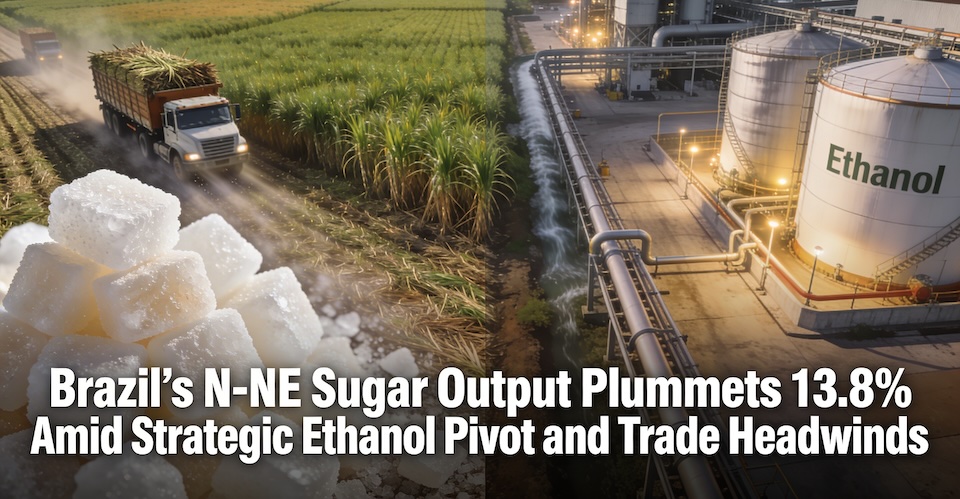
Brazil dominates global sugar production, with its central-southern region serving as the primary sugarcane belt, producing over 600 million tonnes of cane and more than 40 million tonnes of sugar annually. However, the country’s northern and northeastern (N-NE) regions also contribute significantly, typically yielding 3-4 million tonnes of sugar each year.
The 2025/26 crushing season has brought challenging conditions to these regions, with cumulative data through the end of February 2026 revealing a notable decline in performance.
The Data: A Tale of Two Commodities
The cumulative figures show a significant cooling in the N-NE processing pace as mills shift their focus.
Crushing Volume Under Pressure
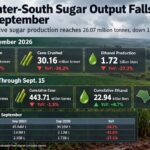
Combined sugarcane crushing in Brazil’s north and northeast reached 52.8 million tonnes through February, representing a 4.1% year-over-year decline. The northern region processed 6.9 million tonnes (down 5.3%), while the northeast handled 45.8 million tonnes (down 4%).
Beyond reduced crushing volumes, mills in these regions are increasingly pivoting toward ethanol production—a clear “ethanolization” trend reshaping the production mix.
Sugar Output Falls Sharply While Ethanol Gains Ground
The dual impact of reduced raw material supply and mills prioritizing ethanol has driven sugar production down dramatically. Through February, combined sugar output in the north and northeast totaled 2.988 million tonnes, a steep 13.8% decline year-over-year.
Ethanol production tells a contrasting story. Total output reached 2.79 billion liters, exceeding year-ago levels. Anhydrous sugarcane ethanol rose 3.4% to 852.8 million liters, while hydrous sugarcane ethanol dipped 3.2% to 1.289 billion liters. Corn-based ethanol added another 648.5 million liters to the total.
Multiple Headwinds Weigh on the 2025/26 Season
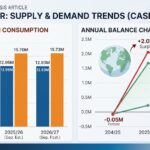
Renato Cunha, CEO of bioenergy industry group NovaBio, attributes the shift toward ethanol to price dynamics on both ICE US and ICE Europe futures exchanges. Investment fund activity around sugar market volatility continues to pressure prices, even as fundamentals point to a modest global supply deficit.
The “Trump Tariff” Factor U.S. trade policy—particularly the so-called “Trump tariffs”—presents another significant challenge, disrupting sugar exports to a key destination market for northern and northeastern producers.
Deteriorating Cane Quality Cane quality has also suffered, with the total recoverable sugar (ATR) index down 7% year-over-year and per-tonne sugar content falling 3%.
Season Nearing Completion
As of late February, the north and northeast had completed 89.5% of projected crushing for the 2025/26 season.
-
Overall N-NE Completion: 89.5%
-
North Region: 97% (nearly finished)
-
Northeast Region: 88.5%
The Bottom Line
Brazil’s northern and northeastern sugar regions face a “perfect storm” this season. The combination of extreme weather, volatile international markets, and a strategic structural shift toward ethanol production is significantly squeezing the sugar supply from this vital supplementary region.