The Indonesian state-owned sugar giant, PT Sinergi Gula Nusantara (Sugar Co), recorded a staggering loss of 680 billion IDR in 2025. This financial downturn is primarily attributed to a “disorderly” management of sugar imports and unfavorable price trends that have left domestic producers reeling.
During a hearing at the House of Representatives in Jakarta on April 8, 2026, Dony Oskaria, an official from the Ministry of State-Owned Enterprises, highlighted that the influx of refined sugar is squeezing the operational space for local mills.
The “Leakage” Problem: Refined vs. Domestic Sugar
A core issue facing the Indonesian market is the “leakage” of imported refined sugar—intended solely for industrial use—into the general consumer market.
“If left unregulated, refined sugar will continue to flow into the consumer market through irregular channels,” Oskaria warned. This leakage effectively crashes domestic prices, making it impossible for local state-owned and private mills to compete with cheaper, high-volume imports.
Despite a 1.5 trillion IDR intervention in 2025, where state enterprises partnered with the Ministry of Agriculture to purchase sugar from local farmers to stabilize prices, the overall effectiveness of these measures remains limited.
Indonesia’s Sugar Balance: The 4 Million Tonne Gap
Data provided by the Minister of Agriculture, Andi Amran Sulaiman, underscores the massive structural deficit that Indonesia continues to face.
National Sugar Statistics (2025/26 Estimate):
| Category | Volume (Million Tonnes) |
|---|---|
| National Consumption (Total) | 6.70 |
| — Industrial Demand | 3.90 |
| — Household Consumption | 2.80 |
| Domestic Production | 2.67 |
| Supply Gap (Deficit) |
4.03 |
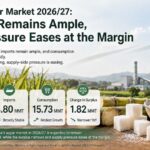
While the country aims for sugar self-sufficiency, the current reality shows that domestic production meets less than 40% of total demand. This massive 4.03 million tonne gap necessitates imports, but the lack of stringent regulatory enforcement is currently harming the very industry it aims to protect.
YnSugar Analysis: The Path to Self-Sufficiency
For Indonesia to reach its goal of national sugar self-sufficiency, Oskaria emphasizes that institutional design and regulatory enforcement must be strengthened.
Key Takeaways for Traders:
-
Regulatory Risk: Expect tighter controls on import licenses and more aggressive monitoring of refined sugar distribution in 2026/27 as the government tries to stem Sugar Co’s losses.
-
Market Volatility: As long as the “leakage” of industrial sugar persists, domestic retail prices will remain volatile, complicating long-term investment in local milling capacity.
-
Import Dependency: With a 4 million tonne deficit, Indonesia remains one of the world’s most critical import destinations, but the type of sugar allowed (raw vs. refined) will be a major political battlefield.