The development of China sugar beet seed pelleting technology has reached a significant “zero-to-one” breakthrough during the 14th Five-Year Plan period (2021–2025). For decades, China’s sugar beet industry has depended heavily on imported pelleted seed from European breeding companies—a dependency rooted in a long-standing technology gap. As a chronic lack of quality seed has limited the sector, with yields historically remaining roughly half those of the United States and Europe, the National Sugar Crops Industry Technology System has now successfully launched the first domestic production line capable of turning Chinese-bred monogerm sugar beet seed into commercial-grade pellets.
Closing a Critical Technology Gap
Pelleting is not a cosmetic step. High-quality primed seed is still irregular in thickness and diameter, and requires a specialized pelleting process to create a standardized round product—pelleting optimizes plantability and accurate seed spacing. For precision drills used in modern mechanized beet production, uniform pellets are non-negotiable: irregular, oddly-shaped seeds cannot be planted at standardized intervals with industrial sowing equipment.
Global industry benchmarks are demanding. Quality sugar beet seeds must satisfy a minimum germination rate of 95%, and the clay-like mixture of water, glue, and powders used in pelleting typically gives seeds a homogeneous shape and size between 3.5 mm and 4.0 mm. Meeting those thresholds with domestically bred genetics has, until recently, been beyond China’s reach.
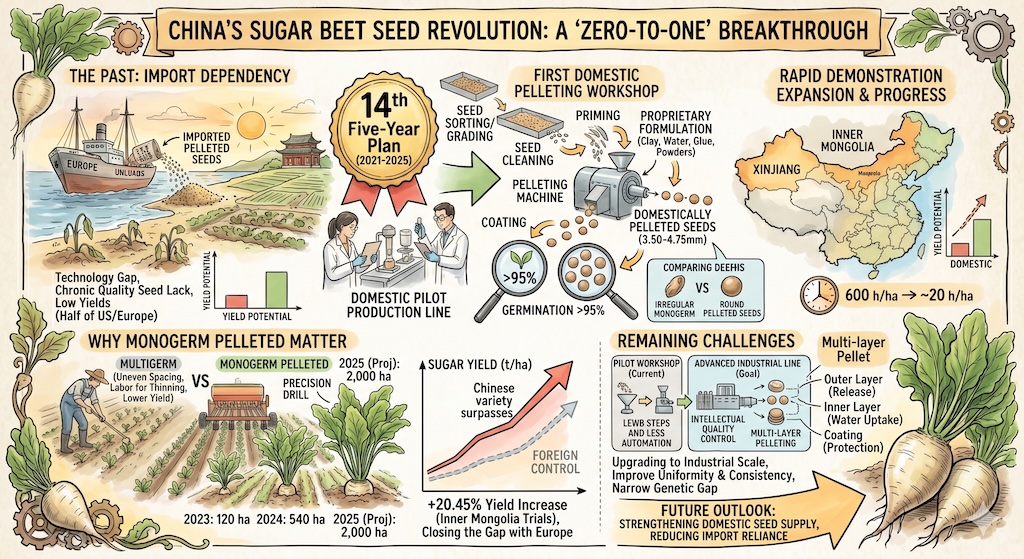
During the 14th Five-Year Plan, Chinese researchers developed a complete processing chain covering seed cleaning, polishing, grading, priming, and a proprietary pellet formulation. A pilot pelleting workshop was established to process domestically bred monogerm sugar beet seed at commercial scale. The output now meets China’s national standard, with a germination rate of at least 95% and pellet diameters of 3.50–4.75 mm—parameters on par with international specifications.
Rapid Expansion of Demonstration Acreage
The breakthrough is translating quickly into field adoption. Using Chinese-bred monogerm male-sterile hybrids suitable for mechanized operations—including cultivars such as ‘NT39106’ and ‘Stm1718’,demonstration plantings have scaled up sharply:
- 2023: 120 hectares
- 2024: 540 hectares
- 2025 (projected): 2,000 hectares
Trials in Inner Mongolia—which along with Xinjiang leads China in sugar beet output, with the region producing around six million tons of harvested sugar beet in 2019,have been especially encouraging. Average sugar yield reached 13.72 t/ha, representing a 20.45% increase over the foreign control variety. For context, modern sugar beet varieties can reach up to 20% sugar content and very high root yields, resulting in average sugar yields per hectare of more than 15 tons in top-performing European systems,indicating that China’s domestic varieties are closing the gap.
Why Monogerm Pelleted Seed Matters
The shift to monogerm pellets reflects a broader agronomic truth. Sugar beet seeds can be monogerm (single embryo) or multigerm (multiple embryos), with monogerm seeds preferred because they enable precise sowing using machinery and support optimal plant growth; multigerm seeds cause uneven plant spacing from multiple seedlings, requiring labor for thinning and reducing yields due to competition among plants. Historically, multigerm seeds required a workload of 600 hours per hectare until harvest, and the mid-20th-century transition from multigerm to monogerm improved crop establishment and cut that labor down to roughly 20 hours.
In China, mechanized precision direct-seeding and paper-tube seedling transplanting,the two dominant production systems—both require pelleted monogerm seed. Domestically certified genetic monogerm varieties have demonstrated competitive yield and quality, but without a domestic pelleting capability, growers were forced to rely on imported finished seed.
Remaining Challenges: Uniformity, Scale, and Automation
Despite meaningful progress in breeding,several domestically bred monogerm varieties have been registered in recent years,Chinese cultivars still lag foreign competitors in root shape uniformity, root-crown regularity, and total root yield. These traits matter commercially because they drive harvester efficiency and factory-gate sugar recovery.
The processing infrastructure also remains a bottleneck. China’s current pelleting operation is a pilot-scale workshop rather than a full-scale industrial line. Grading and coating equipment show inconsistent efficiency and quality stability, and the country has not yet established a mature, end-to-end production line comparable to European facilities.
The contrast with global leaders is telling. At top European operations, germination ability and vigor are checked after every step, with a series of quality tests covering resistance to bolting as well as the size, strength and roundness of the pellet and the moisture content of the seed—and ultimately only 10–20% of the originally harvested seed passes testing procedures to reach the farmer. Modern multi-layer pelleting, as practiced by major European breeders, is highly sophisticated: a multi-layer pellet consists of several layers, each with a different function—the outer layer ensures the correct amount of water is taken up and retained to initiate germination, the inner layer releases this water at the optimum rate, and together they ensure optimum germination under both wet and dry conditions. After pelleting, seed coating reduces pesticide use in the fields by applying smaller amounts directly onto the pellets, with the coating machine distributing protective fluids like insecticides and fungicides for added protection and to support germination.
Chinese processing lines have not yet reached that level of layered functionality, intelligent process control, or standardization.
Outlook
The “from zero to one” milestone is significant, but Chinese industry leaders describe it as a beginning rather than an endpoint. Priorities going forward include upgrading the pilot workshop into a fully industrial line, improving the consistency of grading and pelleting equipment, and continuing to narrow the genetic gap on root architecture and yield.
If China can combine its accelerating breeding progress with a mature, automated pelleting supply chain, the country—currently one of the world’s largest sugar beet producers, with 2024 output reaching roughly 12.8 million tons—stands to reduce its reliance on imported seed for a strategically important crop. For a sector where foreign suppliers have long dominated the high-value seed technology segment, the emergence of a domestic monogerm pelleted seed pipeline marks a structural shift worth watching.