By 2030, China aims to cap daily sugar intake at 25 grams per person. Behind that target lies a billion-dollar industry that already supplies the vast majority of the world’s sugar alternatives.
The Big Picture
China accounts for an estimated 75% of global high-intensity sweetener (HIS) production, followed by the United States and Western Europe. This dominance is corroborated by multiple industry sources, though exact figures vary by category. As early as 2017, ChemLinked data (citing British LMC) placed China’s share at 77% of global HIS output. Looking ahead, the Chinese food sweetener market is expected to reach USD 9.75 billion in 2025 and grow at a CAGR of 4.08% to reach USD 11.91 billion by 2030.
This is more than a manufacturing story; it is an ecosystem of policy, fermentation science, and a 1.4-billion-person consumer market rapidly shifting away from sucrose.
Policy: The Engine Behind the Shift
The Healthy China Initiative (2019–2030) has set clear dietary goals: by 2030, average daily added sugar intake should not exceed 25 grams. On March 27, 2025, China’s NHC unveiled GB 28050-2025, a revised food labeling standard taking effect on March 16, 2027. The new rules expand mandatory nutrition labeling from “1+4” to “1+6” components, adding saturated fat and sugar as compulsory disclosure items. This front-of-pack disclosure is expected to accelerate product reformulation across China’s F&B industry, further driving demand for sugar substitutes.
What China Uses: A Category Overview
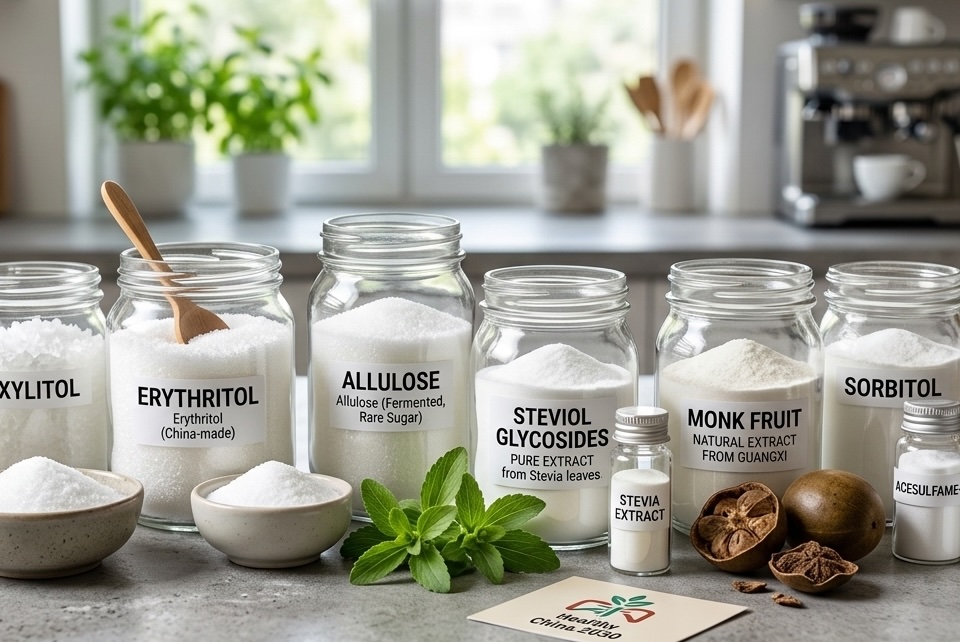
China’s sweetener market is structured around three broad families:
-
Sugar Alcohols (Polyols): These form the functional backbone. Erythritol is the star ingredient in China’s “zero-sugar” beverages, valued for its clean taste. Sorbitol and xylitol remain standard in chewing gum and diabetic-friendly confections, with sorbitol accounting for the highest volume in industrial applications.
-
High-Intensity Synthetic Sweeteners: These remain the workhorses for cost-sensitive segments. Sucralose, 600–800 times sweeter than sucrose, is broadly used in beverages and condiments. Aspartame retains a mature market presence. The segment is fragmented: Shandong Futaste leads in acesulfame-K, while Jinhe Industrial remains a key global supplier for both acesulfame-K and sucralose.
-
Natural Sweeteners: The fastest-growing category. China meets approximately 80% of global stevia demand, though new cultivation in India and Latin America is beginning to scale. Geopolitical tensions and tariffs are driving some manufacturers to diversify sourcing. Monk fruit (luo han guo), cultivated almost exclusively in Guangxi, is expanding as a premium clean-label option.
The Allulose Breakthrough
The newest development is Allulose (D-psicose). On July 2, 2025, China’s National Health Commission formally approved allulose as a food ingredient—a move analysts believe could unleash a new wave of demand. Allulose tastes almost identical to sucrose but contains just 10% of the calories.
Producers are moving fast. Baolingbao boosted its annual allulose capacity to 5,000 tons in 2024 with a 20,000-ton expansion announced, while Sanyuan Biotech is doubling its production to 20,000 tons. While the global allulose market remains relatively small (USD 173 million in 2023), it has maintained a 33% CAGR since 2019.
Key Players: A Global Perspective
China’s sector features a vertically integrated supply chain, from corn processing to finished fermentation products.
-
Sanyuan Biotech is the world’s largest erythritol producer, with a domestic share exceeding 50% and a global share between 25% and 35%.
-
Baolingbao Biology pioneered industrial erythritol in China and counts Coca-Cola and Pepsi among its major clients.
-
Layn Natural Ingredients is a globally recognized specialist in stevia and monk fruit, having invested USD 148 million in 2021 to expand infrastructure.
-
Huakang Co. and Shandong Tianli Pharmaceutical remain prominent in sorbitol and xylitol production.
Structural Trends to Watch
The industry is undergoing a shift from synthetic to natural. While artificial sweeteners still accounted for 77.83% of the Chinese market in 2024, plant-based variants are projected to grow at a 6.03% CAGR through 2030.
At the same time, the erythritol segment has matured through a difficult cycle. By May 2023, China’s capacity had reached 380,000 tons, triggering a price war where prices fell from 40,000 yuan per ton to under 10,000 yuan. By 2024, the market began to stabilize as weaker players cut capacity, with prices rebounding to the 10,000–13,000 yuan range.
China’s sugar substitute industry maintains a clear edge through scale and technology. With 75% of global supply coming from Chinese producers, the country is positioned to shape the industry’s next chapter. For international ingredient buyers and investors, understanding these market dynamics is now a strategic imperative.
YnSugar Analyst’s View
The expansion of China’s sugar substitute industry is no longer just about low-cost synthetic exports; it is now a sophisticated bio-manufacturing shift driven by stringent domestic health policies. For global stakeholders, the implementation of the “1+6” labeling standard in 2027 is a critical milestone to watch, as it will likely institutionalize demand for natural and rare sweeteners like Allulose. While the 2023 Erythritol price war highlighted the risks of rapid capacity expansion, the subsequent market consolidation has created a more resilient and efficient supply chain. We expect China to maintain its 75% production dominance by leveraging its mature fermentation infrastructure to drive down the “premium” price tag of natural alternatives over the next 24 months.