The Thailand sugar industry stands as a global powerhouse, driven by a unique legislative framework and integration model…
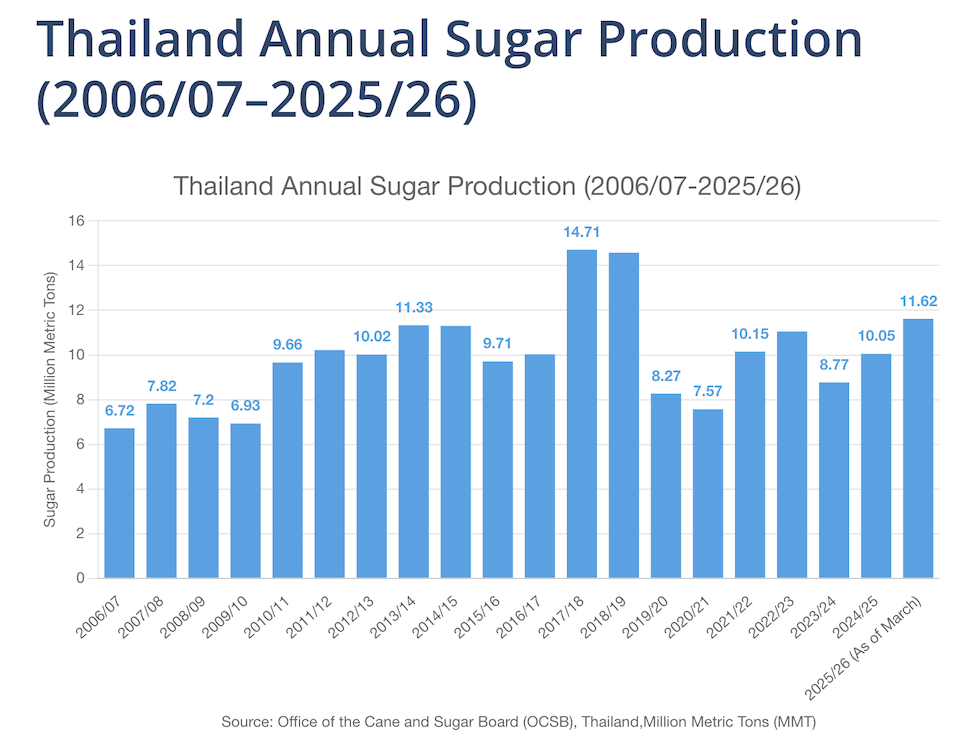
links:https://www.ynsugar.com/chart/thailand-sugar-production-statistics-2006-2026/
A Global Sugarcane Powerhouse
Thailand is one of the world’s top sugarcane-producing nations and, historically, the second-largest sugar exporter after Brazil. In 2023, the production volume of sugarcane in Thailand amounted to nearly 94 million metric tons. The harvested area of sugarcane in Thailand was approximately 10.5 million rai (roughly 1.68 million hectares), placing Thailand among the top four sugarcane producers globally. According to FAOSTAT data, Brazil remains the largest producer at about 782 million tons in 2023, followed by India with approximately 490 million tons, and China in third place at around 104 million tons.
The sugar sector is a cornerstone of the Thai agricultural economy. The sugarcane and sugar industry generates substantial income for Thailand, estimated at no less than 200 billion baht per year, due to its strength in utilizing domestic raw materials for sugar processing to meet domestic demand, with surplus production exported. The sector generates around 7.81 billion US dollars per year and employs 1.5 million people.
The Cane and Sugar Act of 1984: A Legislative Foundation
The regulatory architecture of Thailand’s sugar industry was established through a landmark piece of legislation. In 1984, the Cane and Sugar Act came into force following a crisis of overproduction that affected domestic sugar prices. Based on this Act, Thai sugarcane growing and the sugar industry have been highly regulated by the Thai government through the Office of the Cane and Sugar Board (OCSB), under the Ministry of Industry.
Prior to recent WTO-enforced changes, the Thai sugar policy was highly regulated under the Cane and Sugar Act of 1984. This legislation includes significant instruments such as controls on domestic sugar prices and sugar sales quotas, a price support program, direct farmer payments, low-interest credit services, revenue-sharing guarantees for millers and growers, and a border protection mechanism. The Act established a multi-agency governance framework: the Ministry of Industry (through the OCSB), the Ministry of Agriculture, and the Ministry of Commerce together oversaw the Cane and Sugar Board and its subordinate committees, each with clearly defined responsibilities for organizing and supervising the entire sugarcane and sugar value chain.
The Triple-Quota System (Pre-2018)
For decades, the Thai government operated a structured quota system to manage the domestic production and distribution of sugar. Thailand’s plan was to set aside three quotas each year to prevent sugar shortages. Quota A set aside around 2.2–2.5 million tonnes of sugar for domestic consumption, Quota B for state-run sugar exports, and Quota C for the quantity of sugar to be exported by private sugar millers. Refined sugar was primarily channeled to the domestic market under Quota A, while raw sugar dominated the export quotas. Prices under Quotas A and B were set by the government or the industry’s joint committees, whereas millers could determine their own pricing for Quota C only after fulfilling their obligations under the first two quotas.
On the production side, a planting quota system was used to manage the scale of cultivation across different regions. Farmers who exceeded their allotted planting quotas were subject to penalties, a mechanism designed to prevent overproduction and destructive internal competition.
Important update for readers: On January 15, 2018, the Thai government decided to temporarily deregulate and cancel the quota system, implying that the domestic sugar price would depend on sugar prices in the global market. This reform was driven largely by a WTO dispute. In 2016, the WTO requested that Thailand join consultations with the Brazilian delegation over Thailand’s subsidization of sugarcane farmers, which resulted in a successful challenge to the Thai sugar sector. While the quota system has been dismantled, certain safeguards remain. After the restructuring, millers are no longer required to set aside a fixed amount of sugar for domestic sales, and are free to sell domestically or internationally. The only requirement is that a minimum of 250,000 tonnes of sugar be reserved every month to ensure domestic supply security.
The 70:30 Revenue-Sharing System: Aligning Farmer and Miller Interests
Perhaps the most distinctive feature of Thailand’s sugar regime — one that has survived the post-2018 reforms — is the revenue-sharing mechanism between sugarcane growers and sugar millers.
The Cane and Sugar Act of 1984 guides the creation of a benefit-sharing system to ensure fairness in income distribution between sugarcane farmers and sugar millers. Total income is divided, with 70% allocated to sugarcane farmers, and 30% allotted for sugar millers. This revenue-sharing system (the “70:30 system”) splits net profits from distribution to domestic and export markets between farmers, who receive 70% as “compensation for the sugarcane price,” and processors, who receive 30% as “compensation for production.” These proportions are set by the 1984 Sugarcane and Sugar Act.
Under this system, farmers do not receive a conventional farm-gate price for their cane at the time of delivery. Instead, all sugarcane growers are registered to the mill where they will deliver their canes and the growers commit a certain volume of cane to the mill. The growers receive an 80% initial payment of the share expected at the end of the season. The final settlement is calculated after the sugar is processed and sold.
The 70:30 profit-sharing ratio, whereby 70% of total sugar revenue made each year goes to farmers with the remaining 30% allotted to millers, is expected to help all sugar millers achieve stable gross margins and strengthen the sugar supply chain.
Why the Model Works: Mutual Incentives
This deep integration of farmer and miller interests creates powerful incentive alignment throughout the supply chain. Because growers share directly in the revenue from sugar sales rather than receiving a flat cane purchase price, they have a strong motivation to cultivate high-yielding, high-sugar varieties and to invest in better field management — since higher sugar extraction rates directly increase their own returns. This system appears to help farmers in terms of income sustainability and helps reduce the risk presented by fluctuations in sugarcane prices. The benefit-sharing system guarantees security in raw material supply for sugar mills and advances the development of the upstream segment of the supply chain.
For millers, the system provides a relatively stable and committed cane supply from registered growers, while the shared revenue model means that farmers absorb a portion of market risk — enabling mills to plan their processing and sales operations more predictably.
However, the model has its critics. The system appears to be more beneficial to sugar mills than farmers given that the revenue earned under benefit sharing is calculated only from the income earned by selling sugar and molasses. Income from other co-products generated along the supply chain, such as ethanol and electric power, are disregarded in revenue computation. This has become a growing point of contention as the Thai sugar industry increasingly diversifies into bio-energy.
Looking Ahead
Thailand’s sugar policy is at a crossroads. Thailand began a reform process for its domestic sugar regime in 2016 to comply with WTO requirements, targeting regulatory modifications and amending the Cane and Sugar Act of 1984. While the WTO dispute was resolved in March 2024 owing to adjustments made by the Thai government, not all commitments have been finalized. Uncertainty continues to surround government regulation of the industry, especially the reform of the Sugarcane and Sugar Act and the potential impacts of this on operators’ ability to generate profits.
The sector also faces structural headwinds including climate volatility, labor shortages, unusually high temperatures resulting from El Niño that have caused crop losses, and growth in sugar consumption being undercut by rising global consumer concerns over personal health and wellness, while the introduction of sugar taxes in Thailand and in export markets is reducing demand from drinks manufacturers.
Nevertheless, Thailand’s experience offers a compelling case study in agricultural governance — demonstrating how legislative frameworks, quota-based market management, and innovative revenue-sharing mechanisms can align the interests of smallholder farmers and large-scale processors to build a globally competitive sugar industry.