A Steady Consumer Rebound Underpins the Food Sector
China’s consumer market continued its post-pandemic recovery in 2024. According to the National Bureau of Statistics (NBS), total retail sales of consumer goods reached RMB 48,789.5 billion (approximately USD 6.79 trillion) in 2024, up 3.5 percent year on year.Within that total, retail sales of grain, oil, and food products grew 9.9 percent, while beverage sales rose 2.1 percent.This gradual recovery in household spending has provided a tailwind for China’s broader macroeconomic outlook and created a favorable market environment for the food industry.
Sugar: A Strategically Important Commodity
Sugar is an essential part of daily life worldwide — one of the primary sources of carbohydrate-based nutrition for the human body. It is also an agricultural commodity that draws significant government attention in virtually every major economy. In China, sugar holds particular strategic significance: it is classified not only as a critical livelihood commodity but also as a strategic material, placing it in the same policy tier as staple grains and edible oils.
China’s per capita sugar consumption is estimated between 11–12 kilograms, far behind the world average of more than 20 kilograms, with per capita consumption expected to increase as the economy grows.
A Structural Shift in Sugar Consumption
China’s sugar demand is broadly divided into two categories: industrial consumption (use as an ingredient in processed food and beverages) and household/civilian consumption (direct retail purchase, catering, and home baking).
Over the past decade, the balance between these two categories has undergone a notable structural shift. According to the China Sugar Association, industrial consumption historically accounted for about 64 percent of total sugar consumption, with household consumption at approximately 36 percent.This was the approximate ratio during the 2014/15 marketing year.
The COVID-19 pandemic accelerated a change in consumer behavior. Health awareness rose sharply, and demand for intense sweetness in processed foods began to soften. At the same time, with more meals being prepared at home and a boom in home baking, household sugar purchases increased. By the 2021/22 marketing year, industrial sugar consumption had fallen to roughly 53 percent, with household consumption rising to 47 percent. Recent China Sugar Association data indicate that industrial consumption accounts for approximately 54 percent of total sugar consumption, with household consumption at approximately 46 percent.By the 2023/24 marketing year, the structure stabilized at approximately 55 percent industrial versus 45 percent household.
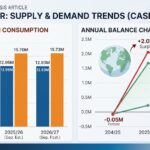
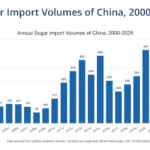
According to the USDA, over the past decade China’s sugar consumption has remained in a range of 14.8 million to 15.8 million tonnes.For marketing year 2024/25, sugar consumption is estimated at 15.7 million metric tons.
China’s Listed Food & Beverage Sector
As of the end of 2024, China’s food and beverage sector comprised 231 publicly listed companies, according to industry data. These companies span six sub-sectors: alcoholic beverages (37 companies, 16.1%), dairy products (15 companies, 6.5%), soft drinks (9 companies, 3.9%), condiments and seasonings (16 companies, 7.0%), snack foods (21 companies, 9.1%), and food processing (133 companies, 57.8%).
Among these, 77 companies — roughly 33.5 percent of the total — are engaged in the production of sugar-containing food products. These sugar-using enterprises are distributed across dairy (15), soft drinks (7), snack foods (21), condiments (9), and food processing (25).
⚠ Data Note: The figure of 231 listed F&B companies is sourced from Chinese securities industry databases.
Sugar-Containing Food Output and Sugar Content by Category
From the 2015/16 to the 2023/24 marketing year, China’s annual output of seven major categories of sugar-containing food ranged from 91.63 million tonnes to 113.72 million tonnes.
The sugar content ratios for these seven categories, as reported by the China Sugar Association, are: confectionery (45%), frozen desserts/ice cream (15%), carbonated beverages (12%), fruit juice (8.5%), canned foods (5%), dairy products (3%), and frozen prepared foods (1.5%). When ranked by total sugar usage (combining output volume and sugar content), the order from highest to lowest is: carbonated beverages, fruit juice, dairy products, confectionery, frozen desserts, canned foods, and frozen prepared foods.
This ranking may surprise observers: although confectionery has the highest sugar content per unit, carbonated beverages consume the most sugar overall due to their vastly larger production volumes.
Implications for Global Stakeholders
For international food companies, ingredient suppliers, and agricultural commodity traders, China’s sugar market presents a complex picture. On one hand, total sugar consumption has been remarkably stable. On the other, the internal composition is shifting — with household consumption gaining ground, health-conscious reformulation trends accelerating, and starch-based sweeteners and high-intensity artificial sweeteners continuing to compete for market share. According to China Sugar Association estimates, sugar accounted for only about 53 percent of China’s total sweetness consumption in 2020, compared to a world average of 77 percent.
For Western companies evaluating opportunities in China’s food sector, understanding the interplay between sugar policy, consumer health trends, and industrial demand is essential to formulating effective market entry or expansion strategies.
Ysugar Outlook:
As China’s consumer market stabilizes in 2026, the sugar industry is witnessing a profound transformation. Beyond the raw consumption figures lies a significant structural realignment that global stakeholders must understand: the narrowing gap between industrial and household demand.