The rapid expansion of the Guitang 44 sugarcane variety is reshaping China’s agricultural landscape…China sugarcane mechanization
A breakthrough cultivar called Guitang 44 is spreading across millions of acres in Guangxi, offering China its best shot yet at mechanizing a stubbornly labor-intensive industry.
China is the world’s third-largest sugar producing country after Brazil and India. Despite its enormous scale, China’s sugarcane mechanization level is low—a vulnerability that drives up costs and undermines competitiveness in the global sugar market.
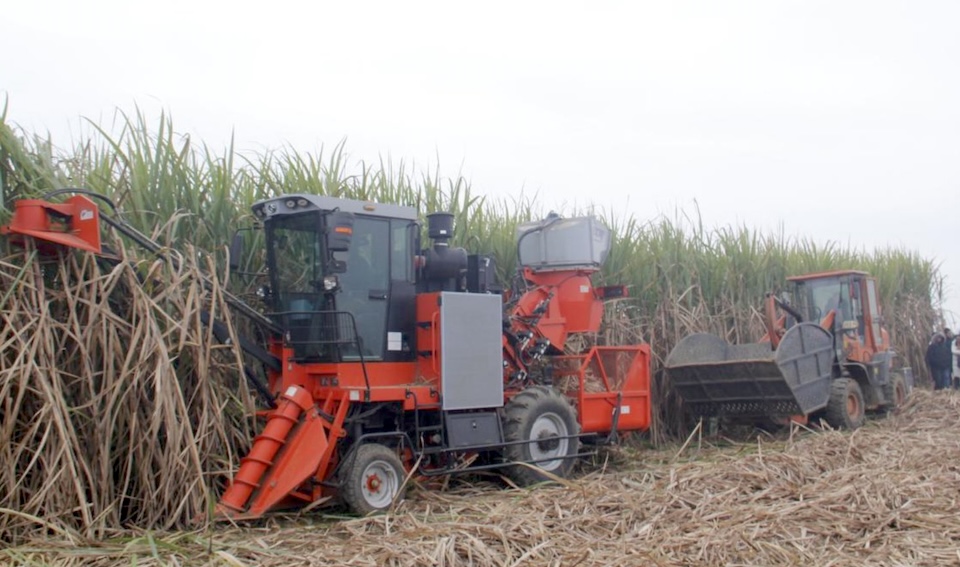
The contrast with Brazil is stark. As the world’s largest sugarcane producer, Brazil is leading the way in terms of industry mechanization, with some 95% of the country’s cane production now harvested by machine. China, by comparison, is far behind. According to the latest figures as of February 2026, the overall mechanization rate in Guangxi — China’s largest sugarcane-producing region — stands at roughly 55%, with mechanical harvesting, the most critical bottleneck, reaching only about 13.66%. Yunnan, the country’s second-largest production zone, lags even further: about 80% of its cane-growing areas sit on hilly or mountainous terrain, making the adoption of large-scale machinery exceedingly difficult.
Why Mechanization Matters — and Why It Has Been So Hard
Guangxi is the dominant sugarcane and sugar producer, accounting for 65% of sugar production in China. Together, Guangxi and Yunnan account for over 80 percent of China’s total sugar production.But the industry faces a convergence of pressures. Cane sugar producers face a variety of challenges including scarce labor, limited mechanization, and competition from other crops. The available labor pool is limited because growing numbers of the younger generation are relocating to urban centers for work.Innovation and mechanized development are constrained by hilly terrain and small-scale farms.
For years, the lack of sugarcane varieties specifically suited to mechanical operations has been a fundamental constraint. In China, large-scale migration of rural labor to cities, high labor costs, and poor mechanization of sugarcane production restrict the sustainable development of this industry.Traditional Chinese cultivars, while productive in many respects, often lodged easily, had poor ratooning performance after machine harvesting, or grew at row spacings too narrow for harvesters to operate effectively. During mechanized production, the technical problems that arise — low plant growth rate, difficulty in jointing, poor lodging resistance, low uniformity, severe shortage of effective stems, and limited seedlings after crushing of sugarcane stalks — are closely associated with the varietal characteristics.
Enter Guitang 44: China’s First Large-Scale Mechanization-Friendly Variety
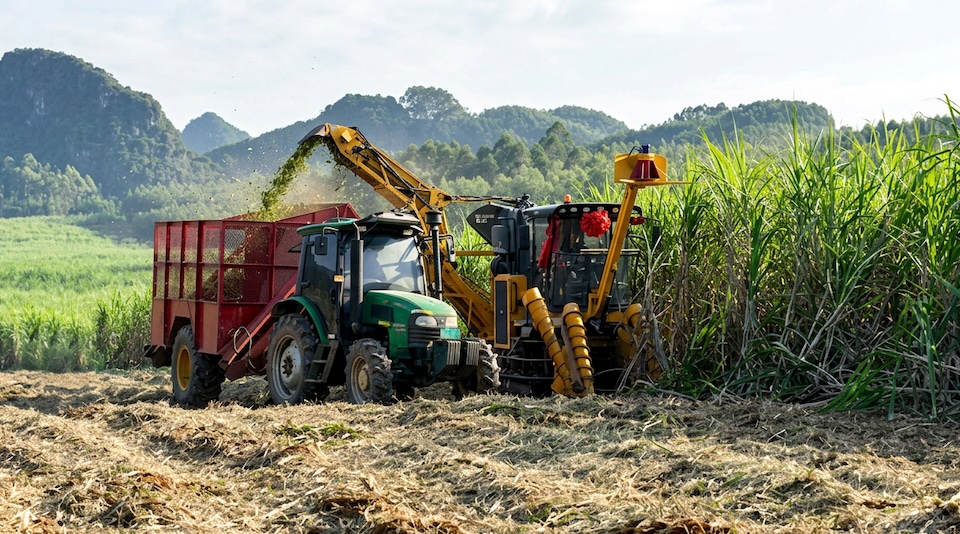
A pivotal development is now reshaping this picture. As reported by China’s Farmers’ Daily, the Sugarcane Research Institute of the Guangxi Academy of Agricultural Sciences has successfully bred and deployed a new cultivar known as Guitang 44 (GT44) — a high-yield, high-sugar variety specifically engineered for mechanized farming. GT44 features erect plant architecture, medium-sized solid stems, early maturity, a high tillering rate, abundant effective stalks, and strong ratooning ability — all traits that make it exceptionally well-suited for wide-row mechanical planting and harvesting.
Field trials under fully mechanized conditions have confirmed GT44’s outstanding performance, with significant gains in both cane yield and sugar content, alongside meaningful cost reductions. By 2025, the variety had been planted across approximately 3.51 million mu (about 234,000 hectares), accounting for 28.43% of Guangxi’s total sugarcane acreage. This makes GT44 the first mechanization-adapted sugarcane variety in China to achieve large-scale commercial deployment.
Over the past two decades, the Sugarcane Research Institute of Guangxi Academy of Agricultural Sciences (SRI-GXAAS) pioneered the sugarcane breeding of “strong ratooning ability, high lodging resistance, and suitable for mechanization” and successfully bred the GT series of varieties, establishing the benchmark for sugarcane breeding in China.Among them, GT 42 and GT 44 are standout varieties in the fifth generation, with GT 42 emerging as the largest and GT 44 as the fifth most significant variety in China by 2023.GT44’s rapid adoption since then, climbing to nearly a third of Guangxi’s planted area by 2025, underscores the pent-up demand for machine-compatible cultivars.
A Broader National Strategy Takes Shape
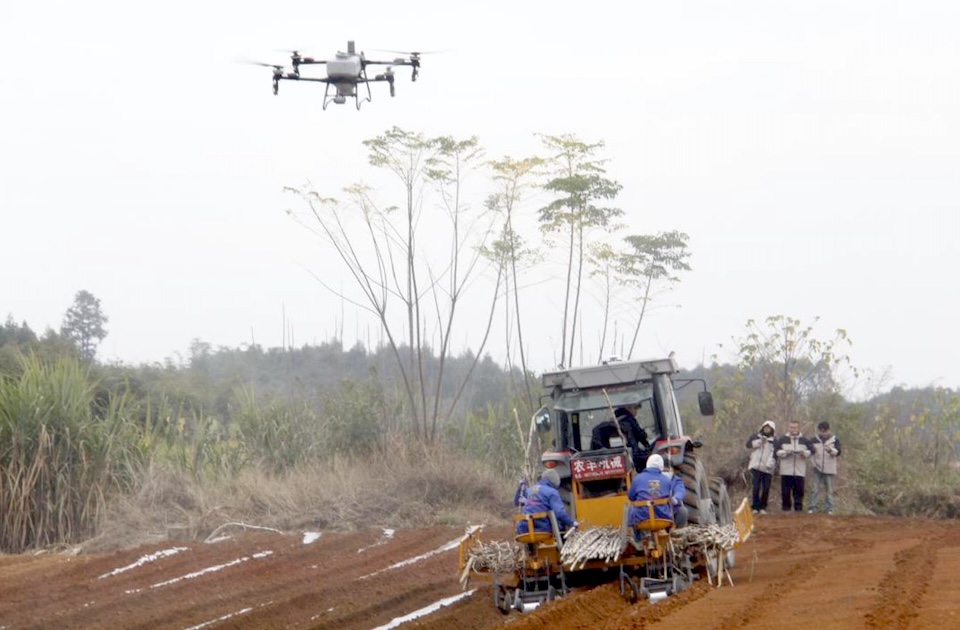
GT44’s rise is not an isolated success story. Since the launch of China’s 14th Five-Year Plan (2021–2025), the national sugar crop technology system has accelerated the breeding of mechanization-friendly sugarcane varieties. Breeders have developed new technical protocols for evaluating cultivar suitability for machines and have pioneered trait-index selection techniques focusing on strong ratooning, tolerance to mechanical harvesting, and lodging resistance. Five dedicated mechanized-variety breeding bases have been established across comprehensive trial stations in Guangxi, Guangdong, and Yunnan.
Recently, researchers have developed the concept of high-heterogeneous composite high-yield and high-sugar breeding, resulting in the breeding of fifth-generation sugarcane varieties, mainly including YZ08-1609, YZ05-51, GT42, GT44, and LC05-136, now accumulatively accounting for over 83.4% of cultivation in China. This new generation of cultivars represents a deliberate shift toward varieties that can perform under mechanized conditions — a strategic reorientation of China’s entire sugarcane breeding paradigm.
Meanwhile, technology is being layered on top of varietal improvement. During planting, farmers are assisted by the BeiDou Navigation Satellite System to ensure precise row spacing, down to the centimeter.In Laibin, one of Guangxi’s key production hubs, “in some sugarcane fields, the amount of fertilizer used per mu has been reduced by 15 percent, while the yield has increased by 200 kilograms.” With 405 combine harvesters, mechanized harvesting saves 300 yuan per mu. Laibin also piloted 35 distributed harvesting stations, processing 116,700 tons of sugarcane by machinery.
The Road Ahead
Despite the momentum, formidable obstacles remain. China’s sugarcane landscape is defined by fragmented smallholder farms and challenging topography — conditions fundamentally different from the vast, flat plantations of São Paulo state that enabled Brazil’s mechanization revolution. Mechanization levels are still low in China for sugarcane, and the hilly terrain in much of the production area makes mechanization adoption for harvesting difficult.
Yet GT44’s success demonstrates that the right variety can be a catalyst for systemic change. By providing a cultivar that works with — rather than against — mechanical harvesters, Chinese scientists have addressed what many experts long identified as the single greatest barrier to mechanization. The variety’s continued spread, combined with policy support, machinery subsidies, and digital agriculture tools, puts China on a more credible path toward narrowing its mechanization gap with the world’s leading sugarcane producers.
For an industry that still relies on hand-cut cane across the vast majority of its fields, a sugarcane plant that stands up straight and refuses to fall over is, quite literally, a game changer.
Ynsugar Outlook: The Strategic Impact of GT 44
The rapid expansion of GT 44 represents more than just a successful breeding program. For decades, the mismatch between varietal traits (susceptibility to lodging) and mechanical capabilities has been the “Achilles’ heel” of China’s sugar sector. By successfully deploying a cultivar that thrives under the pressure of combine harvesters, China is addressing the supply-side constraints that have long kept its production costs significantly higher than those of Brazil.