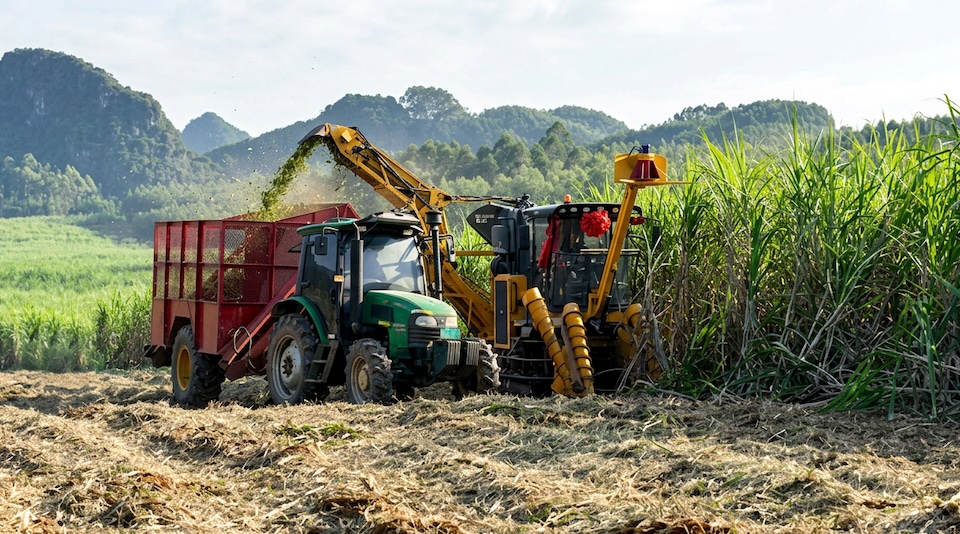
In Laibin, nothing from the sugarcane plant goes to waste — and the results are reshaping what modern agriculture can look like.
The next time you sip a latte through a compostable straw or eat from a biodegradable takeout container, there’s a chance the material traces its origins to a sugarcane field in southern China. In Laibin, a mid-sized city in the Guangxi region, an ambitious experiment in circular agriculture has turned the humble sugarcane stalk into the backbone of an industry worth over 16 billion yuan (roughly $2.2 billion) — and it’s done so by ensuring that virtually every part of the plant finds a second life.
Laibin produces about one-tenth of China’s total sugar output. But sugar is no longer the headline act. Over the past decade, the city has built a fully closed-loop industrial chain around sugarcane, extracting value from parts of the plant that were once treated as waste. Bagasse — the fibrous residue left after juice extraction — is molded into compostable tableware in automated “dark factories” that run with minimal human intervention. Cane leaves are converted into animal feed or burned to generate bioelectricity. Filter mud, a sludge by-product from sugar refining, is processed into organic fertilizer. And molasses, once an environmental headache requiring costly disposal, now serves as the nutrient base for cultivating yeast used in baking, brewing, and even healthcare supplements.
The transformation is no accident. It’s the product of deliberate industrial policy, targeted investment, and a wave of smart-agriculture technology that has modernized Laibin’s farms and factories alike.
From Field to Factory: The Rise of Precision Sugarcane Farming
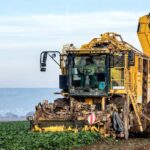
On Laibin’s sprawling cane fields, planting machines equipped with China’s BeiDou satellite navigation system move in precise rows, depositing disease-free seedlings and fertilizer into furrows, then covering, mulching, and laying drip-irrigation lines in a single pass. One machine can plant 15 to 20 acres per day — work that would take the same number of laborers an entire day each to complete by hand.
The intelligence doesn’t stop at planting. Crop-protection drones can spray dozens of acres per hour with pinpoint accuracy. Soil sensors buried in the fields monitor pH, moisture, and nutrient levels around the clock, feeding data into digital platforms that recommend customized fertilizer blends — a practice local agronomists call “prescription fertilization.” The results speak for themselves: on some plots, chemical fertilizer use has dropped by 15 percent while yields have risen by 200 kilograms per acre.
For sugar mills, the digitization runs just as deep. Eight of Laibin’s core sugar-processing companies now operate fully automated production lines, and several have built “lights-out” workshops where robots handle packaging and palletizing without a single worker on the floor.
A Circular Economy in Action
What makes Laibin’s model especially compelling is not any single innovation, but the way the entire system interconnects. Sugar refining generates molasses; molasses feeds yeast production; yeast manufacturing creates nutrient-rich effluent that can be returned to the soil. Bagasse powers cogeneration plants that supply electricity back to the mills. Filter mud enriches the very fields that grew the cane in the first place.
At Guangxi Danboli Yeast Co., an AI-powered visual inspection system scans thousands of yeast products per minute on the finishing line, while a central control room oversees the entire fermentation process through real-time data modeling. The company has achieved what it calls 100 percent circular utilization of its molasses feedstock.
In 2023, China’s Ministry of Industry and Information Technology officially recognized Laibin’s deep-processing sugarcane cluster as a nationally designated specialty industry hub — a stamp of approval that has helped attract outside investment.
The Financing Loop That Feeds Growth
Laibin’s local government has committed significant resources to the effort: 2.6 billion yuan across 34 dedicated subsidy programs over the past three years, covering everything from high-yield seed promotion and irrigation infrastructure to factory upgrades and equipment modernization. The city has built over one million acres of “double-high” (high-yield, high-sugar) sugarcane bases.
Financial institutions have played a complementary role, extending roughly 8 billion yuan in specialized agricultural loans that cover the entire value chain — from planting to refining to downstream processing. One local sugar company used financial support to complete five rounds of technical upgrades, then reinvested in its contract farmers, subsidizing drip-irrigation installations, pest control, and acreage expansion to the tune of tens of millions of yuan annually.
This “bank-to-factory-to-farm” financing loop has created a virtuous cycle: the government expands its tax base, companies improve their margins, and farmers increase their incomes.
New Capital, New Careers
The momentum is drawing outside interest. In 2025, a Beijing-based energy firm signed a deal to build a cane-leaf biomass conversion facility in Laibin. A Shenzhen biotech company, attracted by the region’s scale, set up operations to tackle soil compaction and acidification — chronic problems on land that has grown sugarcane for decades — using microbial remediation technology.
The expanding value chain is also generating entirely new career paths: environmental materials R&D engineers working with bagasse composites, biofermentation technicians optimizing yeast cultures, organic fertilizer formulation specialists designing blends from filter mud. For a city built on farming, these are meaningful steps up the employment ladder.
A Model Worth Watching
Laibin’s sugarcane story offers a case study in what agricultural modernization can look like when circular-economy principles are applied with consistency and scale. In an era when governments worldwide are grappling with food-system sustainability, resource efficiency, and rural economic development, the idea that a single crop — processed intelligently and completely — can anchor a diversified, multi-billion-dollar industrial ecosystem is one that resonates far beyond southern China.
The next frontier may be even more ambitious. As global demand for biodegradable materials and bio-based chemicals accelerates, Laibin is positioning itself not just as a sugar town, but as a bioeconomy hub — one stalk at a time.
Ynsugar Outlook
Beyond the Crystal: The Rise of the Sugarcane Bio-Refinery
Laibin’s success signals a fundamental shift in the sugar industry’s survival strategy. In an era of volatile global sugar prices and increasing climate pressure, the “Sugar-Only” model is becoming obsolete. What we are witnessing is the birth of the Sugarcane Bio-Refinery. By decoupling profit from the sugar crystal and attaching it to carbon-neutral materials (bagasse composites) and high-value fermentation (yeast and supplements), producers can insulate themselves from commodity market shocks.