Brazil sugar production declined sharply in the first half of September 2026, with Center-South output falling 41.6% year on year as wet weather disrupted harvesting and milling operations.
Brazil’s Center-South sugar production fell sharply in the first half of September 2026 as wet weather disrupted harvesting and milling operations. Cumulative sugar output for the 2026/27 season reached 26.07 million metric tonnes by mid-September, down 14.4% from a year earlier, according to calculations based on official data from Brazil’s Ministry of Agriculture and Livestock (MAPA).
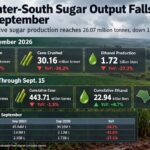
Brazil’s Center-South sugar industry recorded a marked slowdown in the first half of September, with both sugarcane crushing and sugar production falling substantially from the same period last year.
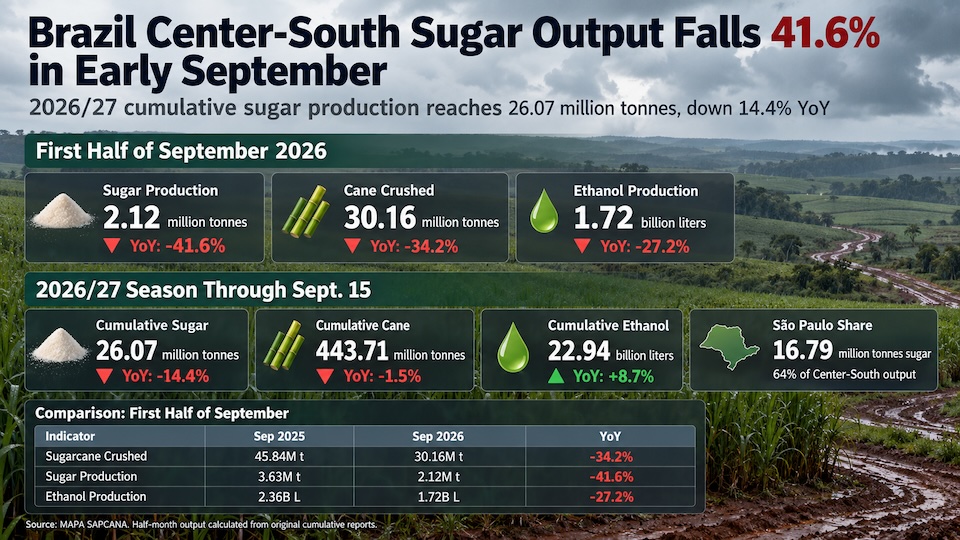
Based on production reports published by Brazil’s Ministry of Agriculture and Livestock, or MAPA, Center-South mills produced approximately 2.12 million metric tonnes of sugar during the first half of September, down 41.6% year on year.
Sugarcane crushing during the period totaled approximately 30.16 million tonnes, compared with 45.84 million tonnes in the same period of 2025, representing a 34.2% decline.
Wet weather across parts of the Center-South restricted harvesting and slowed cane deliveries to mills during the period, according to industry reporting.
Ethanol Output Declines Less Than Sugar Production
Center-South ethanol production totaled approximately 1.72 billion liters in the first half of September, down 27.2% year on year.
The decline was smaller than the fall in sugar production.
Part of the difference reflects the continued expansion of Brazil’s corn ethanol industry, which is less directly exposed to short-term weather disruptions affecting sugarcane harvesting. The 2026/27 season has also seen mills maintain a relatively greater allocation of feedstock toward ethanol compared with periods of stronger sugar maximization.
The distinction is important for the sugar market because Brazilian mills have significant flexibility to adjust the share of sugarcane directed toward sugar or ethanol, depending on relative economics and operating conditions.
Cumulative Sugar Production Reaches 26.07 Million Tonnes
Through September 15, Center-South mills had crushed approximately 443.71 million tonnes of sugarcane during the 2026/27 season, down 1.5% from the same point a year earlier.
Cumulative sugar production reached 26.07 million tonnes, down 14.4% year on year.
By comparison, cumulative ethanol production reached approximately 22.94 billion liters, an increase of 8.7% from the previous season.
The much larger decline in sugar production than in total cane crushing highlights the importance of the production mix in determining Brazil’s final sugar availability.
São Paulo Produces Nearly Two-Thirds of Center-South Sugar
São Paulo remained the dominant sugar-producing state in Brazil’s Center-South region.
Through September 15, mills in the state had crushed approximately 249 million tonnes of sugarcane and produced around 16.79 million tonnes of sugar.
São Paulo therefore accounted for approximately 64% of total Center-South sugar production reported by MAPA during the season to date.
The concentration of production in São Paulo means that weather and operating conditions in the state remain particularly important for Brazil’s overall sugar output.
Brazil Center-South Production: First Half of September
| Indicator | First Half Sep. 2025 | First Half Sep. 2026 | YoY Change |
|---|---|---|---|
| Sugarcane crushed | 45.84 million tonnes | 30.16 million tonnes | -34.2% |
| Sugar production | 3.63 million tonnes | 2.12 million tonnes | -41.6% |
| Ethanol production | 2.36 billion liters | 1.72 billion liters | -27.2% |
2026/27 Center-South Production Through Mid-September
| Indicator | 2026/27 Volume | YoY Change |
|---|---|---|
| Sugarcane crushed | 443.71 million tonnes | -1.5% |
| Sugar production | 26.07 million tonnes | -14.4% |
| Ethanol production | 22.94 billion liters | +8.7% |
| São Paulo sugar production | 16.79 million tonnes | — |
What the Data Means for the Sugar Market
Brazil’s Center-South is the world’s largest sugar-producing and exporting region, making its production pace a key driver of global supply expectations.
The latest figures show that the 2026/27 season has moved into its later stages with sugar production running well below last year’s level, despite a much smaller decline in cumulative cane crushing.
This divergence reflects both operational disruptions and a production mix that has been less heavily weighted toward sugar.
Weather will become increasingly important as the harvest progresses. Additional rainfall can reduce harvesting days, slow cane transportation and affect cane quality, while drier conditions could allow mills to recover part of the lost crushing pace.
At the same time, the allocation of cane between sugar and ethanol will remain an important variable for the final 2026/27 sugar production figure.
For global sugar traders, refiners and industrial buyers, the main indicators to monitor over the coming weeks will be:
- Center-South cane crushing volumes;
- the sugar-to-ethanol production mix;
- sugar recovery levels;
- rainfall across São Paulo and other major producing states; and
- the pace at which mills begin ending their crushing season.
Data Source and Methodology
This report is based primarily on original production data published by Brazil’s Ministry of Agriculture and Livestock (MAPA) through the SAPCANA sugarcane production monitoring system.
YNSUGAR calculated first-half September production by subtracting MAPA’s cumulative production figures through August 31 from those reported through September 15.
Year-on-year changes were calculated using the same methodology and the corresponding MAPA reports for the 2025/26 season.
This approach uses four official MAPA production reports:
- 2026/27 cumulative production through August 31;
- 2026/27 cumulative production through September 15;
- 2025/26 cumulative production through August 31; and
- 2025/26 cumulative production through September 15.
Figures have been rounded for readability.
Disclaimer
This article is based primarily on original production data released by Brazil’s Ministry of Agriculture and Livestock through the SAPCANA sugarcane production monitoring system. Information relating to weather conditions, ethanol allocation and broader market developments is based on publicly available industry sources.
The information and analysis are provided for industry research and informational purposes only and do not constitute investment, trading or commercial advice. Official production figures may be revised. Readers should refer to the latest releases from Brazilian government agencies and other authoritative industry sources for final data.