China finished sugar output reached 12.681 million metric tonnes in January–September 2026, up 19.2% year on year, according to the National Bureau of Statistics of China (NBS).
By YnSugar Market Intelligence Team
Published: October 22, 2026
China’s finished sugar output reached 12.681 million metric tonnes in the first nine months of 2026, an increase of 19.2% year on year, according to the latest industrial production data from the National Bureau of Statistics of China (NBS).
The strong cumulative growth comes as the country’s 2026/27 sugar crushing season gets underway, with sugar beet processing already started and sugar mills in Guangxi, China’s largest cane sugar-producing region, preparing to resume operations.
However, a sharp decline in sugar imports and weaker September production suggest that a new annual production record is far from guaranteed.
China Finished Sugar Output Rebounds in September
Monthly production figures show a gradual slowdown in China’s finished sugar manufacturing activity during the summer, followed by a recovery in September.
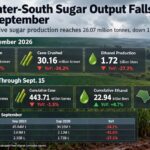
Output declined from 413,000 tonnes in June to 364,000 tonnes in July and 295,000 tonnes in August.
Production subsequently rebounded to 462,000 tonnes in September, supported by the start of the new sugar beet processing season on September 16.
Despite the month-on-month recovery, September output remained 9.1% below the corresponding period in 2025.
| Period | Finished sugar output |
|---|---|
| June 2026 | 413,000 tonnes |
| July 2026 | 364,000 tonnes |
| August 2026 | 295,000 tonnes |
| September 2026 | 462,000 tonnes |
| January–September 2026 | 12.681 million tonnes |
Source: NBS industrial production data. Figures refer to finished sugar manufactured by industrial enterprises above the designated size.
An Important Distinction: Finished Sugar Versus Domestic Sugar Production
The NBS figures should not be interpreted as China’s domestic sugarcane and sugar beet production alone.
The statistical coverage includes finished sugar manufactured by industrial enterprises with annual principal business revenue of at least CNY 20 million (approximately USD 2.8 million).
Importantly, the figures cover:
- Sugar produced from domestically grown sugarcane.
- Sugar manufactured from domestic sugar beet.
- Refined sugar processed from imported raw sugar.
Consequently, the 12.681 million-tonne figure is not directly comparable with crop-year sugar production estimates published by the USDA or other international agricultural forecasting agencies.
This distinction is particularly relevant when assessing China’s domestic agricultural supply, raw sugar import requirements and refinery utilization.
Could China’s Sugar Production Reach a New Record in 2026?
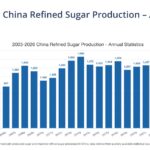
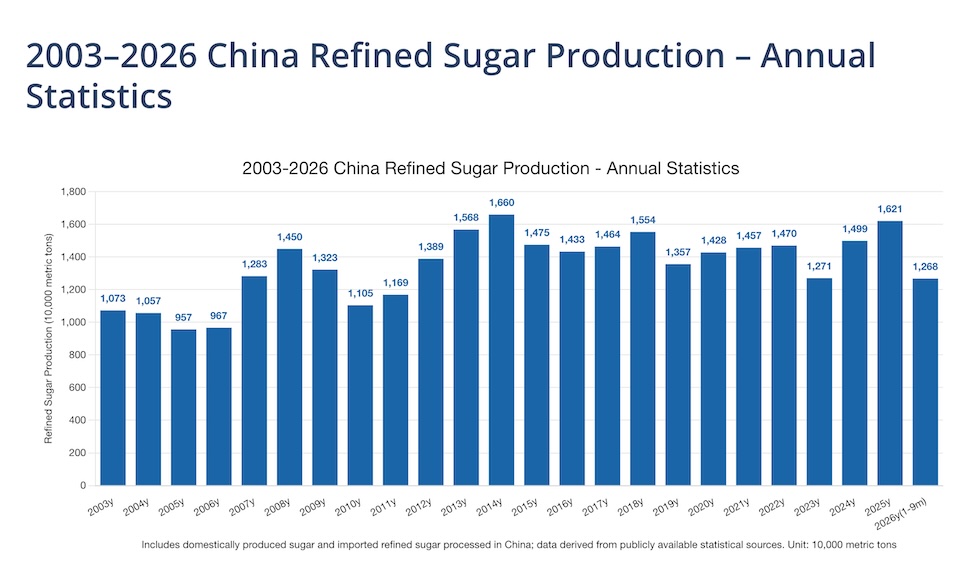
China’s finished sugar output reached approximately 16.21 million tonnes in 2025, ranking among the highest annual levels in the country’s historical industrial production series.
The previous peak was approximately 16.6 million tonnes in 2014.
By the end of September 2026, cumulative output had already reached the equivalent of 78.2% of the full-year 2025 total.
To exceed the historical high of approximately 16.6 million tonnes, China would need to produce another 3.92 million tonnes during October–December.
Whether that target can be achieved will depend on two major factors: the availability of imported raw sugar for refining and the pace at which domestic sugar mills begin crushing during the final quarter.
The start of the 2026/27 crushing season provides an opportunity for production to accelerate, although the substantial fourth-quarter volume required means that a record annual total remains uncertain.
Sugar Imports Fall 20.4% Despite Strong Industrial Output
An important development in China’s sugar supply chain is the contraction in import volumes.
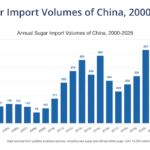
According to customs statistics, China imported approximately 2.51 million tonnes of sugar during January–September 2026, down 20.4% year on year, representing a reduction of around 640,000 tonnes.
The decline contrasts with the 19.2% increase in cumulative finished sugar output.
This divergence partly reflects the different statistical periods and production channels captured by the two datasets.
Because imported raw sugar is a major feedstock for Chinese refineries, changes in import arrivals can influence subsequent finished sugar output.
However, import volumes and refinery production do not necessarily move together within the same month, as processors may draw on previously imported inventories.
The reduction in imports nevertheless represents an important consideration for fourth-quarter refinery operations.
For a more detailed examination of China’s import volumes, sourcing patterns and pricing trends, see YnSugar’s China Sugar Import Report 2025–2026.
Sugar Syrup and Premixed Sugar Powder Imports Also Decline
China’s imports of sugar syrups and premixed sugar powders have also weakened.
Customs data covering five relevant product categories show that cumulative imports reached approximately 744,200 tonnes during January–September 2026, down 15.8% from a year earlier.
These products represent a separate component of China’s broader sweetener supply and are generally not processed into conventional finished crystalline sugar.
They should therefore be analyzed separately rather than added directly to the NBS finished sugar production total.
The simultaneous contraction in conventional sugar imports and these alternative sugar-containing products highlights changing trade flows in China’s sweetener market.
Guangxi Sugar Mills Prepare for the 2026/27 Crushing Season
Attention is now shifting to southern China, where the new sugarcane crushing season is approaching.
Several sugar mills in Guangxi have begun furnace ignition and other pre-season preparations ahead of the 2026/27 campaign.
Guangxi is China’s largest sugarcane-producing region and plays a central role in determining national cane sugar output.
Meanwhile, the country’s first sugar beet mill began processing on September 16, marking the opening of the new domestic crushing season.
Domestic sugar prices remain under pressure compared with last year.
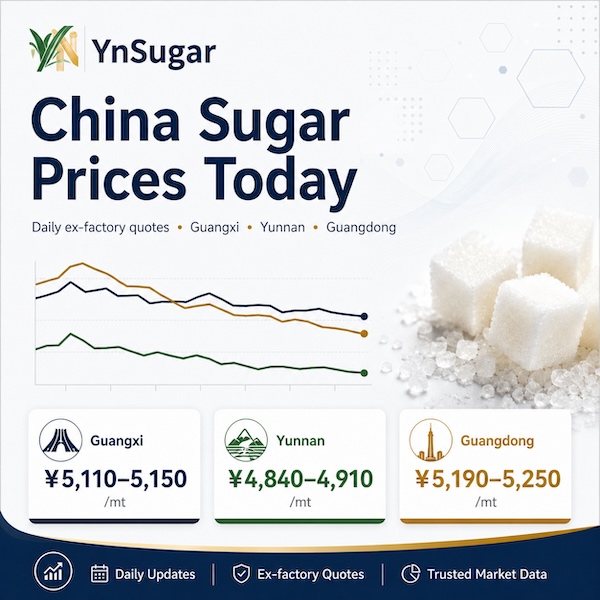
Recent market indications placed old-crop sugar in Guangxi at approximately CNY 5,200 per tonne, around CNY 600 per tonne below year-earlier levels.
Initial new-crop sugar prices have been discussed at approximately CNY 5,400 per tonne, although actual transaction levels will depend on supply conditions, product specifications and market demand.
The interaction between new-crop availability, refinery inventories and domestic prices will be closely watched by sugar producers, refiners and traders.
Market Outlook: Fourth-Quarter Production and Raw Sugar Arrivals in Focus
China’s industrial finished sugar production has maintained strong cumulative growth through September, but the final quarter will be decisive in determining the full-year outcome.
Three developments deserve particular attention:
- Raw sugar arrivals and refinery activity: Lower imports could constrain processing volumes if existing inventories are insufficient to sustain refinery operations.
- Domestic crushing progress: The pace of sugarcane and sugar beet processing during the 2026/27 season will determine how quickly fresh domestic sugar enters the market.
- Price and inventory adjustments: The relationship between old-crop stocks, newly produced sugar and imported raw sugar costs will influence refining margins and market supply.
For international sugar traders, China’s import requirements remain particularly important given the country’s position as a major participant in the global raw sugar market.
The central question is no longer simply whether Chinese industrial sugar output is rising, but whether domestic crushing and imported raw sugar refining can sustain the momentum needed for another historically high production year.
Data Sources and Methodology
Primary statistical sources
- National Bureau of Statistics of China (NBS) — Industrial production data, September 2026; historical finished sugar production series.
- NBS September 2026 Industrial Production Release — Official industrial production release and statistical methodology.
- General Administration of Customs of China (GACC) — Customs trade statistics for January–September 2026.
Methodology: Figures are expressed in metric tonnes. Calendar-year finished sugar production, crop-year domestic sugar output and customs import volumes follow different statistical definitions and should not be treated as interchangeable. Historical comparisons are approximate, and official figures may be revised.
Editorial Analysis: YnSugar Market Intelligence Team. This report combines publicly available Chinese statistics with industry analysis of sugar production, imports and market conditions. Forward-looking observations are analytical assessments, not official forecasts.
Disclaimer
This article is provided for informational and industry research purposes only. Production, import and price data are based on publicly available statistics and market information available at the time of publication and may be subject to revision. Market assessments and forward-looking statements involve uncertainty and should not be interpreted as investment, trading or commercial advice. YnSugar.com accepts no responsibility for decisions made solely on the basis of this report.