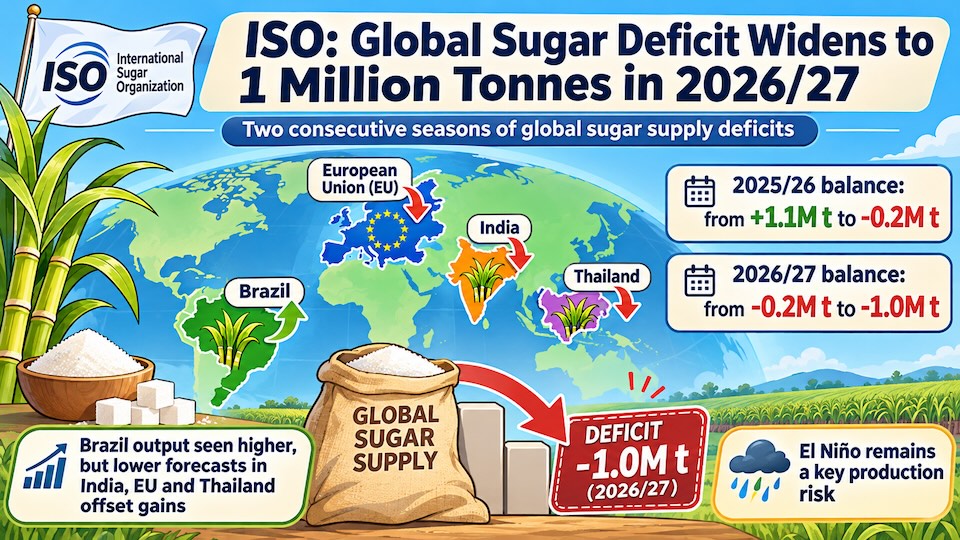
The International Sugar Organization (ISO) has raised its forecast for the global sugar deficit in the 2026/27 season to 1 million metric tonnes, up from 200,000 tonnes projected in August. Its latest assessment points to two consecutive seasons of global sugar supply shortfalls.
The global sugar deficit is expected to widen in the 2026/27 season as downward revisions to production forecasts in several major sugar-producing regions offset anticipated growth in Brazilian output, according to the International Sugar Organization’s November 2026 quarterly market outlook.
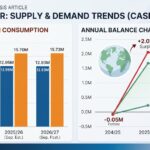
The ISO now projects a global sugar supply shortfall of 1 million metric tonnes in 2026/27, an increase of 800,000 tonnes from its August forecast.
Global Sugar Deficit Widens as Production Forecasts Are Revised
Although Brazil is expected to record substantial growth in sugar production in 2027, the ISO has lowered its production expectations for India, the European Union and Thailand.
The anticipated reductions in these major producing regions are expected to offset the additional supply generated by higher Brazilian production.
The revised outlook highlights the importance of production developments across multiple origins in determining the global sugar balance.
ISO Revises 2025/26 Sugar Surplus to a Deficit
The organization has also significantly revised its assessment of the 2025/26 global sugar balance.
The previous forecast of a 1.1 million-tonne surplus has been replaced by an estimated 200,000-tonne deficit.
The downward revision of 1.3 million tonnes was primarily attributed to lower-than-expected sugar production in Brazil during the third quarter of 2026.
With both the 2025/26 and 2026/27 seasons now projected to record supply deficits, the latest ISO assessment suggests a tighter global sugar supply-demand balance than previously anticipated.
Global Sugar Consumption Continues to Grow
Despite downward revisions to its consumption forecasts, the ISO expects global sugar demand to maintain modest growth.
World sugar consumption is projected to reach:
- 179.2 million tonnes in 2025/26, up 0.4% year on year.
- 179.9 million tonnes in 2026/27, also up 0.4% year on year.
Both estimates are slightly below the projections published in August.
The latest figures indicate that global sugar consumption continues to expand gradually, while production uncertainties remain an important factor shaping the supply outlook.
El Niño Remains a Key Risk to Global Sugar Production
The ISO also identified El Niño as an important weather-related risk to global sugar production over the coming months.
Weather developments across major sugar-producing regions, particularly in Asia and Brazil, will remain important variables in assessing the final production outlook.
The impact of El Niño on rainfall patterns and agricultural conditions may lead to further revisions to global sugar production estimates and the projected supply-demand balance.
ISO Global Sugar Balance: August vs. November 2026 Forecasts
Unit: Million metric tonnes
| Indicator | August Forecast | November Forecast |
|---|---|---|
| 2025/26 global sugar balance | +1.10 | -0.20 |
| 2026/27 global sugar balance | -0.20 | -1.00 |
| 2025/26 global sugar consumption | 179.60 | 179.20 |
| 2026/27 global sugar consumption | 180.40 | 179.90 |
Note: Positive values indicate a supply surplus, while negative values indicate a supply deficit.
Source: International Sugar Organization (ISO), August and November 2026 quarterly market outlooks.
Market Outlook: Two Consecutive Seasons of Sugar Supply Deficits
The latest ISO projections indicate that the global sugar market may face two consecutive seasons in which consumption exceeds production.
Although the projected 2026/27 deficit remains relatively modest compared with total global consumption, the substantial downward revision from August signals a tightening supply outlook.
For international sugar traders, refiners and industrial buyers, production developments in Brazil, India, Thailand and the European Union, together with evolving weather risks, will be key factors to monitor in the coming months.
However, a projected global production deficit does not necessarily translate into an immediate physical shortage or higher sugar prices. Existing inventories, export availability, exchange rates and broader commodity market conditions will also influence the market.
Data Source
International Sugar Organization (ISO), November 2026 Quarterly Market Outlook, with comparisons against its August 2026 forecasts.
Disclaimer
YnSugar.com:This article is based on market forecasts and statistical information published by the International Sugar Organization (ISO). All production, consumption and supply-demand balance estimates are subject to revision as new information becomes available.
The information and analysis provided are for informational and industry research purposes only and do not constitute investment, trading or commercial advice. Readers should refer to the latest publications from the ISO and other authoritative sources before making business or investment decisions.