The Australia raw sugar production cost is currently the lowest among major global producers, sitting at just US$281/t according to recent industry data.
| Country / Region | Production Cost (USD/MT) | Product Category |
| Australia | $281 | Raw Sugar |
| Brazil | $338 | Raw Sugar |
| Thailand | $458 | Raw Sugar |
| India | $470 | Raw Sugar |
| European Union | $700 | Raw Sugar |
| China | $805 | Refined White Sugar |
Key Notes:
-
Methodology Note: Please note that the data for China represents the production cost of Refined White Sugar, whereas data for all other regions refers to the production cost of Raw Sugar.
-
Data Sources: This statistical summary is synthesized from reports provided by Czarnikow and the Australian Sugar Millers Council (ASMC).
-
Currency: All figures are quoted in US Dollars (USD) per Metric Ton (MT).
According to the comparison table, Australia’s raw sugar production cost of US$281/t is the lowest among the six economies listed — well below Brazil (US$338/t), Thailand (US$458/t), India (US$470/t), the EU (US$700/t), and China’s finished white sugar cost (US$805/t). This is not a statistical anomaly. Australia’s sugar industry is widely acknowledged as one of the lowest-cost in the world, and Australian millers are one of the lowest cost producers of sugar globally, currently sitting in decile 1 on the global cost curve. The following factors explain this structural cost advantage.
1. A Narrow, Climate-Optimised Production Belt
Australia concentrates virtually all of its cane production in a single, highly suitable corridor. Around 95 per cent of sugar produced in Australia is grown in Queensland and about five per cent in northern New South Wales, along 2,100 km of coastline between Mossman in far north Queensland and Grafton in northern New South Wales.Over 90% of cane farms are located in Queensland, and the state’s ideal climatic conditions and ample processing facilities contribute to this trend.
Because sugarcane requires a hot climate and plenty of water, concentrating the crop in this warm, wet coastal belt allows growers to achieve high biomass output per hectare. “We grow a very large amount of sugarcane per hectare and producing that much biomass and capturing that much carbon from the atmosphere and turning it into plant material is done very efficiently by the sugarcane plant. That is a key thing if we’re trying to produce renewable materials from plants”— a productivity base that directly lowers per-tonne costs.
2. Scale, Consolidation, and Professionalised Farm Operations
Australia has steadily squeezed out inefficient operators. There are now 1,000 fewer sugarcane farms than there were 15 years ago, with smaller farmers selling their land to larger operators. The continual pressure is to remain price competitive, with larger operations benefitting from cost savings through economies of scale and generally performing better financially. On the milling side, the story is similar: market share concentration is increasing, and only a small number of companies mill and export raw sugar, which accounts for the majority of industry revenue.
Corporate farming operations illustrate just how large the production units have become. One major miller reports that its largest farm in the Burdekin region produces about 320,000 tonnes of sugarcane a year on 3,800ha of flat, furrow-irrigated farmland, with a further 2,000ha in the Herbert, 550ha in Proserpine and 550ha in Sarina. This scale spreads fixed costs across far greater volumes than competitors like India or Thailand can match.
3. A Century-Long Head Start in Mechanisation
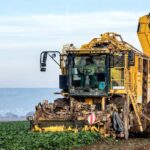
Australia is the world’s pioneer in mechanised cane harvesting, a legacy that continues to deliver cost savings today. The mechanisation of the sugarcane harvest was one of the most significant transformations in the industry’s history, reshaping how farms operated and ensuring the harvest could continue as labour became scarce. For decades, harvesting cane meant long hours of physically demanding manual labour. As production expanded, the industry became increasingly vulnerable to labour shortages caused by war, migration shifts and rising costs. Without change, growers faced the real prospect of being unable to harvest their crop.
The result was a decisive pivot to machinery: mechanical harvesting reduced dependence on manual labour, increased efficiency, and allowed the industry to continue growing in scale and sophistication. The modern harvest is efficient, mechanised and continually improving, and ongoing refinement, automation and precision technologies have continued to improve efficiency and safety. In countries where hand-cutting still predominates, labour costs alone can exceed Australia’s entire production cost per tonne.
4. Advanced Logistics and Export Infrastructure
Australia’s low cost is not just at the farm gate — it extends all the way to the ship. Advanced infrastructure, like private sugarcane railway systems and strategically located bulk sugar terminals, has maximised the efficiency of transporting Australian sugar to international markets. These advantages, coupled with economies of scale from large-scale production, have made Australian sugar more competitive globally, helping to boost export volumes.With 2.5 million tonnes of bulk storage spread across six regional ports with world leading handling facilities Australian supply is year-round and efficient.
Geographic diversification across the growing belt also smooths output risk: across four major growing regions with quite different climatic conditions, production risk is very low with the industry producing between 4.25 and 4.9 million tonnes per annum over the past seven years.
5. Irrigation and Best-Practice Agronomy
While dryland farming is common, a large share of Australia’s cane is irrigated, stabilising yields. Industry representatives note that about 65 per cent of the industry is irrigated, which means a lot of the cost of production goes into pumping water. Growers are actively reducing water cost through technology: sugarcane growers often install sub-surface drip irrigation systems, which allow them to supply water directly in the root zone with efficiencies of up to 95%, and these systems also allow farmers to irrigate as frequently as required.
Industry-wide standards push every farm toward efficiency. Smartcane BMP is the industry best management practice program driving productivity, profitability and sustainability through modules covering every aspect of cane growing, and large growers follow best management practices, including minimum tillage, precision-applied fertilising, technology-guided irrigation scheduling and recycling of water.
6. Monetising By-Products to Offset Milling Costs
Australian mills do not treat cane residues as waste — they convert them into energy and fertiliser revenue streams that subsidise the cost of sugar itself. Manufacturers have diversified income streams by using bagasse, a byproduct of sugar production, as a sustainable energy source, which has contributed to an improvement in industry profitability.Sugar mills already burn bagasse (the fibrous residue that remains after juice is extracted from sugarcane stalks) to produce the energy for their milling operations, effectively giving mills near-zero external energy costs for the crushing season.
Similarly, mill mud — another by-product — is recycled back into the fields. Mill mud is a nutrient-rich by-product of the sugar production process that can be applied to cane fields as organic fertiliser. Research has shown that mill mud can provide a host of benefits. These include higher yields, better soil health and less need to replant due to longer ratoons.This lowers both fertiliser expenditure and replanting frequency.
7. Export-Oriented Scale and Quality Premiums
Because Australia exports the overwhelming majority of what it produces, every part of the system is engineered for large-lot efficiency rather than fragmented domestic retail. More than 80% of all sugar produced in Australia is exported as bulk raw sugar, making Australia the second largest raw sugar exporter in the world.The output is also high-grade: raw sugar is produced and sold in ‘brands’ to customers with specified quality standards (sucrose content as measured by polarisation or pol, moisture etc). Australian supply is high quality with the majority produced as Brand 1 (greater than 98 pol).High purity means less re-processing loss per tonne delivered — effectively a further cost reduction for buyers.
Bottom Line
Australia’s US$281/t raw sugar cost is the product of compounding advantages: a climatically optimal coastal belt, decades of farm consolidation, pioneering 100% mechanised harvesting, world-class bulk-export logistics, widespread irrigation, industry-wide best-practice standards, and full monetisation of by-products. None of these are easily replicable in the short term — which is why Australia is likely to retain its position near the bottom of the global sugar cost curve for the foreseeable future, even as higher-cost producers such as China, the EU, and India struggle with structurally elevated costs.