With mounting concerns that El Niño could disrupt harvests across the world’s key sugar-producing nations, leading sugar analytics firm Czarnikow has sharply revised down its 2026/27 global sugar balance forecast, reigniting debate over the direction of international sugar prices.
Surplus Estimate Cut by Two-Thirds in Just Three Months
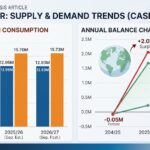
Czarnikow, which operates as both a sugar trader and market analyst, has lowered its 2026/27 global sugar surplus estimate to 1.1 million tonnes, down from 3.4 million tonnes forecast back in February. At the same time, the firm trimmed its 2025/26 (October–September) surplus projection to 5.8 million tonnes, compared with 8.3 million tonnes predicted earlier in February.
The driving force behind this revision is the anticipated impact of El Niño weather patterns on cane production in India, Thailand, and Brazil — the three countries that together shape the global sugar narrative.
Compared with last month’s outlook, the 2026/27 surplus estimate has been cut by roughly 300,000 tonnes versus the March forecast, marking a dramatic retreat from February’s 3.4-million-tonne projection.
Drilling into the numbers: global sugar output for 2026/27 is now pegged at 180.4 million tonnes, 200,000 tonnes below the March estimate, while global consumption is expected to climb to 179.3 million tonnes, 100,000 tonnes higher than previously projected.
El Niño Emerges as the Critical Swing Factor
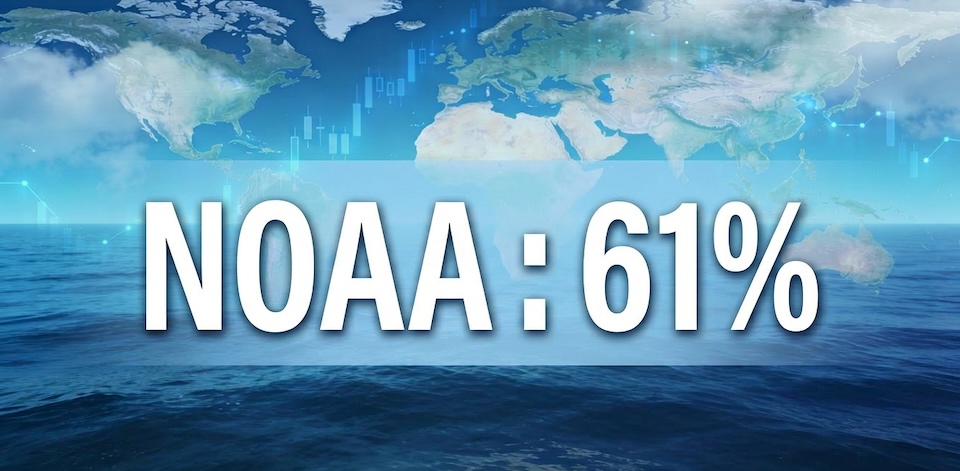
The U.S. National Oceanic and Atmospheric Administration (NOAA) April 2026 outlook assigned a 61% probability of El Niño development during the May–July window, rising to 62% for June–August.
Czarnikow attributes its downgrade largely to the potential fallout from El Niño across the major cane belts. The firm highlighted specific risks to production in India, Thailand, and Brazil.
Historically, El Niño brings hotter, drier conditions to India and Thailand — unfavorable for cane development — while in Brazil’s Center-South region, the same phenomenon tends to deliver excessive rainfall that can delay crushing operations.
India offers a cautionary precedent: the country has previously suffered output losses during El Niño-induced droughts. More recently, Indian production has been on a strong rebound trajectory, supported by improved weather, expanded planting area, and higher yields.
Current Season Still Heading for Second-Highest Output on Record
Despite the looming uncertainty, global sugar production in the 2025/26 marketing year (October through September) is still expected to reach 184.1 million tonnes — the second-highest level in history.
Within that total, Thailand’s output forecast has been raised from 11.5 million to 12 million tonnes, while India’s production is projected at just under 28 million tonnes.
These projections broadly align with data from other market trackers. The latest figures show that between October and March of the 2025/26 season, Indian sugar output rose 9% year-on-year to 27.12 million tonnes, while Brazil’s Center-South production edged up 0.7% to 40.25 million tonnes, with mills showing a clear preference for directing cane toward sugar rather than ethanol.
According to recent data from the National Federation of Cooperative Sugar Factories of India, the country’s sugar production between October 1 and April 15 of the 2025/26 season climbed 7.7% year-on-year to 27.48 million tonnes.
Prices Under Pressure, Brazil’s Ethanol Parity Takes Center Stage
The persistent surplus narrative continues to weigh heavily on international sugar prices.
As of April 13, raw sugar had slid to 14.14 cents per pound — its weakest level since March. Prices have fallen 1.53% over the past four weeks and are down a cumulative 21.83% over the past 12 months.
Nearly every major analyst agrees on one thing: Brazil’s 2026/27 Center-South harvest will be the single most important variable determining whether global sugar prices can recover in the second half of 2026 — or whether they remain anchored near multi-year lows into 2027.
During the 2025/26 season, the sugar mix in Brazil’s Center-South — the country’s dominant production zone — reached 50.7%–51.1%, the highest level in years and a key driver behind the current supply glut. At prevailing crude oil and ethanol prices (WTI hovering around $62–$66 per barrel), Brazilian mills are currently earning better margins producing ethanol than exporting sugar at 13.7 cents per pound.
ING analysts argue that sugar prices will need to stay persistently below ethanol parity to incentivize Center-South mills to divert more cane into ethanol production rather than sugar — a shift that would help shrink the projected 2026 surplus.
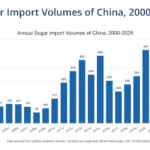
As fluctuating Brazilian production dynamics and ethanol parity premium matrices continue to swing global ICE No.11 white spot pricing, how are these macro shocks reshaping the world’s largest buyer?
For a granular, GACC-audited analysis on landing margins and origin shifts, explore our flagship asset:
China Sugar Import Report 2025–2026: Dynamic Datasets, Price Matrices & Trajectories
.
Forecasts Diverge Sharply Across the Analyst Community
Importantly, views on the scale of the 2026/27 surplus vary considerably across the industry.
Green Pool analysts, for example, project a 2026/27 surplus of just 156,000 tonnes — far below the 2.74 million tonnes they anticipate for 2025/26. With Brazil and India together accounting for roughly 55% of global sugar output and dominating the vast majority of international trade flows, getting the supply story right in these two countries is the heart of any credible forecast.
Market participants broadly agree that the trajectory of sugar prices from here will hinge on three intertwined variables: the actual severity of El Niño impacts, how Brazilian mills allocate cane between sugar and ethanol, and the evolution of India’s export policy.
Czarnikow’s downward revision has already rippled through the futures market — raw sugar futures closed higher on April 21, reacting to the lowered 2026/27 global surplus estimate.
So, Are Sugar Prices Set to Rally?
According to ynsugar analysts, viewed through the lens of commodity cycles, sugar prices in 2026 may be closer to a potential cyclical bottom than a top, making the risk-reward profile for long positions increasingly attractive. That said, abundant supply from major producers like Brazil and India will likely continue to cap price upside in the near to medium term.
The global sugar market now finds itself at an exceptionally complex crossroads, where three powerful forces — climate anomalies, geopolitical conflict, and sharp energy price swings — are intersecting to reshape the commodity’s supply-demand dynamics in ways rarely seen before.
In this environment, the impact of any single factor is invariably constrained and modulated by the others.
Exemption Statement: The market analysis and data projections provided in this report, including the Global sugar surplus forecast 2026, are for informational and technical exchange purposes only. While ynsugar.com utilizes reputable sources such as Czarnikow, NOAA, we do not guarantee the absolute accuracy or completeness of third-party data. This content does not constitute commercial, legal, or investment advice. Any trading or investment decisions made based on this information are at the sole risk of the reader, and ynsugar.com shall not be held liable for any financial losses or market risks incurred.







1 thought on “El Niño Threat Prompts Czarnikow to Slash Global Sugar Surplus Forecast — Are Prices About to Rally?”