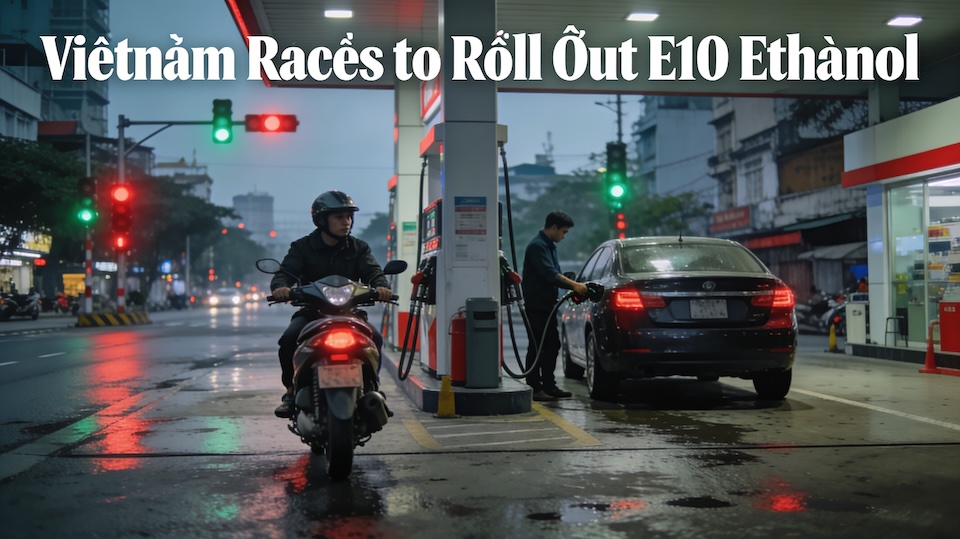
The Vietnam E10 ethanol rollout is accelerating, with the government pushing for a nationwide switch by April 30, 2026.
April 13, 2026
Vietnam is pushing to complete a sweeping nationwide switch from conventional mineral gasoline to E10 biofuel — a blend containing 10% ethanol — within a matter of weeks. The Ministry of Industry and Trade (MoIT) has proposed that all gasoline sold across the country must be blended as E10 starting April 30, 2026, one month ahead of the previously mandated deadline of June 1.
The accelerated timeline reflects growing urgency in Hanoi over global energy uncertainty. Officials say the shift could cut the country’s fossil fuel consumption by roughly 10%. At a first-quarter press briefing, the MoIT acknowledged the mandate is “an extremely demanding task” that requires “the entire system to act with far greater urgency and determination than usual.”
Supply gap looms large
Meeting that ambition, however, will be no small feat. According to Do Van Tuan, chairman of the Vietnam Biofuel Association, the country’s six ethanol plants have a combined design capacity of around 41,000 cubic meters per month — but only three are currently operating, producing approximately 25,000 cubic meters. That covers just 25% to 27% of the estimated national demand of 100,000 to 110,000 cubic meters per month. Even at full capacity, domestic output would satisfy only about 41% of requirements.
Imports will therefore remain indispensable in the near term. Industry estimates suggest Vietnam will need to bring in 700,000 to nearly one million cubic meters of ethanol annually between 2026 and 2027, sourced primarily from the world’s two largest producers — the United States and Brazil. Shipments are expected to arrive through major ports including B12 in Quang Ninh province, Nha Be in Ho Chi Minh City, and Van Phong in Khanh Hoa province.
Big oil companies gear up
Vietnam’s two dominant fuel distributors are already positioning for the transition. Petrolimex, the state-owned petroleum giant, requires 45,000 to 50,000 cubic meters of ethanol per month, with only 20% to 30% sourced domestically and the rest imported. The company currently sells E10 RON95-III at 60 filling stations in Ho Chi Minh City and Quang Ngai province.
PVOIL, the country’s second-largest fuel retailer, has announced it is ready to distribute E10 RON95 through its network of nearly 1,000 stations nationwide beginning in April.
Both companies have been running a pilot program since August 2025, offering E10 RON95 at 42 stations across Hanoi, Ho Chi Minh City, and Hai Phong. Petrolimex says it has not received a single accident report from motorists since the trial began. “Since successfully launching the pilot in Ho Chi Minh City in August 2025, we have received no incident reports from any vehicle users,” the company stated.
Safety concerns addressed, but skepticism lingers
The MoIT has cited reports from automakers including Toyota, Honda, and Ford, as well as findings from the Society of Automotive Engineers (SAE), confirming that E10 is safe for all modern engines. Researchers at the Hanoi University of Science and Technology’s Center for Power Sources and Autonomous Driving have found that E10 performs on par with conventional gasoline in both cars and motorcycles, with some tests showing marginal improvements in power output and fuel efficiency.
Still, consumer wariness persists — particularly among owners of older vehicles. E10 uptake has so far remained relatively low and concentrated in major cities with modern retail infrastructure. Mountainous and remote provinces have been slower to embrace the new fuel, citing concerns over compatibility, a preference for traditional gasoline, and limited blending facilities.
Cheaper at the pump, cleaner in the air
On the cost front, the news is encouraging. Because ethanol is currently priced below gasoline, blending is not expected to raise retail prices. In fact, once the rollout scales up, E10 is projected to be cheaper than the RON95-III grade it replaces.
The environmental case is equally compelling. E10 biofuel is estimated to reduce carbon dioxide emissions by 3% to 5% per vehicle. Scaled nationwide, that translates to annual CO₂ reductions of 640,000 to 800,000 metric tons. Beyond greenhouse gases, the blend also lowers emissions of carbon monoxide, hydrocarbons, and nitrogen oxides — a meaningful benefit for heavily polluted cities like Hanoi and Ho Chi Minh City.
Industry calls for policy support
Despite the promising outlook, significant hurdles remain. Vietnamese businesses in the ethanol sector are calling on the government for greater support, pointing to tight working capital and difficulty securing bank financing. Industry groups have recommended that Hanoi offer corporate income tax exemptions or preferential rates for ethanol production projects over a five- to ten-year window to encourage long-term investment. The current 5% import tariff on ethanol, they argue, should be maintained to provide reasonable protection for domestic producers.
Looking further ahead
Vietnam’s biofuel ambitions do not stop at E10. The government plans to upgrade the national fuel standard to E15 — containing 14% to 15% ethanol — starting January 1, 2031, with the MoIT authorized to adjust blending ratios based on market conditions.
Officials have emphasized that expanding biofuel use is a critical pillar of Vietnam’s green growth strategy, clean energy adoption, and its commitment to achieving net-zero emissions by 2050.
The E10 mandate marks a major market transformation for a nation of roughly 100 million people, and signals that this fast-growing Southeast Asian economy is serious about its energy transition — even if the road ahead is anything but smooth.