Note: The following recommendations apply only to South Asia and Southeast Asia regions.
I. Fertilization Principles
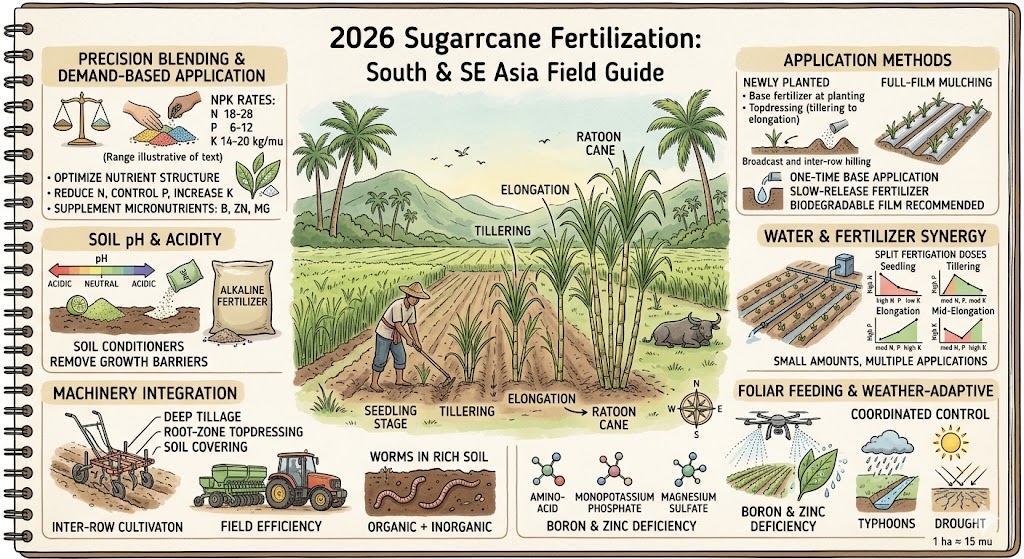
1. Precision Blending and Demand-Based Application. Determine appropriate nitrogen, phosphorus, and potassium rates based on target yield and soil fertility levels. Strengthen the regulatory role of potassium, boron, magnesium, and other nutrients in sugar accumulation, and strictly limit late-season nitrogen application.
2. Reduce Nitrogen, Control Phosphorus, Increase Potassium, and Supplement Micronutrients. Optimize the nutrient structure by moderately reducing nitrogen rates, controlling phosphorus inputs, and increasing the proportion of potassium. Apply targeted supplementation of boron, zinc, magnesium, and other secondary and micronutrients to address deficiencies in acidic sugarcane-growing areas.
3. Integrate Machinery with Agronomy for Greater Efficiency. Promote deep tillage, deep placement of base fertilizer, and root-zone topdressing with soil covering. Use large sugarcane planters and inter-row cultivator-fertilizer applicators to integrate planting, fertilization, and hilling in a single operation, thereby improving field efficiency.
4. Combine Organic and Inorganic Inputs to Build Soil Fertility. Increase the application of well-composted organic fertilizer, promote straw return to fields, and supplement nitrogen to accelerate decomposition. The combined use of organic and inorganic fertilizers improves soil physical and chemical properties and enhances overall fertility.
5. Synergize Water and Fertilizer for Efficient Utilization. Sugarcane fields equipped with drip irrigation should fully adopt fertigation technology, following the principle of “small amounts, multiple applications.” Full-film mulched planting areas should adopt one-time fertilization, using slow- or controlled-release fertilizers or organic-inorganic compound fertilizers to improve water and nutrient use efficiency.
6. Adjust pH and Improve Soil to Remove Growth Barriers. In sugarcane areas with severe soil acidification, apply alkaline fertilizers such as calcium-magnesium phosphate, or use lime and soil conditioners, together with the scientifically managed application of nitrogen fertilizer.
II. Fertilization Recommendations
(1) Fertilizer Rates
- Yield above 6.5 t/mu: Nitrogen (N) 23–28 kg/mu; Phosphorus (P₂O₅) 10–12 kg/mu; Potassium (K₂O) 18–20 kg/mu.
- Yield of 5.5–6.5 t/mu: Nitrogen (N) 20–23 kg/mu; Phosphorus (P₂O₅) 8–10 kg/mu; Potassium (K₂O) 15–18 kg/mu.
- Yield of 4.5–5.5 t/mu: Nitrogen (N) 18–20 kg/mu; Phosphorus (P₂O₅) 6–8 kg/mu; Potassium (K₂O) 14–16 kg/mu.
- For fields with low soil fertility, increase fertilizer rates by 10%–20%; for fields with high soil fertility, reduce rates by 10%–30%.
- Fields using fertigation should apply fertilizer in small, frequent doses, with total rates reduced by 10%–20%. Fields under full-film mulching combined with slow- or controlled-release fertilizers may reduce rates by 10%–15%.
- In magnesium-deficient areas, apply 2–3 kg/mu of magnesium fertilizer (as MgO) as base. On strongly acidic soils, apply 100 kg/mu of alkaline fertilizer or soil conditioner containing silicon, calcium, and magnesium as base. In zinc- or boron-deficient areas, apply 1.0–1.5 kg/mu of zinc sulfate and 0.5–1.0 kg/mu of borax as base, according to need.
(2) Timing and Methods of Application
1. Newly Planted Sugarcane.
- Base fertilizer: Apply at planting, allocating 20%–30% of total nitrogen, 35%–50% of phosphorus, and 15%–25% of potassium. Broadcast the base fertilizer along the bottom of the planting furrow, avoiding direct contact with the seed cane. A large sugarcane planter should be used to integrate planting, fertilization, and hilling.
- Topdressing: Apply from the mid-to-late tillering stage through the early elongation stage, allocating 70%–80% of total nitrogen, 50%–65% of phosphorus, and 75%–85% of potassium. Combine topdressing with inter-row cultivation and hilling.
- Ratoon cane: Promptly after harvest, use a medium or large inter-row cultivator-fertilizer applicator to break the ridge, loosen stubble, apply fertilizer and pesticide, and re-hill. Fertilizer may be applied all at once during ridge-breaking and stubble-loosening, or split into two applications (ridge-breaking/stubble-loosening fertilizer and cultivation/hilling fertilizer).
2. Full-Film Mulched Fields. Apply all fertilizer once as base fertilizer, preferably as slow- or controlled-release fertilizer or organic-inorganic compound fertilizer. After opening the furrow, promptly plant, fertilize, apply pesticide, cover with soil, and lay the film while the furrow remains moist. Film width should be 1.5–3 meters; fully biodegradable film is strongly recommended.
3. Organic Fertilizer. Apply all organic fertilizer as base. When organic fertilizer is used, chemical fertilizer rates may be reduced accordingly. In fields with straw return, base-applied nitrogen may be increased by 5%–10%; in fields with year-round straw return, phosphorus and potassium rates may be reduced by 20%–30%.
4. Fertigation Fields. Apply fertilizer through fertigation in 4–6 split doses:
- Seedling stage: N 10%–20%, P₂O₅ 20%–30%, K₂O 5%–15%.
- Tillering stage: N 20%–30%, P₂O₅ 30%–40%, K₂O 20%–30%.
- Early elongation (2–4 internodes): N 25%–35%, P₂O₅ 20%–30%, K₂O 25%–35%.
- Mid-elongation (7–9 internodes): N 20%–30%, P₂O₅ 10%–20%, K₂O 30%–40%.
5. Timely Foliar Supplementation. From the tillering to the elongation stage, combine foliar feeding with coordinated regional pest and disease control by drone. Spray a mixed solution containing pesticide plus 50–100 mL/mu of amino-acid water-soluble fertilizer, 0.2 kg/mu of monopotassium phosphate, and 0.2 kg/mu of magnesium sulfate. In boron- or zinc-deficient areas, add 0.05% borax and 0.1% zinc sulfate solutions to the spray.
6. Weather-Adaptive Management. If drought occurs during the spring fertilization period, fields with adequate infrastructure should irrigate before mulching at planting, or use fertigation to secure seedling emergence. After summer typhoons, promptly drain fields and apply supplemental nitrogen and potassium.
Exemption Statement: The 2026 Scientific Fertilization Guidelines for Sugarcane presented on ynsugar.com are intended for academic and technical exchange purposes only. These recommendations are based on regional soil and climate models for South and Southeast Asia and should be adjusted according to local soil testing results and specific crop varieties. ynsugar.com and its editorial team shall not be held liable for any crop loss or financial outcomes resulting from the application of these guidelines. Farmers and plantation managers are advised to consult with local agricultural experts before making large-scale fertilization decisions.