The El Niño 2026 sugar market is facing a familiar climatic wildcard…By the YnSugar Analysis Team | May 2026
Executive Summary
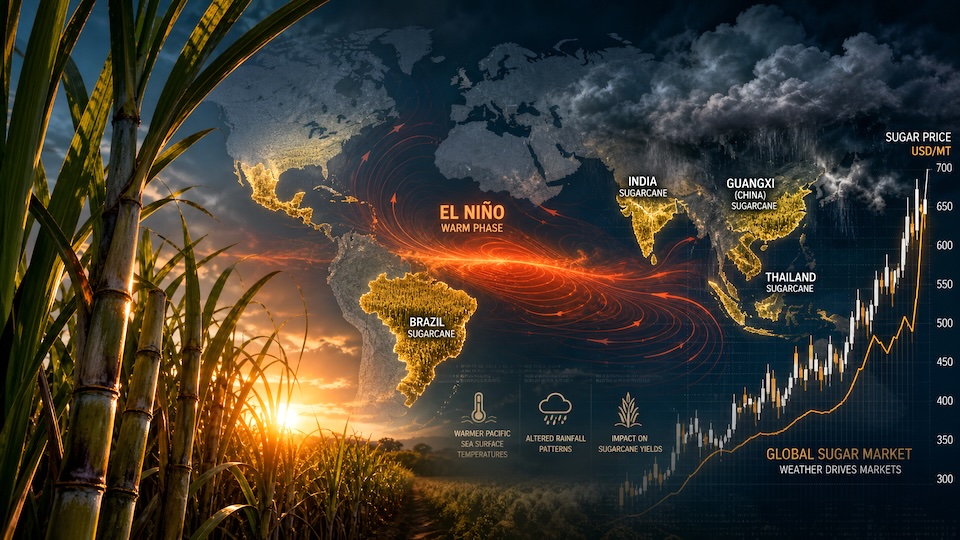
The global sugar market is once again facing a familiar climatic wildcard. According to the latest outlook from the U.S. National Oceanic and Atmospheric Administration (NOAA), the probability of El Niño conditions developing during the May–July 2026 window stands at 61% , rising to 62% for the June–August window. Forecasters expect El Niño to begin emerging in May, with a moderate-to-strong event likely forming during the summer-autumn period (June–August) and potentially persisting through the end of 2026.
For traders, refiners, food manufacturers, and producer-country governments, the central question is straightforward: how will this climatic shift reshape supply from the world’s four most important sugar origins—Brazil, India, Thailand, and China?
The short answer: planting-stage impacts on the 2026/27 cycle should be limited, but a stronger and longer-lasting El Niño could meaningfully tighten 2027/28 balances.
What NOAA’s Latest Outlook Tells Us
Climate models converge on a high-confidence signal. With probabilities above 60% across consecutive overlapping windows, the development of El Niño this year is now the base-case scenario rather than a tail risk. The expected duration—lasting potentially into late 2026 or even early 2027—is what makes this event particularly relevant for sugar fundamentals, since sugarcane is a multi-stage crop where weather during tillering (jointing), grand growth, and maturation each shape final yields and sucrose content differently.
Brazil: The Center-South Remains the Swing Producer
Brazil’s Center-South region is the linchpin of global sugar supply, and the timing of this El Niño event matters more than its headline strength.
The June–August window overlaps with two distinct production cycles:
- The harvesting/crushing period of the 26/27 crop in the Northeast
- The planting period of the 27/28 crop in the Center-South
With raw sugar pricing currently at a structural disadvantage versus hydrous ethanol, Brazilian mills are expected to keep their sugar mix below 48% this season. Under this configuration:
- A moderate El Niño of typical duration would primarily affect the next season (27/28) rather than current output, as the planting-stage moisture profile would be disrupted.
- A strong, early-onset El Niño could disrupt current 26/27 crushing logistics, potentially pushing Center-South sugar production below 39 million tonnes.
That said, the broader picture remains cautiously optimistic. A robust cane availability profile, continued capacity expansion at several mill complexes, and favorable agronomic conditions heading into the season suggest Brazil is well-positioned to absorb a moderate climatic shock without dramatic supply destruction.
India: The Highest-Risk Origin Under an Extreme Scenario
The Northern Hemisphere’s largest sugar producer—and the world’s largest consumer—warrants particular attention this cycle, but the risk profile depends on two simultaneous conditions:
- El Niño must intensify earlier than currently expected, reaching a strong state during the critical monsoon window.
- The Indian Ocean Dipole (IOD) negative phase, which historically offsets El Niño’s drying effect over India, must fail to materialize.
If both conditions align, the 2026/27 jointing (tillering) phase could face monsoon disruption, leading to:
- Lower cane yields per hectare, particularly in rainfed regions without robust irrigation infrastructure (notably parts of Maharashtra and Karnataka).
- A 26/27 sugar output figure that comes in below the current season.
Given India’s role in the global trade balance—through both export quotas and ethanol blending policy—any meaningful shortfall would tighten the world market materially. However, this remains a conditional, lower-probability scenario rather than a base case.
Thailand: Strength of the Event Will Determine the Damage
Thailand—the world’s second-largest sugar exporter—shows perhaps the most non-linear response to El Niño intensity:
- Strong El Niño: Severe and prolonged impact. Excessive drought can simultaneously cut current-season output and damage the cane stand for the following season, producing a double-year supply hit.
- Weak El Niño: Limited impact on the current crushing season. In fact, moderate dryness can actually aid sucrose accumulation, modestly improving sugar content per tonne of cane.
- Prolonged duration (any strength): Even a weak but extended event tends to spill into the next season’s cane availability, ultimately weighing on production.
The asymmetry here is important for traders: Thailand’s downside risk is much greater than its upside, particularly given the country’s exposure to rainfed cane cultivation.
China: Guangxi and Yunnan in Focus
Within China, the provinces of Guangxi and Yunnan—which together account for the vast majority of domestic cane sugar—are sensitive to strong El Niño conditions. However, the timing of this particular event falls outside the planting stage, which materially reduces the risk profile.
The key variable becomes whether the sugar-accumulation phase coincides with sustained heavy rainfall:
- Persistent torrential rain during maturation tends to dilute sucrose content in the cane.
- Offsetting this risk: planted area has expanded, and per-hectare yield expectations remain favorable.
The net result: 2026/27 Guangxi sugar output is likely to remain at relatively high levels. The more important watchpoint for the China balance is whether El Niño extends into February 2027—a prolonged event would intersect the 27/28 planting window and pose the more significant downside risk.
Historical Context: El Niño Events of the Past 15+ Years
Understanding the current setup benefits from a look at recent El Niño cycles:
| Period | Intensity |
|---|---|
| July 2009 – April 2010 | Moderate |
| November 2014 – April 2016 | Strong |
| October 2018 – April 2020 | Weak |
| May 2023 – May 2024 | Moderate |
The 2014–2016 strong event remains the clearest historical reference for what a severe scenario could look like, having coincided with significant cane yield deterioration across Asian origins.
Bottom Line for Market Participants
Pulling the threads together:
- 2026/27 planting stages across major producers face limited risk from the current El Niño setup, given timing and offsetting agronomic factors.
- The 27/28 crop is where the more significant downside lies if the event proves both stronger and longer than current consensus suggests.
- Brazil remains the relative safe haven thanks to capacity and cane availability, while Thailand and (conditionally) India represent the meaningful tail risks that could move the world balance from comfortable to tight.
- For risk managers, the most actionable monitoring points over the coming months are: (1) the speed of El Niño onset, (2) whether the negative IOD develops to shield India, and (3) whether the event persists into Q1 2027.
The fundamentals remain constructive overall, but optionality on the upside in raw sugar prices—particularly for deferred contracts covering the 27/28 marketing year—appears underpriced relative to the climatic risk distribution.
This analysis synthesizes the latest NOAA climate outlook with crop-cycle calendars and agronomic considerations across the world’s four leading sugar-producing nations. It is intended for informational purposes and does not constitute investment advice. Readers making commercial or trading decisions should consult primary forecasts from NOAA, the India Meteorological Department (IMD), Thailand’s Office of the Cane and Sugar Board (OCSB), and CONAB (Brazil), along with their own risk advisors.