By the YnSugar Analysis Team | May 9, 2026
Tucked into the mountainous southwest corner of China, Yunnan Province plays an outsized role in the country’s sweetener supply chain. While Guangxi attracts most of the headlines, the Yunnan sugar industry 2026 status as China’s second-largest producer is more critical than ever. Contributing roughly 17% of national output, Yunnan stands as a strategic backstop for domestic supply.
This article breaks down the structure, performance, and challenges of Yunnan’s sugar sector based on the most recent association data and international agricultural reporting.
1. Production Capacity: Second Nationally, with Room to Run
According to data from the Yunnan Sugar Association, the province enters the 2025/26 season with 16 sugar enterprise groups operating 52 mills, an annual sugar capacity of approximately 2.7 million tons, and a daily cane processing capacity of about 182,900 tons. Capacity is concentrated across eight major producing prefectures, with Lincang, Dehong, Pu’er, and Xishuangbanna accounting for the bulk of crushing volume. This footprint aligns with USDA’s count of 52 sugar mills in operation in Yunnan during MY 2024/25, the same as the previous year.
Capacity utilization remains a structural weak point. Average utilization in 2024/25 reached 66.26%, and over the past five seasons it has fluctuated between 55.56% and 62.26%. Three factors drive the underperformance: unstable raw material supply, market price volatility, and tight working capital among smaller operators.
Crushing performance has nevertheless improved sharply. The 2024/25 season saw 18.063 million tons of cane crushed, with large mills enjoying stable feedstock and small-to-medium mills more exposed to smallholder planting decisions and market pricing. The 2025/26 season is off to an even stronger start: as of May 1, 2026, Yunnan had crushed 21 million tons of cane and produced 2.7522 million tons of sugar—a 16.43% year-on-year jump from the 2.3639 million tons reported at the same point last season. The sugar recovery rate edged down slightly to 13.11%, compared with 13.33% a year earlier.
Yunnan Sugarcane Acreage & Crushing Volume — Five-Season Trend
| Season | In-region cane area (million ha) | Out-of-region cane area (million ha) | Cane crushed (10,000 t) |
|---|---|---|---|
| 2020/21 | 2.197 | 0.534 | 1,696.41 |
| 2021/22 | 2.174 | 0.524 | 1,555.31 |
| 2022/23 | 2.118 | 0.516 | 1,514.59 |
| 2023/24 | 2.250 | 0.560 | 1,544.94 |
| 2024/25 | 2.559 | 0.625 | 1,806.30 |
| 2025/26 (as of May 1) | — | — | 2,100.00 |
Source: Yunnan Sugar Association.
It is also worth noting that Yunnan increasingly relies on cross-border feedstock. In MY 2024/25 (October–February), Yunnan imported 2.34 million tons of sugarcane, up 37% year-on-year, with 54% from Myanmar and 44% from Laos, and these cane imports were processed into over 410,000 MT of sugar, accounting for 17% of Yunnan’s sugar production.
2. Sugar Recovery Rate: Best in the Country
Yunnan’s competitive edge lies in sugar content per ton of cane. The province posted a 13.39% sugar recovery rate in 2024/25—its fourth consecutive season above 13%—outperforming the national average of 13.11% and Guangxi’s 13.30%. That places Yunnan first among China’s cane sugar regions for sucrose extraction.
The numbers behind this leadership are striking: total sugar production reached 2.4188 million tons in 2024/25, equal to 25.11% of national cane sugar output. 88.46% of Yunnan’s mills achieved a recovery rate above 13%, with the top performer hitting 15.04%. For context, on average across China, cane yields are around 65 metric tons per hectare, with a sugar recovery rate of 12–13%—making Yunnan a clear outlier on the upside.
This quality advantage is supported by climate and varietal selection. Yunnan’s sugar production is growing due to favorable rainfall and the adoption of high-sucrose varieties such as YZ05-51, and the region’s tropical to subtropical environment, with temperatures of 15–25°C and rainfall of 1,200–2,000 mm, produces yields averaging 75 tons per hectare.
3. By-Product Utilization: A Circular-Economy Opportunity Largely Untapped
If the recovery rate is Yunnan’s strength, by-product valorization is its biggest missed opportunity.
Product mix today is narrow: white granulated sugar accounts for roughly 99% of output, with by-products mainly diverted to biomass fuel rather than higher-value derivatives. The province generated only RMB 942 million in by-product sales in 2024/25, indicating low integrated utilization.
This mirrors a broader trend in Chinese cane processing. Vinasse, a fermentation by-product with high biochemical oxygen demand, is increasingly being utilized as organic fertilizer on cane fields, while filter cake is applied as a soil amendment, recycling nutrients and reducing chemical fertilizer use. Guangxi mills have also moved aggressively into power and deeper processing—Guangxi Sungain Sugar Industry Group advanced a green, diversified industrialisation blueprint in 2024/25, emphasizing mechanised planting, bagasse-based power generation, and deeper processing of sugarcane by-products.
Yunnan does have several bright spots:
- Yeast exports: Yunnan-made yeast products reach 59 countries, with nearly 22,000 tons exported in 2024.
- Bagasse-based packaging: biodegradable food containers produced from bagasse are exported to European markets.
- Brown sugar: Yunnan’s traditional brown sugar enjoys premium-quality recognition across China, aligning with the trend that brown sugar is projected to expand at a 4.82% CAGR through 2030, while white cane sugar still leads with 77.43% market share in 2024.
4. Mechanization: Significant Progress, But Terrain Still Bites
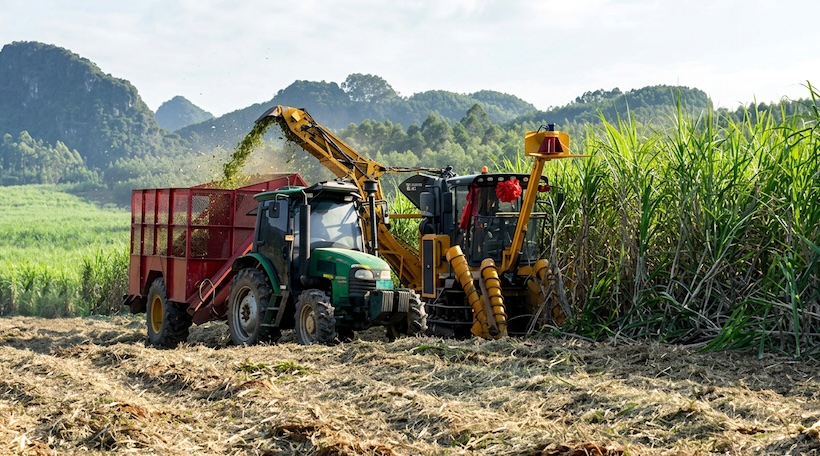
Yunnan’s mountainous geography makes mechanization fundamentally harder than on Guangxi’s gentler terrain. The province’s comprehensive mechanization rate for cane farming was approximately 42% in 2024/25, with **mechanized harvesting at 19%**—a major leap from just 5% in 2021, but still well behind Guangxi’s 72% and below the national 30% mechanized harvest target.
Component breakdown:
- Mechanized tilling: 60.54%
- Mechanized planting: 15.65%
- Mechanized inter-row cultivation/earthing: 24.57%
Yunnan’s equipment strategy emphasizes small, lightweight machinery suited to hillsides and irregular plots. The constraints are well-known: steep slopes and fragmented fields, mismatches between machinery and current cane varieties/agronomy, high purchase and maintenance costs, and farmer resistance to the trash deductions associated with mechanical harvesting.
These obstacles reflect a national pattern. In Guangxi, Yunnan, and Guangdong—the primary production regions—mechanization rates are below 6%, restricting yield improvements despite the adoption of high-sucrose varieties when measured at the harvest stage specifically.
Labor economics make this a strategic imperative. Cane sugar producers face challenges including labor shortages, limited mechanization, and competition from alternative crops, as the labor pool shrinks with younger generations migrating to urban areas, driving up labor costs.
5. Industry Structure: A Tiered, Differentiated Mill Landscape
Yunnan’s 52 operating mills break down into three clear tiers, each pursuing a distinct competitive strategy:
Large mills (32 facilities, ≥4,000 t/day capacity) dominate volume and lead the province’s circular-economy efforts. These plants integrate full-chain utilization of bagasse, molasses, and filter mud, and serve as the anchors for the eight main producing prefectures.
Mid-size mills (18 facilities, 2,000–4,000 t/day) trade scale for agility. They focus on regional markets and increasingly develop small-pack retail products and specialty sugars to capture margin where large players prefer commodity output.
Small mills (2 facilities, <2,000 t/day) survive through differentiation—running contract-farming arrangements to lock in feedstock and concentrating on premium brown sugar and specialty SKUs that commodity producers cannot match cost-effectively.
Outlook
Yunnan’s sugar industry is at an inflection point. Strong sucrose recovery, expanding cane acreage, and a rebound in 2025/26 crushing volumes confirm the province’s role as a strategic backstop for Chinese sugar self-sufficiency—policies to incentivize cane production in Guangxi and Yunnan, which together account for over 80% of China’s total sugar production, underpin national output stability.
But three challenges will define the next five years: closing the mechanization gap on rugged terrain, building genuine value-added depth beyond white sugar, and managing the growing dependence on cross-border cane from Myanmar and Laos. Cultivation in Guangxi and Yunnan faces pressure from urban expansion, and while Yunnan benefits from favorable rainfall and high-sucrose varieties, it also competes for arable land with coffee and rubber plantations that offer higher per-hectare returns—a reminder that sugarcane’s footing in southwest China is not guaranteed.
For an industry that touches one million Yunnan farmers and supplies a quarter of China’s cane sugar, those issues are not academic. They will determine whether Yunnan’s “second place” becomes a launchpad for premium, differentiated growth or a steady-state holding pattern.
*Data sources: Yunnan Sugar Association statistics; USDA Foreign Agricultural Service Sugar Annual and Semi-Annual Reports.
The YnSugar Perspective: Quality-Driven Competitive Advantage
At YnSugar, we view the province’s exceptional Commercial Cane Sugar (CCS) levels not just as a statistical win, but as Yunnan’s most sustainable competitive moat. While other regions focus on pure acreage expansion, Yunnan’s industry is defined by its superior extraction efficiency.
Our internal analysis of the 2024/25 and 2025/26 cycles confirms a pivotal trend: Yunnan has consistently maintained a recovery rate above 13.3%, systematically outperforming both Guangxi and the national baseline.
Analyst Note: Despite a slight dilution in the 2025/26 recovery rate (down to 13.11% due to record-breaking rainfall during the maturation phase), the sheer scale of cane volume—reaching 21 million tons—has pushed total output to a historic high.
Table: Yunnan Sugar Production & Efficiency Benchmarks (2022-2026)
| Season | Cane Crushed (10k Tons) | Sugar Produced (10k Tons) | Recovery Rate (%) | YnSugar Market Status |
| 2022/23 | 1,514.59 | 201.10 | 13.28% | Stable Growth |
| 2023/24 | 1,544.94 | 203.20 | 13.15% | Supply Resilience |
| 2024/25 | 1,806.30 | 241.88 | 13.39% | Efficiency Peak |
| 2025/26 (Est) | 2,100.00 | 275.22 | 13.11% | Volume Expansion |