This HFCS market analysis US China explores the diverging trajectories of the global sweetener industry as of 2026…
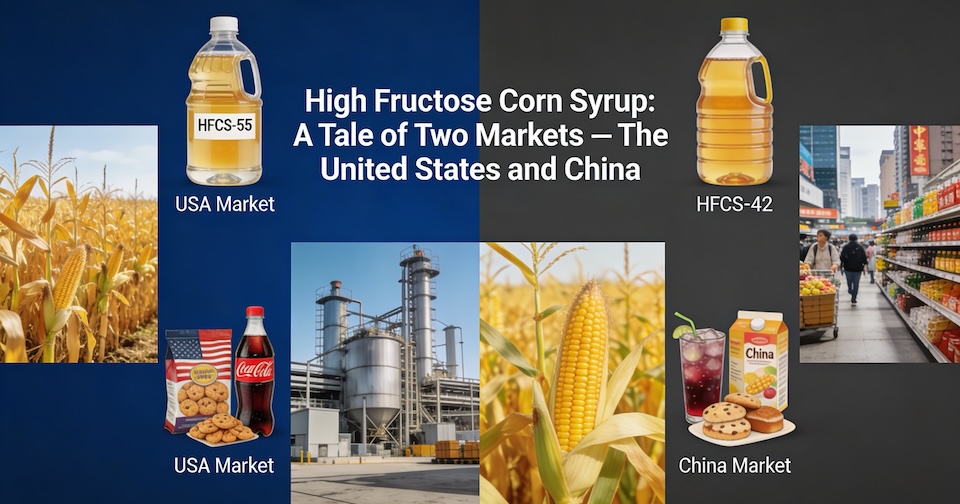
High fructose corn syrup (HFCS) is one of the most consequential sweeteners in modern food history. Born in American laboratories and now deeply embedded in Chinese supply chains, it tells a story of industrial ambition, dietary transformation, and shifting consumer values on opposite sides of the Pacific. As of 2025, these two markets are approaching the same crossroads from fundamentally different directions — one retreating under health-driven political pressure, the other still scaling for growth.
What Exactly Is HFCS?
HFCS is a liquid sweetener derived from corn starch. The starch is broken down into glucose by enzymes, then the corn syrup is further processed with the enzyme D-xylose isomerase to convert some of its glucose into fructose.HFCS was first marketed in the early 1970s by the Clinton Corn Processing Company, together with the Japanese Agency of Industrial Science and Technology, where the enzyme was discovered in 1965.
HFCS is 24% water, the rest being mainly fructose and glucose with 0–5% unprocessed glucose oligomers. The three commercial grades reflect different fructose loads and functional uses:
| Grade | Fructose Content | Relative Sweetness (sucrose = 100) | Primary Applications |
|---|---|---|---|
| HFCS-42 | 42% | ~90 | Baked goods, cereals, canned foods, condiments |
| HFCS-55 | 55% | ~100–110 | Carbonated soft drinks, fruit beverages |
| HFCS-90 | 90% | ~150–170 | Blended down to produce HFCS-55; niche uses |
In spite of having a 10% greater fructose content, the relative sweetness of HFCS 55, used most commonly in soft drinks, is comparable to that of sucrose. HFCS provides advantages in food and beverage manufacturing, such as simplicity of formulation, stability, and enabling processing efficiencies.
The American Story: Pioneer, Peak, and Pushback
Rise to Dominance
The United States commercialized HFCS through the 1970s, and the tipping point came in the mid-1980s. Faced with rising sugar prices, prompted in part by U.S. government quotas and tariffs on imported sugar alongside growing subsidies for domestic corn, Coca-Cola began blending corn syrup with sugar in its beverages. The transition was complete by 1984.Within a decade, HFCS had become one of America’s three primary sugar sources.
Factors contributing to the increased use of HFCS in food manufacturing include production quotas of domestic sugar, import tariffs on foreign sugar, and subsidies of U.S. corn, raising the price of sucrose and reducing that of HFCS, creating a manufacturing-cost advantage among sweetener applications.
The Long Decline
Per capita high-fructose corn syrup (HFCS) deliveries fell to 39.5 pounds, with HFCS deliveries steadily decreasing since topping out at 65.9 pounds in 1999, driving the long-term decline in total sweetener deliveries.Forecast HFCS consumption in the US is 36.75 pounds for 2024, gradually decreasing each year to 33.77 pounds by 2028, with a consistent decline of around 2% annually from 2024 through 2028.
U.S. HFCS Per Capita Consumption Trajectory
| Year | Per Capita Consumption (lbs) | Change vs. 1999 Peak |
|---|---|---|
| 1999 (peak) | 65.9 | — |
| 2018 | 37.7 | −43% |
| 2021 | 39.5 | −40% |
| 2024 (forecast) | 36.75 | −44% |
| 2028 (forecast) | 33.77 | −49% |
The U.S. per capita consumption of high fructose corn syrup amounted to 37.7 pounds in 2018.Despite the long decline, U.S. production remains enormous: in 2022 the United States produced an estimated 7.5 million short tons of high fructose corn syrup (HFCS), with production down from a high in the late 2000s and early 2010s, and output dropping about 740,000 short tons compared to 2017.
The Structural Advantage: Corn Subsidies and Sugar Tariffs
According to the EWG Farm Subsidy Record, corn subsidies in the United States totaled USD 116.6 billion from 1995–2020.In the United States, corn subsidies—reported around $4 billion in 2021—favor starch-based sweeteners like HFCS, improving cost competitiveness against sugar.U.S. farm policy—shaped by the farm lobby—subsidizes corn heavily and imposes tariffs and quotas on imported sugar, making high fructose corn syrup the default sweetener for many U.S. food producers.
Health Controversy and the MAHA Moment
The scientific debate over HFCS versus sucrose remains largely unresolved. “The American Medical Association has confirmed that HFCS is no more likely to contribute to obesity than table sugar or other full-calorie sweeteners.” “Please be assured that Coca-Cola brand soft drinks do not contain any harmful substances.”Dr. Dariush Mozaffarian, a cardiologist and director of the Food is Medicine Institute at the Friedman School of Nutrition Science and Policy at Tufts University, said ‘Both high-fructose corn syrup and cane sugar are about 50% fructose, 50% glucose, and have identical metabolic effects.’ That is, both can equally raise the risk for obesity, diabetes, and high triglycerides and blood pressure.
The political calculus shifted dramatically in 2025. President Trump launched Make America Healthy Again in February 2025. In July 2025, he ordered Coca-Cola to replace high-fructose corn syrup (HFCS) with cane sugar in their beverages.Coca-Cola will soon return to using real cane sugar in its U.S. products after decades of relying on high fructose corn syrup, according to President Donald Trump, who claimed personal credit for brokering the shift.
“We’re going to be bringing a Coke sweetened with U.S. cane sugar into the market this fall,” Coca-Cola Chairman and CEO James Quincey said on a conference call with analysts. The company announced the change in the quarterly earnings report it released Tuesday, describing the new drink as an expansion of its product line.Critically, this was an addition — not a replacement — of the flagship HFCS formula.
The corn lobby pushed back hard. Corn Refiners Association President and CEO John Bode predicts that an increase in using U.S. cane sugar will lead to a rise in foreign cane sugar imports. Bode said, “Replacing high fructose corn syrup with cane sugar would cost thousands of American food manufacturing jobs, depress farm income, and expand the trade deficit.””The immediate impact on corn prices, nationally, would be 15-to-34 cents per bushel, a devastating blow to American agriculture. And, once again, this tweet was talking about cane sugar, so there’s not any consolation for the beet growers,” said Bode.
The economic cost of a broader switch would be significant. Analysts say swapping high-fructose corn syrup for cane sugar would be expensive and complicated. The move could cost the beverage industry over $1 billion, disrupt supply chains, and hurt corn growers who rely on syrup production for revenue. With the U.S. producing far less cane sugar than it consumes, companies may need to import from countries like Brazil, currently facing steep tariffs.
The Chinese Story: Late Starter, Fast Mover
Building Scale
China entered the HFCS industry decades after the U.S. but scaled at remarkable speed, leveraging its massive domestic corn supply. HFCS in China makes up about 20% of sweetener demand. HFCS has gained popularity due to rising prices of sucrose, while selling for a third the price.In China, challenges in domestic sugar production are paving the way for a heightened demand for HFCS, especially as the market for processed foods expands.
Production costs remain the core driver. Corn syrup is increasingly popular in China because it is less expensive than natural sugar generated from sugarcane or sugar beets by around one-third.
Penetration Across Beverage Categories
According to the USDA, almost 90% of HFCS produced in the United States is marketed to the beverage industry.A similar pattern dominates China’s beverage landscape, where HFCS has become the default sweetener across most major categories.
HFCS Application Breakdown — Global and Regional
| Application Metric | Global / Country | Share |
|---|---|---|
| HFCS share of total liquid sweetener consumption | Global | ~42% |
| HFCS-55 share of carbonated beverages | Global | ~85% |
| HFCS-42 share of bakery applications | Global | ~70% |
| HFCS share of U.S. beverage caloric sweeteners | USA | ~60% |
| U.S. soft-drink manufacturers using HFCS-55 as primary sweetener | USA | >95% |
| HFCS-55 beverage segment market share (by value) | Global | 46.57% (2024) |
| HFCS share of China’s overall sweetener demand | China | ~20% |
Strategic Upgrade: The Crystalline Fructose Frontier
China’s HFCS industry is actively moving up the value chain. In November 2024, Cargill announced a $75 million investment to expand its corn wet milling facility in Dayton, Ohio, adding 150,000 tons of annual high fructose corn syrup production capacity to meet growing North American beverage industry demand and strengthen supply chain resilience.Similar capacity investments are underway in Chinese production hubs, where major producers — including COFCO, Xiwang Group, Yihai Kerry, and Zhucheng Xingmao — are expanding both commodity HFCS and higher-margin derivatives such as crystalline fructose and allulose.
In September 2024, Tate & Lyle launched DOLCIA PRIMA Crystalline Allulose, a next-generation rare sugar produced through enzymatic conversion of corn starch, offering 70% fewer calories than sugar while maintaining similar taste.
Global Market: Size, Growth, and Regional Shifts
Forecasts from leading research houses diverge widely depending on methodology, but all agree on two trends: steady single-digit growth and a clear shift in the center of gravity toward Asia-Pacific.
Global HFCS Market — Forecast Range (2024–2034)
| Research Source | 2024/25 Value | Forecast Year | Forecast Value | CAGR |
|---|---|---|---|---|
| Market Data Forecast | $5.69B (2024) | 2033 | $8.36B | 4.36% |
| Global Growth Insights | $6.1B (2024) | 2034 | $8.58B | 3.46% |
| Zion Market Research | $9.73B (2024) | 2034 | $12.04B | 2.3% |
| Expert Market Research | $9.08B (2025) | 2035 | $10.64B | 1.60% |
| Coherent Market Insights | $9.40B (2025) | 2032 | $10.80B | 2.0% |
| Mordor Intelligence (Research & Markets) | $9.46B (2025) | 2030 | $10.25B | 1.62% |
Regional Market Structure
North America holds the largest market share at 37.37% in 2025, supported by established corn processing infrastructure and beverage industry concentration, though growth moderates as health consciousness and regulatory scrutiny intensify across mature markets. Asia Pacific emerges as the fastest-growing region at 5.03% CAGR through 2031, led by China’s increasing HFCS consumption as domestic sugar production challenges and processed food market expansion create substitution opportunities.
North America is expected to retain its leading position in the global High Fructose Corn Syrup Market, accounting for 41.7% of total market revenue in 2025. This regional dominance is supported by a well-established food processing industry, high consumption of sweetened beverages, and a strong supply chain of corn-based sweeteners. In the United States, the historical preference for HFCS in sodas and snacks continues to fuel demand.
The Mexico Counter-Example
Mexico illustrates how quickly “health-driven” trends can reverse when supply economics shift. Mexico’s HFCS consumption reached 1.599 million metric tons in 2025, the highest since 2011/12, demonstrating how supply disruptions in traditional sweetener markets accelerate HFCS adoption. According to data from the USDA, the import forecast for MY 2022/23 is 876,000 metric tons for Mexico, which is expected to climb to 900,000 metric tons in MY 2023/24. As of February 2024, Mexico imported 379,724 metric tons of dry weight HFCS, which is 10 percent higher than in MY 2022/23.
Side-by-Side: The U.S. and China Compared
| Dimension | United States | China |
|---|---|---|
| Commercial launch | Early 1970s (Clinton Corn Processing Company with Japanese AIST); sucrose displaced by 1984 | Late 1990s–early 2000s; rapid expansion post-2010 |
| Production scale | ~7.5M short tons (2022); ~70% of global output | ~8M+ metric tons capacity; among world’s largest |
| Per capita trend | Peak 65.9 lbs (1999); forecast 36.75 lbs (2024) | Rising; supported by processed food and beverage expansion |
| Dominant grade | HFCS-55 ~40% of market; used in >95% of U.S. soft drinks | HFCS-42 and HFCS-55 both widely used |
| Key applications | ~90% goes to beverages; bakery, condiments | Carbonated drinks, bottled tea, sports drinks, juices, bakery |
| Policy environment | Corn subsidies ($116.6B, 1995–2020); MAHA backlash 2025 | Government-supportive; SOE-led capacity investment |
| Regulatory status | FDA-classified GRAS; increasing scrutiny | Classified as food raw material; lower labeling friction |
| Strategic direction | Partial return to cane sugar; clean-label reformulation | Scaling higher-value derivatives (crystalline fructose, allulose) |
Industry Structure: The Global Players
The HFCS market is moderately concentrated, with a handful of multinational agribusinesses dominating global capacity. The high fructose corn syrup market remains fragmented, with a concentration score of 3 out of 10, indicating significant opportunities for market share growth despite major players controlling a large portion of production capacity. Key participants, including Cargill, ADM, and Ingredion, are implementing distinct strategies. ADM is shifting its focus from HFCS production to sustainable alternatives, while Ingredion continues to perform strongly.
Leading players in the global HFCS market include Japan Corn Starch Co., Archer Daniels Midland Company, Cargill Incorporated, Tate & Lyle PLC, Showa Sangyo Co, Ltd., Global Sweeteners Holding Limited, COFCO International, Kerry Group Plc, Ingredion Incorporated, and Roquette, among others.
Capacity investment is ongoing on both sides of the Pacific. In May 2025, Archer Daniels Midland Company (ADM) announced the expansion of its HFCS production capacity in the U.S. Midwest to meet growing demand from the food and beverage industry. This facility upgrade focuses on improving production efficiency and reducing environmental impact.
The Health Debate in Context
The long-running scientific debate over HFCS focuses on how fructose is metabolized compared with glucose. The digestion, absorption, and metabolism of fructose differ from those of glucose. Hepatic metabolism of fructose favors de novo lipogenesis. In addition, unlike glucose, fructose does not stimulate insulin secretion or enhance leptin production. Because insulin and leptin act as key afferent signals in the regulation of food intake and body weight, this suggests that dietary fructose may contribute to increased energy intake and weight gain.
Mainstream regulators remain unmoved. The United States Food and Drug Administration (FDA) states that it is not aware of evidence showing that HFCS is less safe than traditional sweeteners such as sucrose and honey. Yet public perception is a separate matter, and it drives reformulation decisions regardless of the underlying science. While Americans’ high sugar intake is a major contributor to nearly three-quarters of the population being overweight or obese, there is currently no scientific consensus to suggest high-fructose corn syrup is less healthy than cane sugar or other sweeteners.
Convergence and Divergence
The arc of HFCS in the U.S. and China reveals two fundamentally different industrial logics. The U.S. is navigating a post-peak transition — managing the tension between entrenched food-manufacturing infrastructure and a consumer base (now reinforced by direct presidential pressure) demanding cleaner labels and natural ingredients. China, by contrast, is still in an expansionary phase, focused on scale, cost efficiency, and strategic upgrading toward higher-value fructose derivatives.
What both markets share is a growing recognition that the era of unrestricted HFCS growth is over. In the U.S., health movements and political pressure are reshaping formulation decisions — though, as Coca-Cola’s 2025 “cane sugar addition, not replacement” demonstrates, the structural economics of HFCS remain formidable. In China, the push toward crystalline fructose and allulose reflects an awareness that tomorrow’s competitive advantage lies in product quality and functional differentiation, not volume alone.
The world’s two largest HFCS markets are approaching the same crossroads from opposite directions. Their choices — shaped as much by politics, agricultural policy, and tariff regimes as by science or consumer preference — will shape the global sweetener industry for decades to come.
Disclaimer: This article is intended for professional industry analysis and informational purposes only and does not constitute financial or investment advice. The market data, historical statistics, and forecasts (including those from USDA, Mordor Intelligence, and other third-party researchers) are cited for comparative study. While we endeavor to provide accurate and up-to-date information, ynsugar.com makes no warranties regarding the absolute completeness or future accuracy of these projections. Policy-related discussions, such as the “MAHA” initiative, reflect public reporting and should not be interpreted as the platform’s endorsement or political stance.