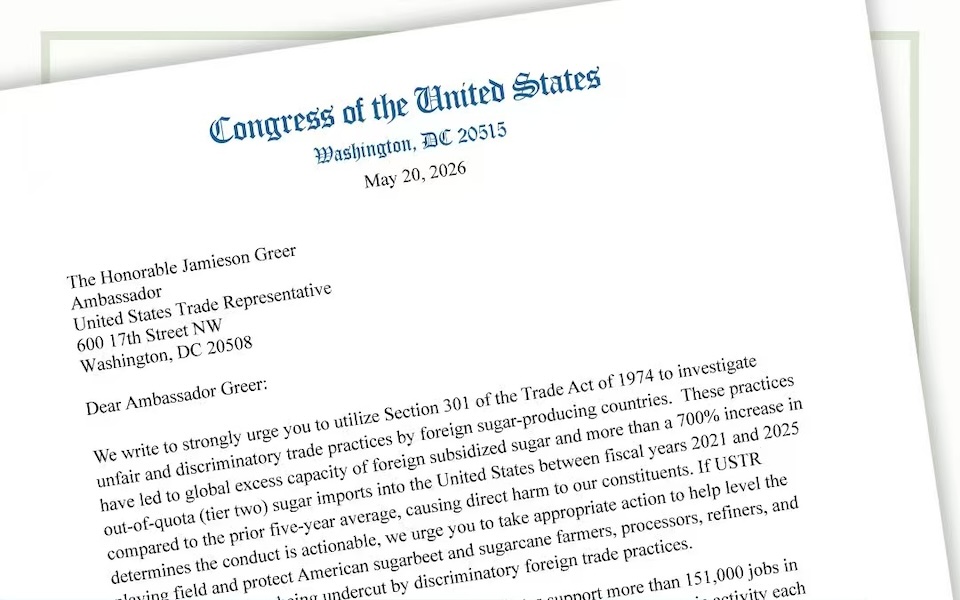
May 2026 — A major political storm has hit the domestic US sugar industry Section 301 trade policy framework. In a massive bipartisan and bicameral show of force, more than 110 members of Congress signed a formal letter on May 20, 2026, urging U.S. Trade Representative (USTR) Ambassador Jamieson Greer to immediately launch a formal Section 301 investigation into foreign sugar subsidies.
The lawmakers argue that unfair, heavily subsidized, and discriminatory trade practices by foreign producing nations are actively dismantling the American sugar production infrastructure.
🏛️ The Congressional Letter and Who Signed It
The aggressive trade push was jointly spearheaded by Senators John Hoeven (R-N.D.) and Elissa Slotkin (D-Mich.), alongside Representatives Julie Fedorchak (R-N.D.) and Troy Carter (D-La.). They were joined by 108 of their congressional colleagues spanning both legislative chambers and both political parties.
The coalition officially invoked Section 301 of the Trade Act of 1974, a powerful statutory enforcement mechanism that grants the USTR broad authority to investigate and retaliate against foreign government actions that burden or restrict U.S. commerce.
This historic legislative intervention has been publicly endorsed by nearly 30 prominent agricultural trade groups, including:
-
The American Sugar Alliance (ASA)
-
The American Farm Bureau Federation (AFBF)
-
The National Farmers Union (NFU)
-
Florida Crystals Corporation
🚨 The Core Complaint: A 700% Surge in Over-Quota Imports
At the center of the sudden congressional alarm is a severe structural imbalance regarding over-quota sugar imports entering the United States. The official letter highlights that over-quota (Tier 2) sugar imports surged by more than 700% between fiscal years 2021 and 2025, compared to the running average of the prior five-year window.
This massive influx has been directly attributed to an outdated regulatory loophole. The U.S. Tier 2 tariff rate—the primary duty structure designed to insulate domestic family farms from heavily subsidized foreign dumping—has not been adjusted or updated in 26 years. This stagnation renders the tariff completely toothless against modern global market manipulation.
The American Sugar Alliance has steadily escalated its market warnings since early April 2026, when it submitted formal documentation to the USTR proving that foreign regimes are exploiting these archaic tariff lines. ASA Chief Economist Dr. Rob Johansson testified before trade officials that domestic sugar processors and farmers have suffered up to $3 billion in lost revenue over just the past two seasons due to the uncontrolled over-quota influx.
📉 Industrial Damage: Disappearing U.S. Sugar Regions
The congressional letter outlines a grim geographical timeline of agricultural decline, mapping out regions where local processing facilities and fields have been permanently forced out of business by foreign trade distortions:
-
Hawaii: Commercial sugarcane farming ceased entirely in 2016, wiping out a multi-century agricultural tradition.
-
Texas: The state’s final remaining sugarcane milling operations shut down indefinitely in 2024.
-
California: Commercial sugarbeet farming was completely lost by 2025 due to factory closures.
Nationally, approximately 14% of American beet sugar processing plants and 12% of cane sugar mills and refineries have permanently shut their doors over the past decade.
“We cannot afford to outsource our family farms, factory jobs, and strategic food security to foreign nations who do not play by the rules,” warned Stephen Simoneaux, a fifth-generation sugarcane grower based in Louisiana.
📊 U.S. Sugar Production and Import Historical Data
The following verified supply balance tracking illustrates the true baseline of the American market, compiled utilizing data from the USDA Economic Research Service (ERS) Sugar and Sweeteners Outlook reports (measured in Million Short Tons, Raw Value – M STRV):
| Fiscal Year | Domestic Sugar Production (M STRV) | Total Sugar Imports (M STRV) |
| 2015/16 | 8.99 | 3.13 |
| 2016/17 | 9.31 | 3.26 |
| 2017/18 | 9.29 | 3.28 |
| 2018/19 | 8.99 | 3.07 |
| 2019/20 | 8.15 | 4.16 |
| 2020/21 | 9.23 | 3.22 |
| 2021/22 | 9.15 | 3.65 |
| 2022/23 | 9.25 | 3.61 |
| 2023/24 | 9.22 | 3.82 |
| 2024/25 | 9.35 | 3.59 |
| 2025/26 (Forecast) | 9.18 | 3.42 |
🔮 Forward Outlook: The Political Window for Action
The timing of this unified congressional push is highly strategic. The Trump administration has maintained an aggressive, enforcement-first posture on global trade barriers. With the USTR having already initiated multiple high-profile trade actions in early 2026, sugar trade advocates are banking on a parallel federal probe specifically targeting state-subsidized sugar supply chains radiating out of Brazil, India, Thailand, and Mexico.
Furthermore, lawmakers cited recent peer-reviewed economic research published in the Journal of Agricultural and Applied Economics proving that retail grocery prices for sugar-sweetened foods are not fundamentally dictated by the raw cost of domestic sugar. This economic evidence provides substantial political insulation, effectively dismantling the food manufacturing lobby’s argument that defending domestic sugar farmers would stoke grocery inflation.
While Ambassador Jamieson Greer and the USTR have yet to issue a final mandate opening a formal sugar-specific trade investigation, the sheer size of this bipartisan coalition ensures that the future structure of U.S. sugar import quotas and Tier 2 tariff walls will remain a critical focus for international trade desks throughout 2026.
🗃️ Data Sources
Background documentation and trade data compiled from the official congressional joint petition addressed to the Office of the United States Trade Representative (USTR), alongside historical market data extracted from the USDA Economic Research Service (ERS) Sugar and Sweeteners database updates, current as of May 2026.
Disclaimer: The trade data, legal references, and political analyses presented in this article are synthesized from public congressional records, official trade group announcements, and historical data provided by the United States Department of Agriculture (USDA). This content is published strictly for general informational, educational, and macroeconomic reporting purposes and does not constitute financial, legal, or commodity trading advice. ynsugar.com assumes no liability for commercial positions or supply-chain strategies formulated based on the public trade policy data presented herein.