Abstract
Over the past fifteen years, the China-Laos borderlands have undergone a paradigmatic transformation from peripheral zones of illicit agriculture to a state-orchestrated economic corridor anchored by sugarcane. This paper traces the full arc of the bilateral sugarcane trade from 2011 to 2026, situating its origins in the Opium Replacement Program (ORP) launched formally in 2004 under China’s “Going Out” policy. Drawing on longitudinal customs data from the General Administration of Customs of the People’s Republic of China, USDA attaché reports, corporate case studies, and secondary literature on agrarian transformation in mainland Southeast Asia, this study identifies three distinct phases of institutional evolution: decentralized contract farming (2004–2015), rapid scaling and formalization (2016–2022), and the emergence of a mature “Border-Industrial Complex” (2023–present). Critically, the analysis reveals a dual-modal logistics reality: while the China-Laos Railway has transported over 81.5 million tons of aggregate freight by April 2026, sugarcane remains exclusively dependent on point-to-point road transport through dedicated border checkpoints such as Mengman and Manzhuang. Furthermore, by examining the operations of specific Yunnan-based sugar enterprises — whose investments now sustain the livelihoods of tens of thousands of Lao households — this paper conceptualizes the trade as a hyper-localized strategic buffer for structurally deficit sugar economy, one whose implications extend far beyond commodity exchange into the realm of cross-border development cooperation, rural poverty alleviation, and shared prosperity.
Keywords: China-Laos relations; sugarcane trade; Opium Replacement Program; border trade; China-Laos Railway; sugar security; cross-border agriculture; Yunnan; development cooperation
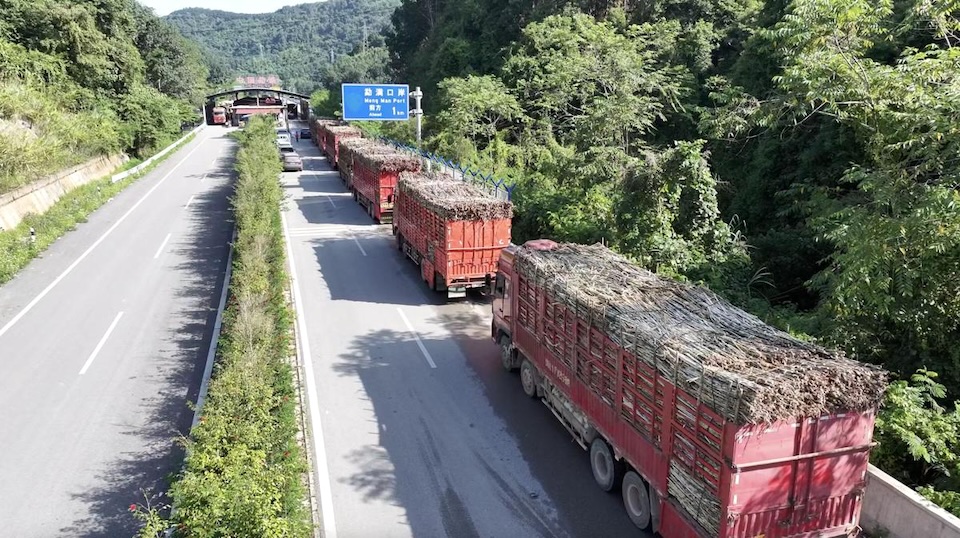
[Photo by Li Yang/for chinadaily]
1. Introduction
The mountainous borderlands separating China’s Yunnan Province from the northern provinces of the Lao People’s Democratic Republic have long occupied a distinctive position in the political geography of both nations. For much of the twentieth century, these regions remained geographically isolated and economically marginalized, with livelihoods in the highlands heavily dependent on opium cultivation. Yet since the early 2000s, a fundamental and deliberate reconfiguration has begun. One central pillar of this reconfiguration has been China’s Opium Replacement Program (ORP), a set of policy supports for outbound Chinese agricultural investment in northern Laos and Myanmar designed to accelerate the transition away from illicit agriculture toward sustainable commercial farming. As Chinese authorities articulated, the goal was to create “a brand new harmonious and drugless Golden Triangle” through development-led transformation (Kramer & Woods, 2012).
Within this broader transformation, sugarcane has emerged as a uniquely strategic crop. Unlike rubber — the ORP’s other flagship commodity — sugarcane offers immediate annual returns and requires relatively low upfront capital, making it accessible to smallholders across the highland communities of northern Laos. Sugarcane’s production characteristics are particularly well-suited for livelihood transition: it tolerates extensive cultivation on upland slopes, yields returns in its first year, and possesses ratoon properties allowing four to five consecutive harvests from a single planting, generating annual income of 9,000–15,000 RMB per hectare — incomes that provide genuine economic alternatives for former poppy-cultivating households.
This paper argues that the China-Laos sugarcane trade has evolved from an ad-hoc substitution initiative into a formalized “Border-Industrial Complex” — a term we use to describe the deep structural integration between Chinese sugar-processing capacity and Lao agricultural land and labor, underpinned by bilateral policy frameworks and infrastructure investment. The argument proceeds in five parts. Section 2 provides the historical and policy context, tracing the ORP’s evolution from local experiments to national program. Section 3 presents quantitative trade data and identifies key inflection points in the bilateral commodity flow. Section 4 examines the logistics architecture, with particular attention to the paradoxical relationship between the China-Laos Railway and sugarcane transport. Section 5 analyzes the micro-level dynamics of corporate integration and its transformative implications for Lao rural livelihoods and China’s sugar security. Section 6 discusses the policy framework, including tariff architecture and the geopolitical significance of the trade as a strategic buffer. Section 7 assesses the future trajectory.
2. Historical and Policy Origins: The Opium Replacement Program
2.1 From Local Experiments to National Policy (1990s–2006)
Chinese authorities initiated crop-substitution efforts as part of their formal narcotics-control toolkit starting in the early 1990s, targeting the ethnic armed group territories of northern Myanmar and the borderlands of northern Laos. The first wave consisted of small-scale experiments undertaken by border counties in cooperation with neighboring communities. These early experiments were driven primarily by local initiative from border prefectures in Yunnan such as Xishuangbanna and Pu’er, which recognized that sustainable narcotics control required not merely interdiction but the provision of viable economic alternatives.
Central authorities consolidated and formalized these efforts with a 2006 order that authorized a comprehensive series of regulatory supports, administered by Yunnan Province and funded substantially by the Chinese central government. Most important was the provision of tax exemptions and import quotas, which created legal importation routes for replacement crops including rice, corn, and sugarcane — ensuring that the economic outputs of the substitution program could access Chinese markets through formal channels rather than informal border trade.
2.2 Scaling and Strategic Formalization (2006–2015)
Launched in 2004 in the wake of China’s “Going Out” policy, the ORP combined subsidies, tax breaks, import quotas, and policy directives aimed at facilitating the extension of China-bound crop production into the uplands of northern Laos and Myanmar’s Shan and Kachin states. It focused on a range of cash crops — predominantly rubber and maize, but also rice, sugarcane, sesame, and other products — integrating neighborly development cooperation with commercial investment and a range of domestic Chinese policy objectives related to public health, border security, and regional poverty alleviation.
By 2012, the program had expanded dramatically in both scale and ambition. Almost 200 Chinese companies had become involved in efforts to provide farmers in the Golden Triangle with sustainable alternatives to growing opium poppies. Since 2005, the number of companies investing labor and techniques into alternative crops rose from 42 to 180, with total financial investment exceeding 1 billion yuan. Sugarcane occupied a particularly important niche within this ecosystem. Chinese sugar enterprises cooperated with Lao border villages to develop contiguous sugarcane production bases through direct investment, providing seeds, seedlings, fertilizers, and pesticides, dispatching technicians to train Lao farmers in modern cultivation techniques, and committing to purchase all harvested cane at guaranteed prices — a contract-farming model that offered unprecedented income stability to highland communities.
2.3 The Bilateral Development Framework
The ORP’s success in the sugarcane sector was reinforced by the broader bilateral relationship between China and Laos, which deepened significantly through the 2010s. The two countries formalized a “Comprehensive Strategic Partnership of Cooperation” and increasingly framed their economic ties through the lens of the Belt and Road Initiative (BRI) and the concept of a “China-Laos Community of Shared Destiny” . Within this framework, cross-border agricultural cooperation — including sugarcane — was elevated from a local border initiative to a component of national development strategy, with both governments recognizing its dual function: narcotics control and poverty alleviation on the Lao side, and sugar supply security on the Chinese side. The Lao government at both national and provincial levels provided strong support, granting land concessions, facilitating labor access, and publicly recognizing leading Chinese sugar enterprises as “pioneer enterprises in opium replacement planting.”
3. Quantitative Analysis: Trade Volumes and Structural Shifts (2015–2026)
3.1 Macro-level Trade Data
China’s sugarcane imports have grown substantially over the past decade, with Laos serving as a consistently major source. The following table, compiled from China Customs data, illustrates this trajectory across eleven years:
Table 1: China’s Sugarcane Imports from Laos (2015–2026)
(Source: General Administration of Customs, PRC)
| Year | Total China Imports (10k tons) | Imports from Laos (10k tons) | Share of Lao Cane (%) |
|---|---|---|---|
| 2015 | 105.41 | 24.30 | 23.05% |
| 2016 | 80.70 | 21.14 | 26.20% |
| 2017 | 98.59 | 31.98 | 32.44% |
| 2018 | 118.40 | 48.74 | 41.17% |
| 2019 | 141.62 | 60.07 | 42.42% |
| 2020 | 170.55 | 78.51 | 46.03% |
| 2021 | 177.00 | 116.10 | 65.59% |
| 2022 | 215.04 | 109.89 | 51.10% |
| 2023 | 190.90 | 117.88 | 61.75% |
| 2024 | 298.41 | 143.45 | 48.07% |
| 2025 | 359.07 | 117.03 | 32.59% |
| 2026 (Jan–Feb) | 153.32 | 44.31 | 28.90% |
Several features of this data warrant careful analysis. First, the absolute volume of Lao sugarcane entering China has grown dramatically over the period, rising nearly sixfold from approximately 243,000 tons in 2015 to a peak of over 1.43 million tons in 2024. This expansion reflects both the maturation of the ORP-era planting bases and successive improvements in cross-border logistics infrastructure. Second, the trade shows a clear inflection point around 2018–2019, when Laos’ share of China’s total sugarcane imports broke above 40% and absolute volumes began accelerating rapidly — a period corresponding to the intensification of bilateral development cooperation under the BRI framework.
Third, the data reveals an important structural development in 2024–2026: while Laos’ share of total imports has declined from its 2021 peak of 65.59% to 28.90% in early 2026, this does not reflect an absolute contraction of Lao exports but rather a significant diversification of China’s import sources. Myanmar’s sugarcane exports to Yunnan have surged in this period, with the USDA reporting that in Marketing Year 2024/25, Yunnan imported 2.34 million metric tons of sugarcane with 54% sourced from Myanmar and 44% from Laos. This diversification represents a deliberate strategic choice by Chinese policymakers to broaden supply channels and reduce concentration risk, while maintaining Laos as a core supply partner. Fourth, China’s total import volume continues to expand robustly: by the end of MY 2024/25, Yunnan was estimated to import over 3.8 million metric tons of cane, and in MY 2025/26, the USDA projects that Yunnan will import approximately 5 million metric tons of sugarcane — reflecting the deepening integration of cross-border agricultural supply chains.
3.2 The Structural Deficit Driving Imports
These imports must be understood within the context of China’s structural sugar supply-demand balance. As of the latest 2026 analysis, China stands as the world’s second-largest consumer of sugar, with annual consumption of approximately 15 million tons, and its third-largest producer, with domestic output reaching approximately 11 million tons. The inherent gap of roughly 4 million tons between annual domestic consumption and production is the central dynamic of the Chinese sugar market. This structural deficit is managed through a sophisticated combination of strategic imports, releases from state reserves, and domestic production support policies.
The concentration of domestic production in two provinces adds a geographic dimension to this challenge. Guangxi and Yunnan together account for over 80% of China’s total sugar production. In 2024, China’s sugarcane planting area was 1,277,000 hectares, with total production of 102.09 million tons of sugarcane against industrial demand of 105.08 million tons. Cross-border sugarcane from Laos and Myanmar thus serves a critical complementary function — supplementing domestic production in the very province (Yunnan) where processing capacity is concentrated, while reducing pressure on Guangxi’s already heavily utilized farmland.
The concentration of domestic production in two provinces adds a geographic dimension to this challenge. Guangxi and Yunnan together account for over 80% of China’s total sugar production. In 2024, China’s sugarcane planting area was 1,277,000 hectares, with total production of 102.09 million tons of sugarcane against industrial demand of 105.08 million tons. Cross-border sugarcane from Laos and Myanmar thus serves a critical complementary function — supplementing domestic production in the very province (Yunnan) where processing capacity is concentrated, while reducing pressure on Guangxi’s already heavily utilized farmland.
While cross-border raw cane imports buffer provincial crushing capacities in Yunnan, China’s macro-regional supply security remains heavily dependent on oceanic refined flows. For a systemic analysis of GACC customs arrivals, tumbling CIF landing margins, and single-source concentration risks, review our comprehensive benchmark asset:
China Sugar Import Report 2025–2026: Volume, Price, Origins & Provincial Breakdown
.
3.3 Import Value Growth: The CAGR Perspective
The value dimension of the trade further underscores its significance. Myanmar (approximately 1.5 million tons) and Laos (approximately 1.4 million tons) were the main suppliers of sugarcane imports to China in 2024. From 2013 to 2024, the highest compound annual growth rate among major suppliers was recorded for Laos, at +17.9% in volume terms. In value terms, the largest sugarcane suppliers in 2024 were Myanmar (approximately $99 million) and Laos (approximately $79 million), with Laos recording a CAGR of +16.9% in import value — the highest sustained value growth rate among all source countries. This consistent double-digit growth over more than a decade demonstrates the resilience and structural depth of the China-Laos sugarcane partnership.
4. Logistics Architecture: The Railway Paradox and Road Dependency
4.1 The China-Laos Railway: A Transformative Infrastructure Achievement
The China-Laos Railway, which opened on December 3, 2021, represents one of the most significant infrastructure achievements in the bilateral relationship and a flagship project of the Belt and Road Initiative. As of April 12, 2026, the railway had cumulatively transported over 81.5 million tons of freight and carried more than 70.7 million passengers since its inauguration. The growth trajectory has been remarkably steep: in 2025, the railway transported 24.48 million tons of cargo, representing a 96.3% increase over 2022’s 12.47 million tons. In the first quarter of 2026 alone, the railway handled 6.18 million tons of cargo, including 1.5 million tons of cross-border goods.
The railway’s operational capacity has expanded continuously since opening. Cross-border freight trains increased from an initial 2 per day to 18 per day, with traction tonnage rising from 2,000 to 2,500 tons per train. Customs clearance times at Mohan railway port have been compressed by over 60% for imports and over 90% for exports through intelligent infrastructure upgrades, including smart scanning systems and paperless declaration platforms. Cross-border transport now covers 31 provinces within China and extends to 19 countries and regions, with over 3,000 commodity categories transiting the line. The railway has thus become the backbone of the China-Laos economic corridor, dramatically reducing transport times and costs for a vast array of goods.
4.2 The Sugarcane Exception: Why Point-to-Point Road Transport Persists
Despite the railway’s transformative impact on regional trade, sugarcane remains 100% reliant on road transport. This is not an infrastructure gap but a structural necessity rooted in the commodity’s physical characteristics. Sugarcane is a highly perishable, bulky commodity with an extremely low value-to-weight ratio. Once cut, sugar content begins degrading immediately — industry standards require field-to-mill delivery within 24 to 48 hours to maintain optimal sucrose levels. Railway transshipment — involving loading at a Lao-side station, rail transit, unloading at a Chinese-side station, and re-loading onto trucks for final mill delivery — would introduce unacceptable delays and mechanical damage to the cane stalks, directly reducing sugar recovery rates.
The scale of this road-based operation is enormous. For the 2025/26 crushing season, running from approximately October 29, 2025 through April 2026, an estimated 930,000 tons of sugarcane were projected to enter China through Mengman Port alone, representing a 12% increase from the previous season, with projected industrial output value of 620 million yuan. For the 2024/25 season, over 1.4 million tons of sugarcane entered through three primary border crossings — Mengman Port, Manzhuang Passage, and Xinmin Passage — with the Mohan border checkpoint processing over 70,000 truck passages carrying 1.33 million tons of cane, generating over 840 million yuan in revenue for local sugar enterprises.
4.3 The “Spillover Effect”: How Rail Liberates Roads
The railway’s contribution to sugarcane logistics is thus indirect but profoundly significant. By absorbing the macro-regional freight that previously competed for highway capacity — processed foods, electronics, tropical fruits, manufactured goods, mineral products — the railway has effectively liberated the road networks for concentrated agricultural use during the critical October-to-April crushing season. This “spillover effect” is the key mechanism through which rail infrastructure supports the sugarcane trade without directly carrying a single ton of cane. Before the railway’s opening, the same highways now dedicated to sugarcane trucks during crushing season were congested with general cargo traffic, causing delays and bottlenecks at border checkpoints. The railway’s absorption of over 24 million tons of freight annually has fundamentally eased this constraint, enabling faster and more reliable sugarcane delivery times that directly benefit both mill efficiency and farmer income.
5. The Border-Industrial Complex: Corporate Integration and Rural Transformation
5.1 The Enterprise Model: A Leading Sugar Group as Archetype
A leading sugar group in Yunnan, established in 2007, stands as the region’s largest enterprise in the sector and serves as the archetypal case of this model. The company operates with a daily sugarcane processing capacity of 51,500 tons and an annual sugar output exceeding 700,000 tons, with operations spanning eight prefectures across Yunnan and benefiting approximately 400,000 cane farmers on both sides of the border.
cross-border engagement began in 2000, when its Mp Sugar Mill initiated cooperation with authorities in Laos’ Luang Namtha Province — specifically the districts of Muang Sing and Muang Long — to develop sugarcane cultivation as an alternative to poppy farming. In 2006, the company formally joined the ORP enterprise roster, operating under the principle of “replacement development, serving drug prohibition” This dual mandate — commercial viability paired with social mission — has defined the company’s approach for two decades.
By the 2023/24 crushing season, Mp Sugar Mill’s overseas planting area in Laos had reached 181,700 mu (approximately 12,113 hectares). Sugarcane has become the primary economic income source for two entire districts in Luang Namtha Province, and the company has received multiple awards from the Lao government as a “pioneer enterprise in opium replacement planting” . The cumulative impact is substantial: over its operational history, has paid a total of 31.4 billion yuan in cane procurement to farmers, constructed 4 “hope schools” and over 6,000 kilometers of community roads in cane-growing regions, and its Laos replacement planting projects have successfully converted over 50,000 mu of former poppy-cultivating land to sustainable sugarcane production.
In 2024, Xishuangbanna subsidiary alone achieved industrial output of 1.564 billion yuan, disbursed 903 million yuan in cane procurement payments to farming households, provided 11.7 million yuan in free infrastructure investment for rural communities, and distributed 61.89 million yuan in direct subsidies including production bonuses, transportation subsidies, and new planting incentives. These figures illustrate the depth of the enterprise’s integration into the rural economy — it functions not merely as a buyer of raw materials but as a comprehensive development partner.
5.2 The “Sweet Boss” Phenomenon and Grassroots Development
The Chinese technicians dispatched to Lao villages — known locally as “sweet bosses” — represent a distinctive form of grassroots development cooperation. Unlike top-down aid programs, these technicians live and work alongside village communities for extended periods, providing hands-on instruction in soil preparation, planting techniques, pest management, and harvest timing. Their presence creates sustained human connections across the border, building trust and mutual understanding that transcends purely commercial relationships.
The micro-level data on individual enterprise impact illustrates the scale of this grassroots engagement. In the 2018/19 season, one company paid 159 million RMB in cane procurement to 3,529 households across 68 villages in Muang Sing and Muang Long districts, creating localized capital injections that generated average household incomes of approximately 44,000 RMB per year for a community of over 25,000 Lao villagers. To contextualize this figure: Laos’ GDP per capita in 2018 was approximately $2,568 (roughly 17,700 RMB), meaning that sugarcane households in these districts were earning more than double the national average — a transformative improvement in living standards directly attributable to cross-border agricultural cooperation.
In villages such as Ban Yao in Laos’ Phongsali Province, where 67 households once subsisted primarily on poppy cultivation, the introduction of sugarcane through Chinese-Lao cooperation transformed livelihoods within a decade. The cooperation model — in which Chinese sugar companies provide all inputs (seeds, seedlings, fertilizers, pesticides), dispatch technicians for on-site training, and guarantee full purchase of all harvested cane at pre-agreed prices, while county-level agricultural extension teams conduct specialized training on cultivation techniques — has proven replicable across dozens of highland communities. The model’s success lies in its comprehensiveness: rather than offering isolated interventions, it constructs an entire value chain around smallholder farmers, minimizing their risk while maximizing their income potential.
5.3 Supply Integration: The Xishuangbanna Case
Northern Laos has effectively become a deeply integrated production zone for Yunnan’s sugar industry, with cross-border supply chains operating with the efficiency and reliability typically associated with domestic logistics. The integration is most pronounced in Xishuangbanna, where border-adjacent mills source the overwhelming majority of their raw materials from Lao planting bases that they have developed and maintained over two decades.
In the 2024/25 season, one Xishuangbanna mill sourced 98.21% of its raw materials — 825,000 tons out of 840,000 tons total — from its Lao supply base. This figure reflects not vulnerability but rather the success of the contract-farming model: the mill’s Lao planting areas, cultivated by thousands of households under technical guidance from Chinese agronomists, consistently deliver higher yields and more reliable supply than fragmented domestic sources in Yunnan’s mountainous terrain.
Table 2: Supply Integration Indicators in Yunnan’s Sugar Sector (2024/25)
(Sources: General Administration of Customs)
| Metric | Total Volume (10k tons) | Cross-border/Lao Volume (10k tons) | Share (%) |
|---|---|---|---|
| National sugarcane imports (2025) | 359.07 (China total) | 355.18 (via Yunnan) | 98.92% |
| Yunnan crushing (2024/25 season) | 1,806.30 (total cane) | 313.00 (imported cane) | 17.33% |
| Sample Xishuangbanna mill | 84.00 (total cane) | 82.50 (Lao-sourced) | 98.21% |
The concentration of virtually all national sugarcane imports through Yunnan (98.92%) reflects the geographic logic of the trade: sugarcane’s perishability and low value-to-weight ratio make long-distance transport impractical, so imports naturally flow through the province that shares a land border with the producing countries and houses the processing mills. At the provincial level, imported cane accounts for 17.33% of Yunnan’s total crushing volume — a significant but not dominant share that demonstrates the complementary rather than substitutive role of cross-border supply. The provincial sugar industry maintains a diversified supply base with domestic cane still providing the majority of raw materials, while cross-border cane serves as a critical supplementary source that enables fuller utilization of milling capacity and enhances overall industry competitiveness.
6. Policy Framework: Tariffs, Trade Agreements, and Strategic Significance
6.1 The Tariff Architecture
China’s sugar tariff regime operates as a layered system designed to balance domestic industry vitality with the need for supplementary imports. China imposes a tariff of 15% on shipments within its annual Tariff Rate Quota (TRQ) of 1.95 million tons of refined sugar. A three-year safeguard tariff imposed in 2017 initially taxed above-quota sugar imports at 95%, reducing by 5 percentage points annually until its expiration in May 2020, after which above-quota imports reverted to a 50% tariff rate. Under the Regional Comprehensive Economic Partnership (RCEP), China continues to classify sugar products among sensitive items excluded from tariff reduction commitments, maintaining protection for the domestic processing industry.
Crucially, sugarcane (the raw agricultural product) and sugar (the processed commodity) face distinct regulatory treatments. Sugarcane imported under the ORP framework benefits from preferential treatment through special border-trade provisions, including duty exemptions and streamlined customs procedures. China also implements preferential tariff rates on certain imported commodities originating from Bangladesh, Laos, Cambodia, and Myanmar in accordance with the Asia-Pacific Trade Agreement and bilateral governmental exchanges. This differentiated tariff architecture serves a deliberate purpose: it protects domestic sugar refiners from international price competition while encouraging the importation of raw sugarcane that feeds Chinese milling capacity, creating employment and value-added within China’s borders.
6.2 The Strategic Buffer Function
The China-Laos sugarcane model differs fundamentally from commercial sugar-sourcing strategies that rely on arms-length market transactions with distant suppliers. Rather than purchasing refined sugar on the volatile international market — where prices are subject to Brazilian harvest fluctuations, shipping disruptions, currency movements, and speculative trading — the model operates as what we term a “Policy-Infrastructural Package” . This package integrates ORP subsidies, border-trade facilitation, corporate investment in Lao rural infrastructure, technical assistance, and bilateral diplomatic frameworks into a coherent system.
The strategic significance of this arrangement is considerable. China’s structural sugar deficit of approximately 4 million tons annually is unlikely to close in the foreseeable future and may widen modestly as consumption grows alongside urbanization and rising incomes. The management of this deficit through the calibrated use of imports, state reserves, and domestic production support will remain the central policy challenge for the next decade. In this context, the Lao and Myanmar sugarcane supply chains function as a proximate strategic complement — a nearby, politically stable, and institutionally embedded source of raw material that can be scaled through bilateral coordination rather than being subject to global market volatility. This contrasts favorably with China’s reliance on Brazilian refined sugar (approximately 80% of refined sugar imports by origin), which is exposed to transoceanic shipping risks, exchange rate fluctuations, and geopolitical uncertainties across multiple transit zones.
The model also serves China’s broader regional development objectives. By channeling investment, technology, and guaranteed markets to some of the poorest communities in mainland Southeast Asia, the sugarcane trade operationalizes the concept of “shared prosperity” (共同富裕) at the international level. It demonstrates that economic complementarity — Lao land and labor combined with Chinese capital, technology, and market access — can generate mutual benefit when embedded within supportive institutional frameworks.
7. Future Trajectory: Scaling, Diversification, and Deepening Integration
The Border-Industrial Complex enters its third decade with strong momentum and several identifiable development vectors. First, the USDA projects that Yunnan’s cross-border sugarcane imports will reach approximately 5 million metric tons in MY 2025/26, representing continued robust growth. This expansion will require further investment in border-crossing infrastructure, including additional dedicated sugarcane inspection lanes, expanded truck staging areas, and potentially new or upgraded crossing points.
Second, technological upgrading within the planting bases themselves represents a significant growth frontier. Chinese sugar enterprises are increasingly introducing mechanized harvesting, precision fertilization, and improved cane varieties to their Lao operations. Yingmao’s research cooperation with the Yunnan Academy of Agricultural Sciences’ Sugarcane Research Institute has focused on developing varieties optimized for the specific soil and climate conditions of northern Laos’ highland zones. These varietal improvements, combined with better agronomic practices, have the potential to significantly increase yields per hectare — enabling production growth without proportional expansion of planted area.
Third, the source-country diversification evident in the 2024–2026 data — with Myanmar’s share growing alongside continued strong Lao volumes — reflects a maturation of China’s cross-border sugar strategy. Rather than relying on a single source, Chinese enterprises and policymakers are developing parallel supply chains across multiple neighboring countries, creating a more resilient and flexible procurement network. The March 2025 earthquake in Myanmar’s Mandalay region temporarily raised concerns about supply disruption, but industry experts assessed that Myanmar’s sugarcane exports would normalize, confirming the value of geographic diversification.
Fourth, the continued expansion of the China-Laos Railway’s freight capacity will further amplify the “spillover effect” described in Section 4.3. As the railway absorbs an ever-larger share of general cargo — projected to exceed 30 million tons annually within the next two to three years — the road networks serving sugarcane transport will benefit from reduced congestion and improved travel times. Additionally, the planned extension of railway connectivity deeper into Laos and potentially linking to Thailand’s rail network may create new possibilities for broader agricultural trade, even if sugarcane itself remains road-dependent.
Finally, the institutional framework continues to deepen. The China-Laos Community of Shared Destiny, formalized at the highest levels of bilateral diplomacy, provides an overarching political framework within which sector-specific cooperation — including sugarcane — enjoys sustained high-level support. The Lancang-Mekong Cooperation (LMC) mechanism, which convenes six riparian nations for coordinated development planning, offers an additional multilateral platform for harmonizing agricultural standards, phytosanitary protocols, and trade facilitation measures.
8. Conclusion
The China-Laos sugarcane trade has evolved over fifteen years from a peripheral narcotics-substitution experiment into a formalized Border-Industrial Complex that sits at the intersection of agricultural policy, trade governance, infrastructure development, and regional development cooperation. The trade’s architecture in 2026 is defined by three structural pillars: a persistent Chinese sugar supply-demand gap that guarantees sustained import demand; a logistical division of labor in which the China-Laos Railway handles macro-freight while highways serve as dedicated arteries for agricultural flows; and a depth of corporate-village integration that has made Chinese sugar enterprises the primary development partners in entire Lao districts.
The model’s achievements are substantial and measurable. Former poppy-cultivating communities across northern Laos now earn stable incomes from sugarcane, with household earnings in the most developed zones reaching double the national average. China’s sugar industry has secured a proximate, reliable, and institutionally embedded supplementary supply source that complements domestic production and reduces exposure to volatile international markets. Bilateral relations between China and Laos have been strengthened through tangible, ground-level cooperation that delivers mutual benefit to farming communities and processing enterprises alike.
As the trade scales toward the projected 5 million tons of annual cross-border cane flow, the Border-Industrial Complex will continue to test and refine the proposition that sustained regional integration requires not grand architectural blueprints alone but the patient, cumulative work of grassroots extension, infrastructural connectivity, institutional alignment, and shared development vision. The China-Laos sugarcane corridor offers a compelling demonstration that this proposition can be realized.
Disclaimer: This paper is based on publicly available trade data and industry research. It is intended for industrial research purposes only and does not represent the official policy or position of any government authority.