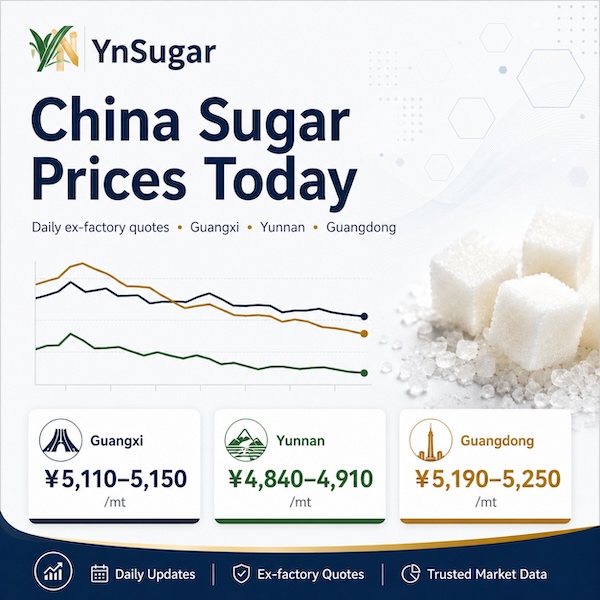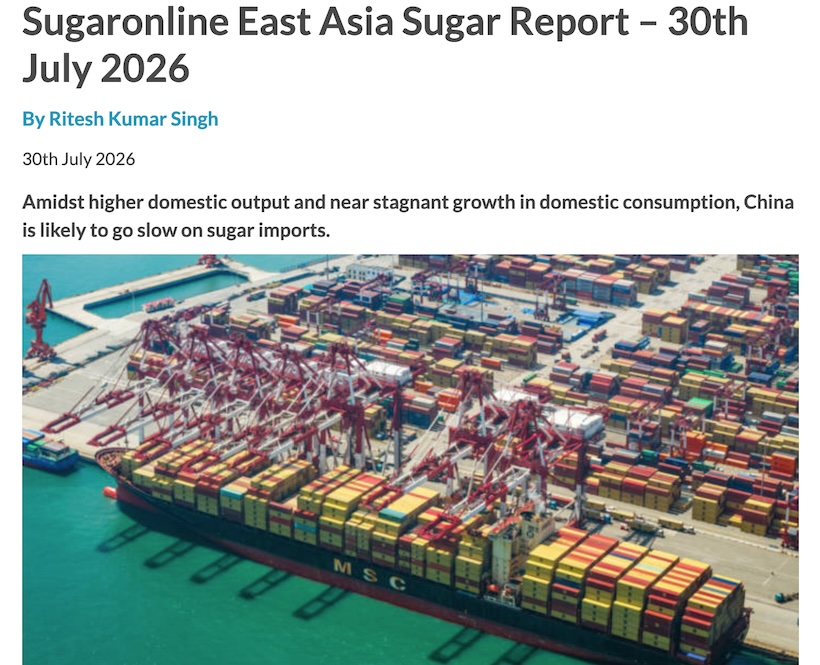
Recent industry reports indicate that China sugar imports are set to decelerate significantly as domestic production surges and demand remains stagnant…
Executive Summary
According to a East Asia sugar report released by Sugaronline on July 30, China is expected to decelerate its sugar import pace in the coming period. This shift is primarily driven by a notable surge in domestic output alongside stagnating demand growth.
Industry analysts agree that import permit issuance, international-to-domestic price spreads, and the absorption rate of local inventories will be the critical drivers determining China’s import demand moving forward.
Domestic Production Surges Past Estimates
While the USDA Foreign Agricultural Service (FAS) previously forecast China’s 2025/26 sugar production at 12.6 million metric tons (MT)—up 1.44 million MT (~13%) from 11.16 million MT in 2024/25—data obtained by ynsugar reveals an even higher figure.
-
2025/26 Actual Output: Domestic sugar production has already breached 12.96 million MT.
-
Cane Sugar Drivers: Cane sugar alone is expected to reach 11.1 million MT. This expansion is fueled by crop yield gains in Guangxi (China’s primary growing region) and increased sugarcane imports into Yunnan Province from neighboring Myanmar and Laos.
-
2026/27 Forecast: Output is projected to remain strong at 12.7 million MT.
Stagnant Consumption Constrains Import Space
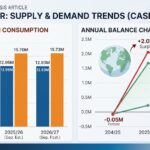
In contrast to surging yields, China’s sugar demand remains subdued. The USDA projects domestic consumption to hold flat at 15.8 million MT for both the 2025/26 and 2026/27 marketing years. Ongoing economic uncertainties and restrained consumer spending are the main headwinds limiting demand growth.
       China Sugar Supply & Demand Overview (Million MT)
┌───────────────────────────┬───────────┬───────────┬───────────┐
│ Metric                    │  2024/25  │  2025/26  │  2026/27E │
├───────────────────────────┼───────────┼───────────┼───────────┤
│ Domestic Production       │   11.16   │   12.96*  │   12.70   │
│ Domestic Consumption      │   15.80   │   15.80   │   15.80   │
│ Projected Imports (USDA)  │   5.30    │   4.50    │   4.50    │
│ Ending Stocks             │     --    │   2.78    │   4.02    │
└───────────────────────────┴───────────┴───────────┴───────────┘
*Source: ynsugar proprietary data
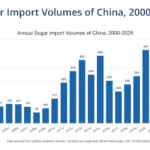
Consequently, the USDA has revised China’s 2025/26 import estimate down from 5.3 million MT to 4.5 million MT (an 800,000 MT drop), with 2026/27 imports expected to stay at this lower level.
To safeguard domestic processors and sugarcane farmers, Beijing is likely to keep a tight rein on import licenses as local inventories rise. USDA estimates show ending stocks expanding from 2.78 million MT in 2025/26 to 4.02 million MT in 2026/27, requiring more time for the market to absorb domestic supplies before buying foreign raw sugar.
Regulatory Controls and Import Margins
China operates an Out-of-Quota Permit System alongside its Tariff-Rate Quota (TRQ):
-
TRQ (1.945 Million MT): Subject to a 15% tariff, with roughly 70% allocated to state-owned enterprises (SOEs).
-
Out-of-Quota Imports: Subject to a 50% tariff and mandatory Automatic Import Licenses.
Because of this mechanism, even when global raw sugar prices fall, physical arrival volumes are dictated by official permit issuance and local processing margins rather than open market arbitrage alone.
Why Demand Won’t Disappear Completely
Despite the slowdown, China will not exit the import market.
-
Core Deficit Remains: A structural gap of over 3 million MT persists between domestic production (~12.7–12.96M MT) and consumption (15.8M MT).
-
Liquid/Premix Imports Decline: In the first five months of 2025/26, combined imports of sugar syrup and premixed powder dropped 32% year-on-year to ~605,000 MT. Reduced reliance on alternative sweeteners reinforces the need for raw and refined sugar imports to cover the shortfall.
📊 Explore In-Depth Import Trends: For comprehensive historical data, tariff structures, and real-time updates on Chinese raw sugar trade, read our complete guide on China Sugar Import Report & Analysis.
Global Impact: Focus on Brazil
Brazil currently supplies over 80% of China’s sugar imports. Any restriction or delay in Chinese import licenses directly impacts Brazilian raw sugar export momentum and reduces near-term demand support for ICE raw sugar futures.
Key Takeaway: China is shifting from aggressive bulk procurement to a cautious, flexible, and phased replenishment strategy. “Slower imports” does not mean a market shutdown; rather, buying volumes and timing will be strictly calibrated against the domestic supply deficit, import margins, and policy interventions.
Sources and Methodology
This analysis is based on the July 30, 2026 Sugaronline East Asia Sugar Report, the USDA Foreign Agricultural Service’s April 2026 China: Sugar Annual report and proprietary production data compiled by ynsugar.
USDA FAS figures cited in this article include estimates prepared by the Guangzhou Agricultural Trade Office, which may differ from official USDA PSD figures. The ynsugar production estimate is preliminary and may be revised as additional regional and mill-level data become available.
Disclaimer: The information provided in this article is for market intelligence and informational purposes only and does not constitute financial or investment advice. While data from ynsugar and third-party sources like USDA and Sugaronline is believed to be reliable, ynsugar makes no guarantees as to its completeness or accuracy.