Vietnam’s sugar industry has maintained production at a relatively high level in the 2025/26 crop year. However, abundant supply, weak demand for domestically produced cane sugar, competition from high-fructose corn syrup and concerns over undocumented sugar are pushing the market into an increasingly difficult position.
Vietnam’s sugar mills had crushed approximately 13.3 million tonnes of sugarcane and produced around 1.298 million tonnes of sugar by the end of June 2026, according to the Vietnam Sugarcane and Sugar Association, or VSSA.
Most mills had completed their crushing operations, although several factories in the Central and Central Highlands regions remained active because their harvests started later than those in other producing areas.
Based on the reported figures, the industry produced the equivalent of approximately 9.76 tonnes of sugar for every 100 tonnes of cane crushed.
Output was about 2.5% higher than the 1.266 million tonnes produced in the 2024/25 season. However, it was also roughly 5.3% below the VSSA’s earlier projection of more than 1.37 million tonnes for 2025/26.
The figures suggest that Vietnam’s immediate challenge is no longer simply increasing production. The more urgent issue is whether domestically produced cane sugar can be sold at prices that support sugar mills and sugarcane farmers.
Domestic sugar prices fall to a three-year low
Vietnam’s sugar supply remains abundant, with the market receiving sugar from domestic mills, official imports from ASEAN countries and sugar of unverified or allegedly smuggled origin.
Against this background, domestic prices have fallen to their lowest level in approximately three years, while sales of locally produced cane sugar reportedly dropped to a multi-year low in June.
Prices were broadly stable during June across Hanoi, central Vietnam and Ho Chi Minh City, but remained under considerable pressure:
- Standard white sugar was generally quoted at VND15,600–16,200 per kilogram.
- Refined sugar was priced at approximately VND16,900–17,200 per kilogram.
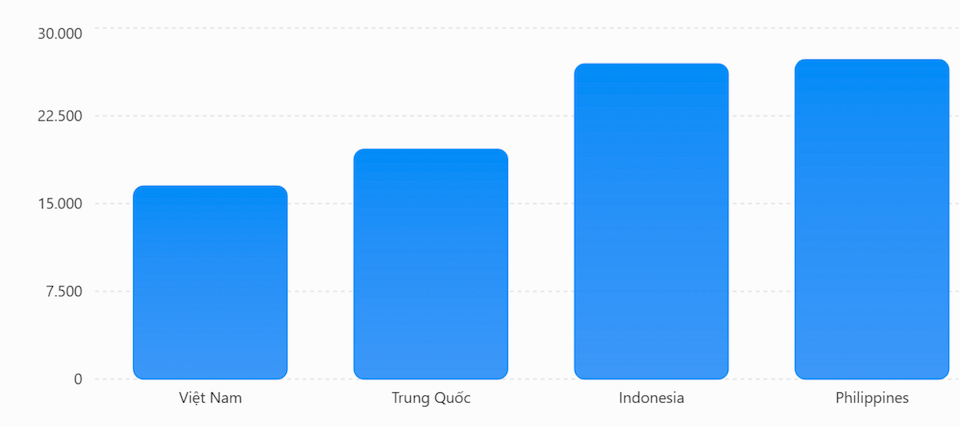
The VSSA’s converted regional comparison placed Vietnam’s average sugar price at approximately VND16,505 per kilogram, well below the levels reported in several other major Asian sugar markets:
- China: VND19,646 per kilogram
- Indonesia: VND26,946 per kilogram
- The Philippines: VND27,315 per kilogram
On this basis, prices in China were around 19% higher than in Vietnam, while prices in Indonesia and the Philippines were approximately 63% and 65% higher, respectively.
These figures support the VSSA’s assessment that Vietnam currently has the lowest sugar price among the selected major producing markets included in its comparison.
However, international readers should treat the comparison as an industry benchmark rather than a fully harmonised regional price index. Sugar specifications, wholesale and retail levels, taxes, exchange rates, distribution costs and the timing of quotations may differ between countries.
Global raw and white sugar markets moved in different directions
Vietnam’s domestic weakness developed against a mixed international market.
The VSSA report, citing International Sugar Organization data, said the average ISA raw sugar price declined to approximately 13.9 US cents per pound in June, while the ISO white sugar price index averaged around USD456 per tonne.
The divergence reflected weaker raw sugar prices during part of the month and a subsequent recovery in white sugar, amid changing expectations for supplies in the European Union and India and continued uncertainty in energy and agricultural markets.
The ISO defines its ISA Daily Price as an average of the closing quotations for the first three ICE No. 11 raw sugar futures positions. Its White Sugar Price Index is based on the first two London white sugar futures positions.
For Vietnam, however, international futures were only one part of the picture. Domestic market structure, import competition and product traceability appear to have had a more direct influence on local sales.
Undocumented sugar remains a major industry concern
The VSSA identifies smuggled and untraceable sugar as one of the most serious pressures facing legitimate domestic producers.
According to the association, some sugar is distributed through cash-based transactions without invoices or adequate documentation. It argues that such practices allow sellers to avoid taxes and compliance costs, creating an uneven competitive environment for sugar mills and formal distributors.
VnEconomy reported that authorities in Quang Tri detected three shipments of white sugar without valid proof of origin on National Highway 9 during June. The shipments had a combined weight of approximately six tonnes and were transferred to market-surveillance authorities for further handling.
Quang Tri’s market-management authority has separately confirmed that sugar was among the essential commodities targeted in its anti-smuggling and market-control operations during the first half of 2026. The authority reported 165 inspections and 135 cases handled across all categories of commercial violations during the six-month period.
The VSSA also raised concerns about sugar being repackaged and sold without labels, identifiable origin or expiry dates. Such products may be offered through traditional markets, small retail outlets and social-media channels, making traceability and enforcement more difficult.
These allegations should be understood as the association’s assessment of the market. The exact nationwide volume of smuggled or undocumented sugar was not disclosed in the report.
HFCS is taking a larger share of industrial sweetener demand
Vietnam’s cane-sugar industry is also facing competition from imported high-fructose corn syrup, commonly known as HFCS.
Vietnam imported approximately 22,215 tonnes of HFCS in June 2026, bringing total imports during the first six months of the year to 111,839 tonnes, broadly unchanged from the corresponding period of 2025, according to customs figures cited in the report.
The VSSA said much of this volume was imported by beverage manufacturers, a customer group that historically purchased significant quantities of domestically refined sugar.
Unlike smuggled or undocumented sugar, HFCS is a legally imported sweetener. Its competitive impact therefore reflects differences in price, product formulation, processing requirements and procurement strategies rather than an enforcement issue.
Nevertheless, continued HFCS use means that domestic sugar producers are competing not only against other sources of crystalline sugar, but also against substitute sweeteners in one of their most important industrial markets.
Cane farmers could face the greatest long-term risk
The VSSA expects Vietnam’s sugar supply to remain abundant through July and August 2026, as domestically produced sugar, ASEAN imports and unverified sugar continue to circulate in the market.
At the same time, the association has seen little evidence of a meaningful recovery in demand for domestically produced cane sugar. It therefore expects prices to remain close to their three-year lows in the near term.
Prolonged low sugar prices could eventually be transmitted back through the supply chain. Mills facing weaker margins may have less capacity to maintain sugarcane procurement prices, while farmers continue to bear the costs of labour, fertiliser, land, irrigation and transportation.
The VSSA estimates that sugarcane purchase prices in Vietnam are currently equivalent to only around 60–70% of the levels available to growers in some neighbouring countries. The association warns that this gap may leave farmers unable to cover production costs if weak sugar prices persist.
The scale of the industry makes this more than a short-term pricing problem. Vietnam’s sugar sector supported more than 225,000 farming households during the previous crop year, according to figures presented by the VSSA in September 2025.
Market access, not production, is now the central challenge
Vietnam’s 2025/26 results show that the domestic industry is still capable of crushing more than 13 million tonnes of cane and producing close to 1.3 million tonnes of sugar.
However, production growth alone will not secure the future of the sector.
The industry’s prospects will increasingly depend on stronger product traceability, consistent enforcement of invoice and tax rules, effective control of illegal trade and the ability of mills to remain competitive in a broader sweetener market that includes both imported sugar and HFCS.
Without improved access to legitimate consumer and industrial markets, low sugar prices may eventually discourage cane planting, weaken mill utilisation and reverse some of the production gains achieved over recent seasons.
Disclaimer
This article is intended solely for general information and industry analysis. The data and statements cited are based on publicly available information from VnEconomy, the Vietnam Sugarcane and Sugar Association, Vietnamese customs authorities and other referenced sources. While reasonable efforts have been made to verify the information, figures may be revised, and differences in statistical methodology, product specifications, exchange rates and reporting periods may affect comparisons. Allegations concerning smuggling, undocumented sugar, tax evasion or market misconduct reflect the views or findings of the cited organisations and authorities and should not be interpreted as independent legal conclusions by the publisher. This article does not constitute investment, trading, legal or commercial advice.