In its latest release on August 6, the Brazilian Sugarcane and Bioenergy Industry Association (Unica) provided updated harvest figures for the 2026/27 season. Consolidating monthly data through July 1, the report offers vital market signals for global traders and sugar analysts monitoring South-Central Brazil, the world’s primary origin for export raw sugar.
The latest Unica sugar production metrics reveal a distinct divergence: while total sugarcane crushing volume in South-Central Brazil expanded year-over-year, overall sugar output fell sharply by 12.38%. Driven by favorable local margins and energy policy dynamics, Brazilian millers aggressively prioritized bioethanol production over sucrose extraction, directly altering global supply expectations.
1. Cumulative Harvest Data: More Cane Crushed, Less Sugar Produced
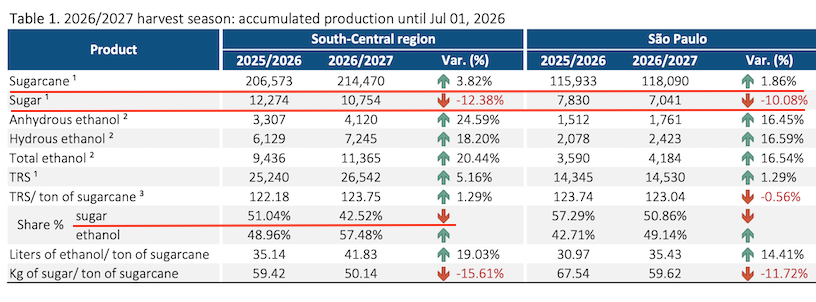
From the official start of the 2026/27 harvest season on April 1 through July 1, sugarcane crushing in South-Central Brazil reached 214.47 million metric tons, representing a 3.82% increase compared to 206.57 million tons during the same period last crop year. In São Paulo state alone, crushing volume totaled 118.09 million tons, up 1.86% year-over-year.
Despite processing nearly 7.90 million additional tons of raw cane, sugar output experienced a steep decline:
- Cumulative Sugar Production: Reached 10.75 million metric tons by July 1, down 15.20 million tons (-12.38%) from 12.27 million tons in 2025/26.
- São Paulo Sugar Output: Stood at 7.04 million tons, reflecting a 10.08% drop compared to last year’s 7.83 million tons.
- Production Mix Shift: The allocation of sucrose toward sugar manufacturing plummeted to 42.52%, down 8.52 percentage points from 51.04% last season. Conversely, the ethanol mix expanded to 57.48%.
Rather than directing additional sugarcane resources toward physical sugar production, millers channeled raw material into biofuel distillation. Consequently, total ethanol production through July 1 jumped 20.44% to 11.37 billion liters. Anhydrous ethanol output surged 24.59% to 4.12 billion liters, while hydrous ethanol output grew 18.20% to 7.25 billion liters. Yield efficiency also improved, with ethanol production per ton of cane rising 19.03% to 41.83 liters.
2. June Monthly Performance: Sugar Output Plunges 26.33%
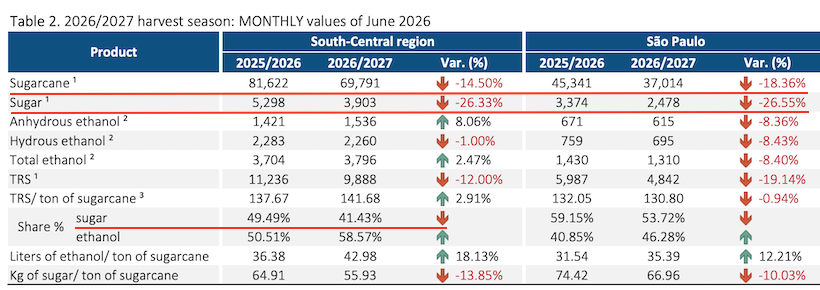
Focusing specifically on June 2026 monthly operations, the contraction in sugar production became even more pronounced:
During June, South-Central mills crushed 69.79 million metric tons of sugarcane, down 14.50% from 81.62 million tons in June 2025. Monthly sugar output tumbled by 26.33% year-over-year to 3.90 million metric tons, compared to 5.30 million tons in the prior period.
This 26.33% drop significantly outpaced the 14.50% reduction in crushed cane volume. The primary catalyst was a further shift in mill allocation: the June sugar mix fell to just 41.43% (vs. 49.49% last year), while the ethanol share reached 58.57%.
Key Takeaway: Despite a 14%+ decline in June crushing volume, total monthly ethanol production maintained positive growth (+2.47% to 3.80 billion liters), confirming that Brazilian mills continued to give structural priority to ethanol processing.
3. Raw Material Quality: Sucrose Yields Show Improvement
The decline in sugar output was not caused by poor crop quality. Agricultural indicators for the 2026/27 crop remain healthy across key producing regions.
By July 1, Total Recoverable Sugar (TRS) per ton of cane in South-Central Brazil averaged 123.75 kg/ton, representing a 1.29% increase from 122.18 kg/ton last season. Cumulative TRS generation reached 26.54 million tons, up 5.16% year-over-year.
For June alone, TRS content reached 141.68 kg/ton (+2.91% YoY). These figures demonstrate that higher sucrose availability across fields was systematically diverted into biofuel processing rather than commercial sugar crystal manufacturing.
4. Market Outlook & Analytic Conclusions
According to the ynsugar research team, the latest Unica dataset provides four key takeaways for international commodity markets:
- Cumulative Crushing Remains Positive: Despite a slower June pace (-14.50%), cumulative sugarcane crushing volume (+3.82%) aligns with broader forecasts for a solid agricultural crop in South-Central Brazil.
- Supportive Signal for World Sugar Prices: With cumulative sugar output down 1.52 million tons (-12.38%) and June output dropping over a quarter, global physical sugar supply will face tighter export availabilities, providing underlying support to NY No. 11 raw sugar futures.
- Ethanol Parity Dominates Strategy: The drop in sugar mix from 51.04% to 42.52% highlights strong domestic biofuel demand and favorable mill economics for ethanol over sugar.
- Can Sugar Production Recover Later in the Season? While raw material (TRS and crushing capacity) remains sufficient to boost sugar output, recovery will strictly depend on whether millers adjust their production mix above 42%. Traders must closely monitor domestic gasoline-ethanol price dynamics, exchange rate movements, and NY sugar futures parities.
In summary, the latest Unica report reflects a clear operational strategy: higher cumulative crushing, richer sucrose content, but significantly lower sugar output in favor of bioethanol. As long as Brazilian mills maintain this allocation strategy, international sugar markets will see less export supply pressure than previously anticipated.
Editorial Note & Disclaimer:
This market report is prepared by the ynsugar research team based on official statistical data released by the Brazilian Sugarcane and Bioenergy Industry Association (Unica) on August 6, 2026. All data points are compiled for analytical and informational purposes only and do not constitute direct trading or investment advice. Global commodity markets are subject to high volatility; market participants should evaluate physical supply-demand dynamics and financial risks independently. For verified industry updates, visit Unica’s Official Website or consult ynsugar.com.