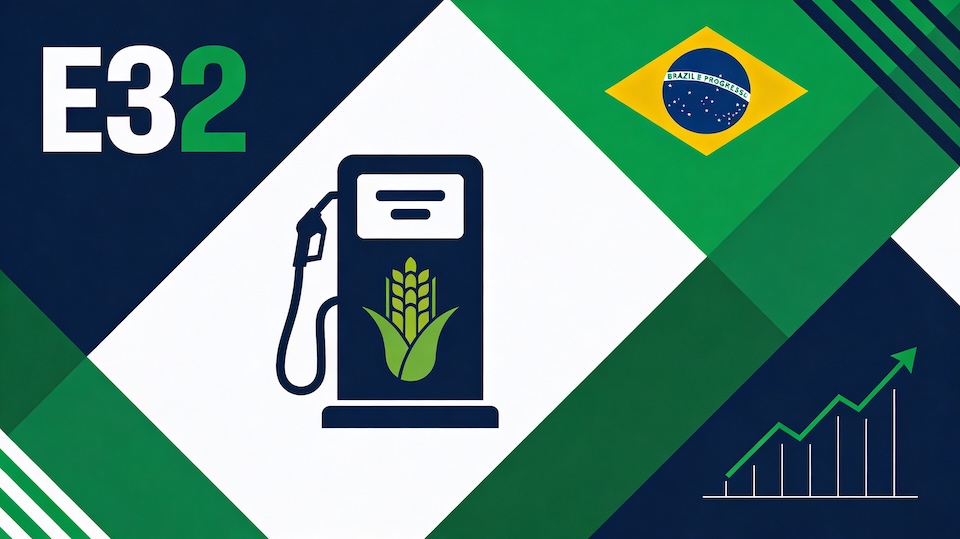
The official proposal for the Brazil Ethanol Blend 32% (E32) was confirmed on April 24, marking a decisive step toward national fuel autonomy.
Brazil’s Minister of Mines and Energy, Alexandre Silveira, announced on April 24 that a proposal to raise the mandatory anhydrous ethanol blend ratio in gasoline from the current 30% to 32% (E32) will be submitted for consideration at the next meeting of the National Energy Policy Council (CNPE). The meeting is expected to be held in early May; according to related reports, it is scheduled for May 7.
Minister Silveira stated that the measure would allow Brazil to achieve self-sufficiency in gasoline and put an end to its dependence on imports. According to estimates, the move could reduce monthly gasoline import demand by approximately 500 million liters — a volume sufficient for Brazil to achieve gasoline self-sufficiency for the first time and bring its reliance on external fuel imports to zero.
Currently, approximately 15% of Brazil’s gasoline consumption depends on imports. Geopolitical conflicts in the Middle East have driven international gasoline prices up by 65%, exacerbating this dependence. Data from Brazil’s National Petroleum, Natural Gas and Biofuels Agency (ANP) show that, as a result of external shocks, the average retail price of gasoline at Brazilian fuel stations has already risen by 8%.
Silveira emphasized the importance of energy security when announcing the decision. He stated: “We will submit the E32 proposal to the CNPE — raising the anhydrous ethanol content in gasoline from 30% to 32%, a ratio already tested and validated when we adopted E30. This is the new economy of job and income creation; it is the energy revolution that President Lula promised and brilliantly delivered, which is reinvigorating the national economy, and we will achieve gasoline self-sufficiency.”
The technical feasibility of the proposal is based on research and testing conducted in 2025 for the rollout of E30, which demonstrated the technical viability of that blend ratio and ensured safe implementation. Silveira disclosed that tests covering ethanol blend ratios between 28% and 32% have all been passed.
The E32 proposal is consistent with Brazil’s Lei do Combustível do Futuro (Future Fuel Law), which was approved and signed in 2024 and permits anhydrous ethanol blend ratios in gasoline of up to 35%.
Global Market Implications: The Sugar-Ethanol Parity Shift
The transition from E30 to Brazil Ethanol Blend 32% is not merely a domestic energy milestone; it is a seismic signal to global commodity traders. As Brazil mandates higher domestic ethanol consumption, the “sugar mix”—the ratio of sugarcane dedicated to sugar production versus ethanol—will face structural pressure to tilt further toward fuel production.
Industry analysts anticipate that a 32% mandate creates a robust “demand floor” for ethanol, which could potentially tighten global raw sugar supplies for the 2026/27 harvest. With international gasoline prices remaining volatile due to geopolitical tensions, Brazil is effectively leveraging its agricultural capacity to de-risk its economy from external energy shocks. This move mirrors the ambitious E20 targets seen in India, suggesting a global trend where major sugar producers prioritize domestic energy security over raw sugar exports.
Background:
Brazil raised the ethanol blend ratio in gasoline from 27% to 30%, and the biodiesel blend ratio in diesel from 14% to 15%, effective August 1, 2025. At the time, Silveira stated that the adjustment to mandatory biofuel blend ratios would make Brazil “gasoline self-sufficient for the first time in 15 years.”
Brazil currently produces more than 30 billion liters of ethanol per year, making it the world’s second-largest producer after the United States. Unlike U.S. corn-based ethanol, Brazilian sugarcane ethanol has a significantly superior greenhouse gas lifecycle profile — reducing carbon emissions by approximately 70% compared to gasoline, according to most lifecycle analyses.
Disclaimer: This analysis is based on the Brazil Ethanol Blend 32% (E32) proposal announced by the Ministry of Mines and Energy on April 24, 2026. The data (including the 500 million-liter import reduction and geopolitical price impacts) are derived from official statements and ANP reports as of late April 2026. Commodity and energy markets involve significant risks; ynsugar.com assumes no responsibility for financial decisions based on this content.