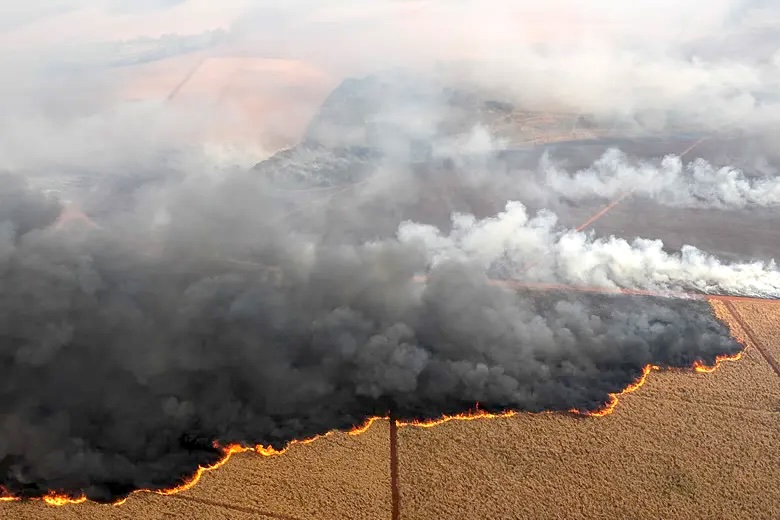
Sugarcane fires are no longer a seasonal nuisance in Brazil — they have become a systemic threat to the country’s most strategically important agricultural sector, and the financial toll is staggering.
The Scale of the Damage
In 2024, approximately 414,000 hectaresof sugarcane were destroyed by wildfires across Brazil’s Center-South region, the country’s agricultural heartland, causing an estimated **2.67 billion reais (roughly $486 million)**in direct losses. Between August and September alone, some 656,000 hectares were affected — an area larger than the state of Delaware. São Paulo state, which accounts for the lion’s share of national output, recorded 8,712 fire incidents in a single year.
The human cost of these numbers has a face: Raízen, Brazil’s largest biofuel producer and a joint venture between Shell and Cosan, saw roughly 7% of its sugarcane crop destroyed in 2024, triggering a 30% drop in processing volume and a sharp decline in sugar sales.
Brazil produces over 600 million tonnes of sugarcane per harvest— more than any other country on Earth. Protecting that output is not just a matter of agricultural policy. It is a matter of national economic strategy.
Table 1: Financial and Agricultural Impact (2024–2025)
| Category | 2024 Crisis Year | 2025 Recovery (Est.) |
| Destroyed Area (Center-South) |
414,000 ha
|
Decreasing trend
|
| Direct Financial Loss |
2.67 Billion BRL
|
N/A |
| Recoverable Sugar (ATR) Loss |
Up to 15%
|
N/A |
| Raízen Processing Impact |
-30%
|
Stabilizing
|
Why the Fields Keep Burning
The causes are neither mysterious nor particularly new, but they have become dramatically more dangerous. Industry analysts point to what they call the **”30-30-30 phenomenon”**: temperatures above 30°C, relative humidity below 30%, and wind speeds exceeding 30 km/h — a combination increasingly common during the dry season between April and September.
Human factors compound the risk. Sparks from harvesting machinery, discarded cigarettes along rural highways, burning roadside trash, and in some cases deliberate arson all contribute to outbreaks that are difficult to trace and harder to prosecute. Crucially, these fires are no longer a planned management tool — they are pure, uncompensated loss.
The agronomic damage is layered. Fire degrades the essential sucrose content in cane, cutting **recoverable sugar yields by up to 15%**. The cane straw — increasingly valuable as a biomass energy feedstock — is incinerated rather than harvested. Soil loses organic matter and microbial diversity, suppressing productivity across multiple subsequent growing seasons.
A Green Giant With a Smoke Problem
The deeper crisis is one of credibility, and it strikes at the heart of Brazil’s global positioning.
Brazilian sugarcane ethanol is, by virtually any scientific measure, one of the cleanest liquid fuels on the planet — generating just 35.2 grams of CO₂ equivalent per megajoule, representing a 62% reductionin carbon intensity compared to gasoline. This track record underpins Brazil’s ambitions under the EU-Mercosur trade framework, which includes a 650,000-tonne import quota for Brazilian ethanol, with 200,000 tonnes earmarked specifically for fuel use.
Yet every satellite image of a smoke-blanketed São Paulo canefield that reaches a European desk tells a different story. As sustainability certification requirements tighten in EU and U.S. markets — and as green credit facilities increasingly demand full supply-chain traceability — Brazil’s failure to contain these fires is handing ammunition to competitors and skeptics alike.
The paradox could hardly be more pointed: the same industry that produces cellulosic ethanol with over 90% lifecycle greenhouse gas reductions, generates electricity from bagasse, and is pioneering commercial-scale biomethane is also the industry whose fields periodically fill the skies of inland Brazilian cities with particulate matter. That contradiction is becoming harder to explain in Brussels or Washington.
The Response: Promising, But Uneven
The industry is not standing still. In April 2026, the Copersucar ecosystem launched “Fogo Zero nos Canaviais 2026”(Zero Fire in the Canefields 2026), mobilizing affiliated sugar mills around community outreach, firefighter training, and public awareness campaigns. São Paulo state’s “Operação SP Sem Fogo” (Operation SP Without Fire) scaled its monitoring coverage from 29,600 to 421,500 hectares — an increase of 1,321% — while environmental fines jumped from 2.79 million to 64.7 million reais.
On the technology side, leading mills are deploying satellite and thermal sensor networks for early fire detection, fitting harvesters with heat-triggered automatic shutoffs, and accelerating the shift to “green cane” harvesting— cutting without pre-burning, which preserves the straw as both a soil protector and an energy input. São Paulo state itself offers the industry’s clearest proof of concept: legislation passed in 2002 progressively eliminated planned burning, with the practice largely phased out by 2017.
The numbers from 2025 suggest the response is working to a degree — fire incidence fell meaningfully compared to the crisis year of 2024 — but the trajectory remains fragile and heavily weather-dependent.
A Test of Industrial Maturity
What is unfolding in Brazil’s canefields is, at its core, a test of whether one of the world’s most important agricultural sectors can govern itself to the standard its own marketing demands.
The economics of inaction are no longer ambiguous. A single severe fire season can erase hundreds of millions of dollars in output, destabilize the earnings of major publicly listed companies, and provide regulators in key export markets with justification for tighter sustainability conditions or outright trade barriers. For an industry that has built its global pitch around being the responsible, renewable alternative to fossil fuels, fire risk management is no longer a peripheral operational concern — it is a core reputational asset.
Brazil has the technology, the institutional knowledge, and increasingly the regulatory framework to solve this problem at scale. The question is whether the urgency of the next dry season will finally force the industry-wide discipline that voluntary programs and intermittent enforcement have so far failed to deliver. In an era where supply-chain transparency is becoming a prerequisite for premium market access, the cost of getting this wrong keeps rising — one burning field at a time.