For international stakeholders tracking the Chinese sugar market, understanding the leading producers in Guangxi—China’s “Sugar Bowl”—is essential. One of the most prominent questions is: What is the current scale and capacity of the Guangxi Sugar Industry Group (Guangtang Group)?
As of the 2025/26 season, Guangxi Sugar Industry Group Co., Ltd. operates a total of 14 factories. This portfolio includes 13 sugarcane sugar enterprises and 1 refined sugar enterprise. Collectively, these facilities possess a daily processing capacity of 82,000 tons of sugarcane, with an annual sugar production reaching 1.2 million tons.
The Heartland of Chinese Sugar
Guangxi is indispensable to China’s food security. The province consistently accounts for over 60% of China’s total sugarcane acreage and sugar output. With an annual production exceeding 7 million tons, Guangxi’s performance dictates the domestic price trends and import requirements for the world’s second-largest sugar consumer.
The Competitive Landscape: 73 Mills, 4 Major Giants
In the 2025/26 season, the 73 operational mills in Guangxi are primarily managed by a handful of elite industrial groups:
-
Guangxi Sugar Industry Group (Guangtang): The state-owned pillar with a significant domestic footprint.
-
Guangxi Agricultural Investment Sugar Group (Guangnong Sugar): Another leading state-owned entity (formerly Nanning Sugar).
-
Guangxi Yangpu Nanhua Sugar Group: A private giant with extensive milling capacity.
-
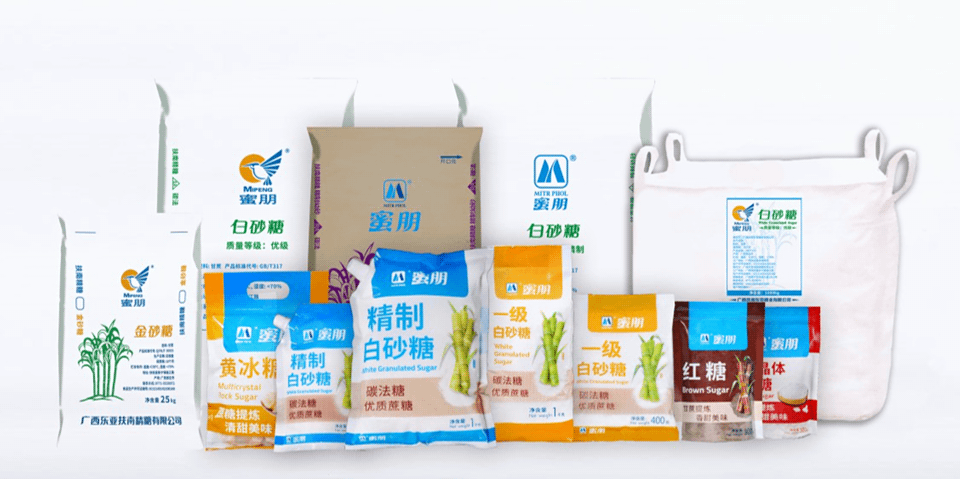
East Asia Sugar Group: A prominent joint venture (with Thailand’s Mitr Phol) bringing international processing standards to the region.
Beyond the “Big Four”: A Diverse Industrial Landscape
While the industry is often associated with major names like Guangtang, Guangnong, Nanhua, and East Asia, it is important to note that Guangxi’s sugar landscape is not limited to these four groups. The province’s production is driven by a wider array of players operating across 73 active sugar mills during the current season. This diversity ensures a competitive and multi-layered supply chain within China’s primary sugar-producing region.
Vertical Integration and the Circular Economy
Western investors and ESG-conscious buyers are increasingly focused on Guangxi’s transition from simple milling to a fully integrated circular economy. Modern Guangxi sugar groups no longer view sugarcane as a single-product crop. Instead, they have mastered a “Full Value Chain” model:
-
Sugar & Paper: Bagasse (fiber residue) is converted into high-quality pulp and paper products.
-
Molasses & Alcohol: Molasses is fermented into fuel ethanol or high-grade spirits.
-
Filter Mud & Fertilizer: Waste filter mud is processed into organic fertilizer and returned to the cane fields, completing the nutrient cycle.
2025/26 Season: A Record-Setting Performance
Guangxi continues to dominate domestic production, accounting for over 60% of China’s total output. The current season has shown exceptional resilience and productivity. As of March 31, 2026, total sugar production in Guangxi for the 2025/26 crushing season has reached 7.41 million tons.
YnSugar Analyst’s View
While the specific count of factories under Guangxi Sugar Industry Group is a key data point, the real story for 2026 is the efficiency of the 73-mill collective. Despite fluctuations in global weather patterns, Guangxi has maintained a stable 7-million-ton output through mechanical harvesting upgrades and better seed varieties. For global buyers, the consolidation of these 73 mills into a few major groups means more stable pricing and more reliable supply chain transparency compared to the fragmented market of a decade ago.