Statistics on cross-border sugarcane imports into China reveal a quietly ambitious agricultural program attempting to reshape the illicit crop dynamics of the Golden Triangle. For decades, the mountainous borderlands where Myanmar, Laos, and Thailand converge have remained a prolific source of illicit opium, with northern Myanmar historically rivaling Afghanistan in poppy cultivation. The resulting social fallout ripples across the region, straining border security and trapping farming households in a cycle of poverty. Today, market-linked crop substitution is attempting to change that calculus — one truckload of sugarcane at a time.
The Logic Behind Cross-Border Sugarcane Imports
The concept of alternative development — replacing narcotics crops with legal agricultural commodities — has been a fixture of international drug policy since the 1970s. What makes the Northern Myanmar case distinctive is its sheer scale, its bilateral architecture, and its commercial backbone.
China shares a roughly 2,185-kilometer border with Myanmar, with Yunnan Province’s Lincang City sitting directly across from some of the most poppy-dense townships in Shan State. Rather than relying solely on aid-funded programs, Beijing and local Yunnanese enterprises built a market-linked model: Chinese sugar companies develop land in northern Myanmar, provide seeds, technical training, and machinery to local farmers, then truck the harvested cane across the border to mills in Yunnan.
The arrangement began taking formal shape in 1996, when Zhenkang County and the Kokang Special Region signed an agreement to jointly cultivate roughly 160 hectares with sugarcane — a modest pilot that eventually grew into one of the largest cross-border crop-substitution programs in Southeast Asia.
How the Model Works on the Ground
The dominant operating structure relies on the “enterprise + base + farmer” model. Chinese sugar conglomerates — most prominently Nanhwa Sugar Industry Group — establish production bases in northern Myanmar and contract with local households, supplying inputs on credit against future harvest proceeds. By 2018, Lincang’s cross-border cooperation mechanisms had helped cultivate approximately 17,300 hectares of sugarcane in northern Myanmar, drawing roughly 4,900 households into the formal agricultural economy.
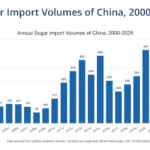
The scale of the program is most visible in the latest trade figures. During the 2025–26 crushing season (October 2025 through May 2026), China’s total cross-border sugarcane imports from overseas sources reached a cumulative 4.0062 million metric tons — up 599,900 tonnes compared to the same period in the previous season.
Yunnan Province’s border crossings accounted for 3.9404 million tonnes, or 98.36% of the national total, underscoring just how geographically concentrated this trade corridor is. Guangxi ports handled the remaining 65,800 tonnes, about 1.64% of the national aggregate.
Breaking down the source countries reveals a clear hierarchy of regional suppliers:
| Source Country | Import Volume (Million Metric Tons) | Percentage Share (%) |
| Myanmar | 2.6103 | 65.16% |
| Laos | 1.3194 | 32.93% |
| Vietnam | 0.0766 | 1.91% |
| Total | 4.0062 | 100.00% |
Myanmar remains by far the dominant supplier, accounting for nearly two-thirds of all cross-border sugarcane imports into China — a position that reflects both the depth of the existing cooperation infrastructure and the scale of Chinese agricultural investment in northern Shan State.
The logistical spine of the program runs through four key border crossings — Qingshuihe, Yonghe, Nansan, and Mangka — where Chinese authorities have installed H986 smart customs systems compressing clearance to roughly eight minutes per vehicle. That speed matters enormously: sugarcane loses both moisture and sugar content within hours of harvesting, so rapid transit directly determines commercial value and the farmer’s final income.
The Agronomic and Economic Case
Sugarcane is not an arbitrary choice. Northern Myanmar’s border zones share a tropical and subtropical monsoon climate with average annual precipitation around 1,600 millimeters and temperatures between 18°C and 20°C — conditions that closely mirror the natural habitat of high-yielding cane varieties already proven in Yunnan and Guangxi.
Chinese agronomists have introduced early-maturing, high-sugar varieties including Yunzhe 081609 and Yuetang 93159, the latter specifically selected for its low sugar-inversion rate during transport, ensuring mills receive raw material with commercially viable sucrose concentrations after a multi-hour cross-border journey. Soil-testing-based fertilization programs have demonstrated yield increases of around 12.75 tonnes per hectare alongside a 0.26 percentage-point improvement in sugar content. With sugarcane purchase prices hovering around 400 yuan per tonne and per-household annual income increases estimated at roughly 12,000 yuan, many local residents have voluntarily expanded their plots and encouraged neighbors to join.
The Hard Realities: Conflict, Climate, and Market Uncertainty
The program’s vulnerabilities are as significant as its advantages, and recent years have provided a stress test that exposed all of them simultaneously.
-
Political Instability: This remains the single greatest structural risk. Conflict in Shan State by late 2023 had effectively paralyzed harvest logistics across key growing areas; a planned 20,000-hectare expansion in 2024 was completed to only about one-third of target as shifting regulations and on-the-ground insecurity made new investment unfeasible. In 2025, conflict-driven displacement in northern Shan State left substantial fields of unharvested cane abandoned.
The statistical record reflects this volatility starkly — Lincang’s cross-border cane crush fluctuated between a low of roughly 241,000 tonnes (2016–17) and a peak of 900,000 tonnes (2020–21), a nearly fourfold swing driven largely by political conditions rather than agronomic factors. The fact that imports recovered to over 4 million tonnes nationally in 2025–26 suggests the industry’s resilience, but also masks the ongoing fragility of individual growing areas still affected by armed conflict.
-
Climate Risk: Weather anomalies compound the problem. Typhoon Yagi struck northern Myanmar in September 2024, killing 226 people and submerging nearly 20,000 hectares of sugarcane fields in Shan State and Kachin State, translating into a 40% reduction in sugarcane imports through the Mangxin corridor that season. El Niño-driven drought earlier that year had desiccated riverine water sources and raised seedling mortality rates.
-
Market Competition: Pressure from neighboring countries adds a third layer of pressure — and the 2025–26 import data makes this visible in stark numerical terms. Laos, once a minor supplier, now accounts for nearly 33% of China’s cross-border sugarcane imports, having attracted significant Chinese agricultural investment on the back of its comparatively stable political environment and competitive land-lease terms. That Laos — a much smaller country — has captured nearly half of Myanmar’s import share is a structural warning sign for the program’s long-term competitiveness.
The Demand Picture: Why the Market Argument Remains Compelling
Despite these risks, the demand fundamentals are robust. China’s sugar supply-demand gap widened to approximately 4.64 million tonnes in the 2024–25 crushing season, with domestic production of roughly 11.16 million tonnes falling well short of consumption of around 15.8 million tonnes — pushing external dependence to nearly 30%. China’s per capita sugar consumption stood at approximately 11.8 kilograms in 2024, compared to roughly 36 kilograms in Western Europe and North America — a gap representing enormous latent demand growth as Chinese incomes and processed food consumption expand.
The 599,900-tonne year-over-year growth in cross-border sugarcane imports during 2025–26 — even against the backdrop of continued conflict and climate disruption in northern Myanmar — is a meaningful signal that supply-chain participants on both sides are betting on sustained demand growth.
A Path Forward: What a Durable Program Requires
To secure the long-term viability of this agricultural bet, policymakers and corporate stakeholders must address four critical pillars:
-
Financial Inclusion for Smallholders: Affordable credit and customized agricultural insurance are essential to sustaining farmer participation through inevitable setbacks. A pilot already tested by Cangyuan customs authority, allowing sugarcane-processing companies to defer tax payments via tariff bond insurance, freed up approximately 3.3 million yuan in working capital for Nanhwa Sugar Group in 2024 alone. Insurance coverage for typhoon, drought, and pest damage helped reduce per-hectare disaster losses from around 31,500 yuan to microfilm 5,700 yuan during the 2024 typhoon season for enrolled farms.
-
Diversification of the Supplier Base: The rise of Laos as a 33% supplier demonstrates that Chinese mills are not passively waiting for Myanmar’s stability to return. Instead of allowing this to become a zero-sum competition, policymakers could frame a complementary model: Myanmar provides deep agronomic partnerships and high-volume production infrastructure, while Laos serves as a crucial buffer supplier during Myanmar’s political disruptions.
-
Local Talent Development: Technical training must move beyond indefinite reliance on itinerant Chinese technicians. Formal partnerships between Yunnan agricultural universities and vocational institutions in northern Myanmar would accelerate the transmission of cultivation and post-harvest management skills to a new generation of local practitioners capable of sustaining the industry independently.
-
Risk Intelligence Infrastructure: Implementing real-time sugar price monitoring, cross-border trade policy alerts, and climate early-warning tools calibrated to Shan State’s specific agroclimatic conditions would enable both corporate investors and smallholder farmers to make better-informed planting and hedging decisions.
Conclusion
The sugarcane substitution program in northern Myanmar is ultimately not just an agricultural story. It is a test case for whether economic integration can displace illicit crop cultivation more durably than enforcement alone — and whether cross-border commercial relationships can generate enough mutual benefit to survive political turbulence and climate volatility.
The 2025–26 data point — 4 million tonnes of cross-border sugarcane imported into China, with Myanmar still holding a 65% share despite years of compounding disruptions — suggests the program has more staying power than its critics might expect. But Laos’s rapid ascent to nearly one-third of that market is a reminder that staying power is not the same as competitive dominance. Whether sugarcane can ultimately outcompete poppies across northern Myanmar depends less on the agronomics — those are broadly favorable — and more on whether the human and institutional infrastructure around the crop can be made robust enough to weather whatever comes next.
Disclaimer: The ynsugar analysis, market insights, and structural conclusions presented in this article represent the independent professional viewpoints of the ynsugar research team and are formulated strictly for tracking global agricultural market dynamics and logistical trends. This report is provided for informational and reference purposes only. It does not constitute commercial trading advice, investment recommendations, or official foreign policy endorsements.