The cultivated sugarcane genome has finally been fully decoded. Published in Nature on May 27, 2026, the landmark study “Genetic architecture of sugarcane traits in a polyploid genomics framework” represents the most complete genetic analysis ever achieved — and a roadmap for breeding the world’s sweetest crop.
Sugarcane feeds and fuels the world. It accounts for roughly 80% of global sugar production and is a growing source of bioenergy. Yet for decades, the plant’s genetics remained almost impenetrable — its genome so vast and tangled that even the most advanced sequencing tools struggled to make sense of it.
That bottleneck ended this spring, when a Chinese-led research team published a landmark paper in Nature, delivering the first fully phased, chromosome-level genome assembly of POJ2878, the foundational cultivar that shaped nearly every modern sugarcane variety on the planet.
One Plant, Extraordinary Complexity
To understand why this took so long, consider what scientists were up against:
-
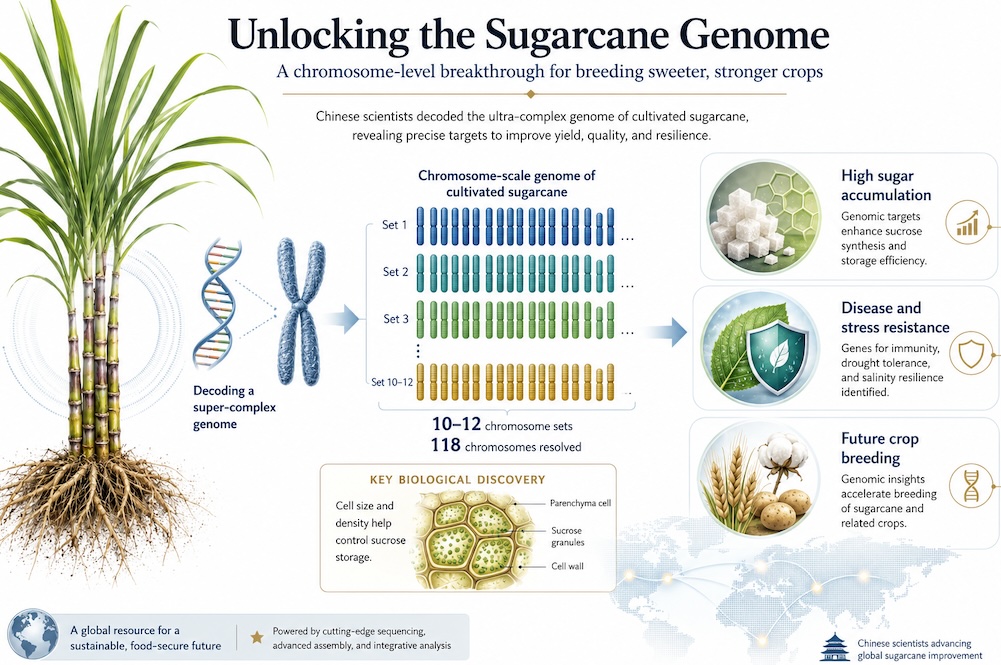
Modern cultivated sugarcane carries 10 to 12 complete sets of chromosomes (a condition called high-ploidy polyploidy).
-
It boasts a genome exceeding 10 billion base pairs—more than three times the size of the human genome.
-
Its chromosomes from two ancestral species, Saccharum officinarum and Saccharum spontaneum, are so similar to each other that standard sequencing tools routinely misassign DNA fragments to the wrong chromosome.
The result has been a field stuck with three persistent obstacles: the genome was almost impossible to fully assemble, candidate genes were nearly impossible to pin down, and precise breeding targets were nearly impossible to define.
The research team, co-led by corresponding authors Zhang Xintan of the Shenzhen Institute of Agricultural Genomics (CAAS), Ming Ruiguang of Fujian Agriculture and Forestry University, and Zhang Muqing of Guangxi University, resolved all three.
The Breakthrough: 118 Chromosomes, Fully Resolved
Using an in-house developed Pore-C-based assembly algorithm, the team reconstructed POJ2878’s genome at full chromosomal resolution, successfully phasing all 118 chromosomes. The assembly revealed extensive subgenomic recombination and non-homologous chromosomal rearrangements — structural complexity that previous partial assemblies had simply glossed over. This is the first time the full architecture of a cultivated sugarcane genome has been laid out with this level of precision.
The team also developed two additional independent computational tools tailored specifically to polyploid genome analysis:
-
Allel-Express: For profiling allele-specific gene expression across multiple subgenomes simultaneously.
-
KMERIA: A k-mer-based polyploid GWAS algorithm for identifying trait-associated loci in high-ploidy crops.
Together, these three tools form a reusable analytical pipeline with implications well beyond sugarcane.
POJ2878: The Variety That Shaped the Modern Industry
The research didn’t just sequence one variety — it also surveyed 981 sugarcane accessions from 19 major producing regions worldwide, building the largest sugarcane population genomics dataset ever assembled.
The findings were striking: more than 95% of modern cultivars carry large genomic segments inherited directly from POJ2878, confirming the variety’s extraordinary influence on a century of global breeding.
Selection scans across this population revealed the genetic signatures of domestication and improvement. Key genes identified include:
-
CBL1: Associated with cold tolerance.
-
TIP1: Regulates cell size.
-
TB1: Controls tiller architecture.
-
SUS2 (Specific Haplotype): Strongly associated with elevated sucrose content — providing a direct molecular handle for breeders targeting higher sugar yields.
Rethinking How Polyploid Crops Improve
One of the paper’s most intellectually significant contributions challenges a foundational assumption in plant breeding. The conventional view holds that better crops come from accumulating more favorable alleles — stacking good genes on top of good genes.
The new data suggest something more nuanced: in polyploid crops, trait improvement depends more on precise gene dosage balance across multiple chromosome copies than on simple allele accumulation.
This finding reframes how breeders should think about genetic improvement in any crop with multiple genome copies — a category that includes not only sugarcane but also wheat, cotton, and potato.
The Sugar-Storing Cell at the Heart of It All
The team used its KMERIA algorithm to perform the first polyploid-aware genome-wide association study on sugarcane, identifying loci linked to parenchyma cell size and sucrose storage capacity in the stalk. The functionally validated hit was SUT2, a sucrose transporter gene whose activity directly influences how much sugar accumulates in the plant’s storage cells.
This is the first study to confirm at both the cellular and molecular level that parenchyma cell size and density are critical regulators of sucrose accumulation in sugarcane — providing a clear, actionable target for engineering the next generation of ultra-high-sugar varieties.
Summary of Major Breakthroughs
Industry Insight
Beyond the laboratory, these high-sugar varieties will directly impact trade balances and supply chains. For a deeper analysis of current market structures and production data, see the full China Sugar Import Report.
A Global Collaborative Effort
The study was a major collaborative effort involving more than ten premier institutions, including:
-
Chinese Academy of Tropical Agricultural Sciences
-
Shenzhen Institute of Agricultural Genomics (CAAS)
-
Yunnan Academy of Agricultural Sciences’ Sugarcane Research Institute
-
Fujian Agriculture and Forestry University
-
Guangxi University
As the authors conclude, these results illuminate the genetic architecture underlying biomass productivity and sugar yield in sugarcane — and lay the foundation for accelerating the improvement of polyploid crops critical to global food and bioenergy security.
Disclaimer: The content presented above is a technical summary of academic research published in Nature on May 27, 2026. ynsugar provides this information for industry analysis, academic exchange, and educational purposes only. It does not constitute commercial breeding or investment advice. While we strive for absolute accuracy, please refer to the original peer-reviewed paper for definitive scientific data.