The global sugar market outlook 2026/27 indicates that the market is entering a phase of delicate structural transition in its supply-demand dynamics.
Any discussion of the world sugar market inevitably centers on two production giants: India and Brazil. Both are currently navigating a difficult balancing act between food-grade sugar and biofuel production. Combined with a growing El Niño weather threat, the global supply balance for the 2026/27 crush season is hanging by a thread.
This analysis draws on the latest publicly available data from multiple institutions to provide a comprehensive assessment of the global sugar outlook.
India’s Dilemma: Sugar or Ethanol?
At the heart of India’s challenge lies a pricing problem.
An executive director at Shree Renuka Sugar stated at the Mumbai sugar conference that if sugarcane ethanol prices are not raised, the industry may “abandon ethanol and produce more sugar instead.” This is not alarmism — it reflects a structural distortion that has persisted for several years.
The root cause: government inaction on ethanol procurement prices.
The Indian government has not raised the procurement price for ethanol derived from sugarcane juice and B-heavy molasses for nearly four years. Over the same period, domestic sugar prices have risen steadily, leaving mills with virtually no incentive to divert more cane toward ethanol. This price inversion is particularly acute in northern India, where sugar prices exceed those in Maharashtra. Ethanol pricing relative to sugar would need to rise substantially from current levels to motivate greater ethanol production in that region.
The gap between costs and procurement prices has been quantified.
The Indian Sugar and Bio-energy Manufacturers Association (ISMA) has highlighted that the mismatch between input costs and ethanol procurement prices is widening. The Fair and Remunerative Price (FRP) for sugarcane has risen from ₹305 per quintal in 2022/23 to ₹355 in 2025/26 — an increase of 16.5% — yet procurement prices for ethanol made from sugarcane juice and B-heavy molasses have remained unchanged since 2022/23.
The current production cost of B-heavy molasses ethanol stands at approximately ₹66.09 per liter, while the procurement price is just ₹60.73 — a shortfall of nearly ₹5 per liter. Sugarcane-based ethanol faces a similar cost-price gap of around ₹5 per liter.
Adding to the irony is the inter-feedstock imbalance: corn-based ethanol currently fetches ₹72 per liter, while sugarcane-based ethanol commands only ₹65.61 — already below its production cost. This creates a severe distortion in ethanol pricing.
This lack of incentive has directly suppressed output.
Sugarcane-based ethanol production has stagnated at 3–4 billion liters for five consecutive years, despite installed capacity of 9 billion liters.
To be fair, the Indian government has not been entirely idle.
The government has announced the removal of all volume restrictions on ethanol production from sugarcane juice, syrup, and all classes of molasses for the 2025/26 ethanol supply year. This significant policy shift is designed to support sugar mills, boost renewable energy production, and advance biofuel blending targets. Earlier volume caps had been imposed due to reduced sugarcane availability, but improved rainfall over two consecutive monsoon seasons has since expanded planted acreage.
The critical distinction here is that lifting volume restrictions addresses the “can they produce” question, while the price inversion determines “will they produce” — two very different policy levers.
India’s other calculation: energy security.
India is actively seeking to better utilize its vast ethanol production capacity to reduce dependence on energy imports. Measures include raising the ethanol blending ratio in gasoline, introducing flex-fuel vehicles, using ethanol in cooking stoves, and exploring ethanol blending in diesel. This motivation has intensified following Persian Gulf conflicts that pushed oil prices higher. As one of the world’s largest crude oil importers, India faces particularly acute exposure to Gulf tensions in terms of energy security, inflation, and macroeconomic stability.
However, there is a subtle counter-logic at work: if the Strait of Hormuz reopens, energy costs ease, and the pressure to ramp up ethanol production diminishes — while mills still need higher ethanol prices to justify the switch — then a decline in oil prices paradoxically makes the government less willing to raise ethanol procurement prices.
Brazil: Oil Prices Drive the Sugar-to-Ethanol Pivot
If India’s story is one of rigid policy pricing, Brazil illustrates how market-driven flexibility can rapidly tilt toward fuel production when driven by oil prices. Brazilian mills can nimbly allocate cane between sugar and ethanol, and the core variable governing that allocation is crude oil.
In the early weeks of the 2026/27 crush, ethanol economics clearly dominate.
Brazilian ethanol prices carry a substantial premium over New York sugar prices. Anhydrous ethanol converts to 19.73 cents per pound and hydrous ethanol to 17.96 cents, compared with ICE raw sugar closing at 14.63 cents — an initial sugar-ethanol parity heavily favoring ethanol. Based on this, consultancies have judged that mills will maintain their focus on ethanol at least until mid-June.
Middle East conflict has been the direct catalyst for this latest pivot. As hostilities escalated, Brent crude rose 30%, pushing gasoline prices higher. In Brazil, Petrobras — which controls over 80% of the refining market — is the price setter. Markets had been watching whether it would pass through international gasoline price increases to the domestic market, and it finally did so only recently. There is a layer of political economy here: the price increase was feasible because the government partially subsidized the federal gasoline tax. After all, fuel price hikes are unpopular in a presidential election year.
Brazilian ethanol demand also has a policy floor.
Last year, the Brazilian government raised the mandatory anhydrous ethanol blend in gasoline from 27% to 30%. Authorities are also evaluating a further increase from 30% to 35% under the “Future Fuels Act.”
On the production side, UNICA (representing Brazil’s sugarcane industry) together with the corn-based bioproducts sector project record ethanol output for the 2026/27 season — an increase of 4 billion liters over the current crop, equivalent to Brazil’s entire gasoline import volume in 2025.
But market flexibility cuts both ways.
The latest data suggest the pendulum may already be swinging back. Market expectations for 2026/27 sugarcane output stand at 630–650 million tonnes, with the sugar-ethanol mix estimated at 47–48%. Notably, the hydrous ethanol parity has begun shifting in favor of directing cane toward sugar production.
This elasticity is precisely why sugar prices are so sensitive to oil: WTI crude remaining elevated sustains ethanol’s attractiveness and locks in supply constraints; any rapid decline in oil prices immediately erodes ethanol incentives, causing mills to redirect cane toward sugar and increase supply to the sweetener market.
Global Sugar Market Outlook 2026/27: Approaching the Tipping Point
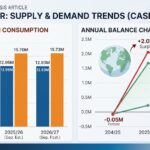
When India and Brazil’s dynamics are projected onto the global canvas, the 2026/27 supply-demand balance reveals that the global surplus has narrowed to a level where virtually any weather shock could tip it into deficit.
Institutional forecasts align in direction:
-
USDA Forecast: The USDA projects global sugar production falling by 1.2 million tonnes to 184.9 million tonnes, with declines in Brazil, the EU, the US, and Thailand offsetting India’s gains.
-
ISO Outlook: The International Sugar Organization (ISO) forecasts 2026/27 global production declining 1.15% year-on-year to 180 million tonnes, resulting in a 262,000-tonne global supply deficit.
The range of balance estimates across major trading houses reflects profound forecast uncertainty:
[2026/27 Global Sugar Balance Estimates Revision]
Czarnikow:  1.4M tonne Surplus  --->  100,000 tonne Deficit (Cut)
StoneX:     550,000 tonne Deficit
Covrig:     380,000 tonne Surplus --->  100,000 tonne Surplus (Trimmed)
The critical takeaway: the distance between surplus and deficit has become vanishingly small. Even a modest global output reduction of 1–2 million tonnes would be sufficient to erase the expected surplus and push the market into severe stock drawdowns.
El Niño: The Sword of Damocles
As analyst Chaturvedi noted, “El Niño is hanging over our heads.” Weather risk is the thread of uncertainty running through this entire landscape, and probability assessments have been revised upward in recent months.
The U.S. National Oceanic and Atmospheric Administration (NOAA) now assigns an 82% probability of El Niño conditions emerging before July, with a 37–40% chance of a “super” El Niño event by year-end.
The India Meteorological Department last Friday downgraded its cumulative June-to-September monsoon rainfall estimate from 92% of the long-term average (as forecast in April) to 90%.
El Niño’s impact mechanism involves a time lag that is often overlooked.
The immediate risks include harvest disruptions in Brazil’s Center-South region, as well as weaker cane development in India and Thailand if rainfall disappoints. But the greater risk may materialize in 2027/28: monsoon rainfall affects ratoon cane development and replanting in India and Thailand, meaning the full production impact often manifests one season later.
In other words, even if the 2026/27 season weathers the storm, the “bill” may arrive in the following crop year.
Historically, in years associated with El Niño, global production losses have exceeded 5 million tonnes — though wetter conditions in Brazil have at times partially offset losses elsewhere.
Synthesis and Outlook
Weaving these threads together, the global sugar market for 2026/27 can be characterized as a “fragile equilibrium under triple pressure”:
First, biofuel policy has become a structural constraint on sugar supply. Whether through India’s drive to reduce crude import dependence via ethanol or Brazil’s steadily rising mandatory blending ratios that underpin ethanol demand, sugarcane as a feedstock is being continuously pulled from the plate to the fuel tank. For the global sugar market, Brazil’s record-setting ethanol outlook intensifies competition for cane. Stronger mandates and greater policy clarity around higher blending ratios structurally tilt production toward ethanol at the margin — particularly when local fuel economics are favorable.
Second, oil prices are the “master switch” of this mechanism. Brazil’s market-driven flexibility means sugar prices are tightly bound to oil, while India’s administered pricing creates a different kind of oil-price dependence. Though operating through different mechanisms, both nations are pulled by the same energy variable.
The recent oil price retreat has already begun to shift the balance: WTI crude fell to a three-and-a-half-month low, weakening ethanol economics and potentially prompting global mills to redirect cane crushing toward sugar rather than ethanol — thereby adding supply to the sweetener market.
Third, El Niño is the amplifier. With the surplus already narrowed to the single-digit millions of tonnes, El Niño need not cause catastrophic crop failure to push the market into deficit. This explains why sugar prices have recently oscillated between “ample supply” and “climate risk” narratives.
Some analysts argue that if a strong El Niño simultaneously strikes India and Thailand, sugar prices could surge to 24 cents per pound — nearly double current levels.
In closing, the ynsugar analysis team acknowledges uncertainty around whether 24 cents is achievable, but identifies three signals most worth monitoring in the months ahead: whether the Indian government ultimately raises ethanol procurement prices (which determines the “sugar or ethanol” calculus); how the actual sugar-ethanol mix evolves during Brazil’s Center-South crush season; and the intensity of El Niño development alongside monsoon performance.
A surprise in any one of these factors could tip the delicate “surplus or deficit” balance decisively in one direction. The current low-price environment appears stable, but it rests on a series of assumptions that have yet to be resolved.
As of June 18, raw sugar futures traded at 14.13 cents per pound — down 5.86% over the past month and 11.20% lower year-on-year — driven by easing Middle East tensions and a sharp decline in oil prices that has reduced ethanol’s competitive edge.
Markets remain in constant flux. Nothing can be ruled out.
Note: This analysis incorporates data and perspectives from the ISO, USDA, NOAA, Czarnikow, StoneX, Covrig Analytics, ISMA, UNICA, and other institutions, combined with the ynsugar analysis team’s commentary. This content is provided for informational purposes only and should not be used as a basis for trading decisions.