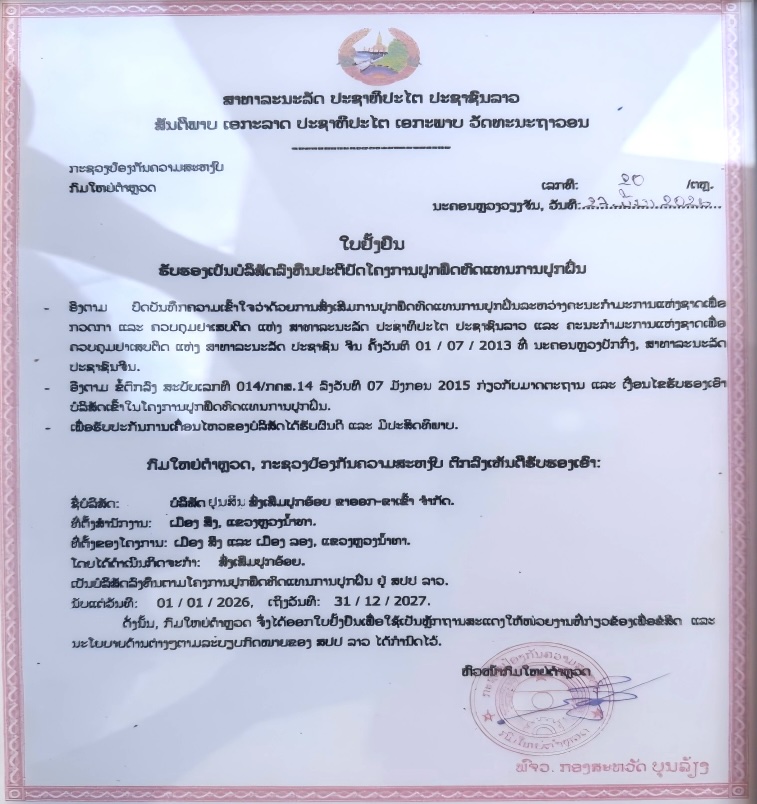
A Chinese Yunnan Sugar Company Receives Laos Alternative Crop Cultivation Certificate
May 4, 2026 — The Anti-Drug Commission of Namtha Province, Laos, convened a counter-narcotics working conference. The management and staff representatives of a Yunnan Province-based Chinese sugar company attended by invitation, joining delegates from the Drug Inspection and Control Division of the Namtha Provincial Public Security Department and other law enforcement representatives to discuss anti-drug strategies and advance government-enterprise cooperation.
The meeting focused on two core agenda items.
First, both sides conducted a thorough review and in-depth exchange on counter-narcotics work plans for the second half of 2026. Discussions centered on key priorities including eradicating illicit crops, eliminating drug cultivation, and expanding alternative crop programs. Participants reached consensus on follow-up cooperation directions and work priorities, ensuring seamless coordination and unified efforts in counter-narcotics operations along the China-Laos border.
Second, a certificate presentation ceremony was held in which the Drug Inspection and Control Division of the Namtha Provincial Public Security Department officially awarded a Poppy Alternative Crop Cultivation Certificate to the Chinese sugar company. Lao representatives pledged to strictly uphold the drug control laws and regulations of both China and Laos, to fully support the company’s sugarcane alternative crop cultivation activities in Namtha Province, and to jointly advance dedicated campaigns to eradicate drug crop cultivation at the source.
At the meeting, Lao representatives highly commended and formally recognized the sugar company’s years of achievements in developing sugarcane cultivation in Laos. They affirmed the company’s long-standing commitment to cooperating in poppy eradication and supporting local counter-narcotics efforts, and praised it as a model enterprise for alternative crop cultivation and anti-drug cooperation along the China-Laos border — one that has made important contributions to increasing local farmers’ income, improving livelihoods, and eliminating the conditions that foster drug production.
China’s Sugarcane Imports from Laos (2015–2026)
Source: General Administration of Customs, PRC
| Year | Total China Imports (10k tons) | Imports from Laos (10k tons) | Share of Lao Cane (%) |
|---|---|---|---|
| 2015 | 105.41 | 24.30 | 23.05% |
| 2016 | 80.70 | 21.14 | 26.20% |
| 2017 | 98.59 | 31.98 | 32.44% |
| 2018 | 118.40 | 48.74 | 41.17% |
| 2019 | 141.62 | 60.07 | 42.42% |
| 2020 | 170.55 | 78.51 | 46.03% |
| 2021 | 177.00 | 116.10 | 65.59% |
| 2022 | 215.04 | 109.89 | 51.10% |
| 2023 | 190.90 | 117.88 | 61.75% |
| 2024 | 298.41 | 143.45 | 48.07% |
| 2025 | 359.07 | 117.03 | 32.59% |
| 2026 (Jan–Feb) | 153.32 | 44.31 | 28.90% |
Looking ahead, both sides will seize this meeting as an opportunity to continuously deepen cooperation with Namtha Province’s anti-drug and public security authorities, steadily expand the scale of sugarcane alternative crop cultivation, strictly implement counter-narcotics requirements, and use the power of industry to build a robust barrier against drug production — contributing an enterprise-driven force to the building of a China-Laos community with a shared future.
-
Q: What is alternative planting in the China-Laos border region?
-
A: It is a strategic program replacing illicit poppy cultivation with economic crops like sugarcane to improve local livelihoods and security.
Related Articles:From Replacement Planting to the Border-Industrial Complex: The Structural Evolution of China-Laos Cross-Border Sugarcane Trade (2011–2026)