As experts monitor the El Niño 2026 Sugar Impact, latest probabilities suggest a major shift in the global supply map…
After more than a year of La Niña-neutral conditions, the world’s leading meteorological agencies are converging on a striking consensus: El Niño is poised to return by mid-2026, and it could come back with force. For the global sugar industry—already navigating tight balance sheets—this shift in the Pacific could redraw the supply map for the 2026/27 crop year.
A Rapid Shift Toward High-Confidence Forecasts
Just two months ago, the World Meteorological Organization (WMO) placed the probability of El Niño emerging between March and May at a mere 10%, with neutral conditions dominating at 60% and lingering La Niña at 30%. That picture has changed dramatically. In its latest update released on April 24, the Geneva-based WMO reported that sea surface temperatures in the equatorial Pacific are rising rapidly, signaling that El Niño could re-emerge as early as the May–July window.
The probabilities from major forecasting centers now line up clearly:
- NOAA’s Climate Prediction Center has issued a “Final La Niña Advisory / El Niño Watch,” placing the probability of El Niño formation at 61% for May–July and 62% for June–August 2026, with conditions expected to persist through year-end.
- Columbia University’s International Research Institute (IRI) projects El Niño conditions at 70% probability for April–June, climbing to 88%–94% through the remainder of the forecast horizon.
- The Japan Meteorological Agency puts the odds of El Niño during the Northern Hemisphere summer at 70%.
- China’s meteorological authorities expect El Niño to emerge in May and persist through the end of 2026.
⛈ Weather Risk Matrix: Supply shortfalls driven by El Niño are expected to push import demand higher — read our China sugar import report for a complete demand response analysis.
What is drawing particular attention is not merely the timing but the potential intensity. Wilfran Moufouma Okia, WMO’s head of climate prediction, stated that after a neutral start to the year, models are in strong agreement: “We have high confidence that El Niño is on its way and will intensify. Models suggest this could be a strong El Niño event… forecasts after April will become more reliable.” U.S. meteorologists estimate roughly a one-in-three chance of a “strong” event during October–December, while European climate models assign even higher odds to a “super El Niño” scenario.
The underlying physics supports these concerns. While surface temperatures in the equatorial Pacific remain near average, subsurface heat content is building rapidly—a classic precursor to El Niño development. Forecasters caution, however, that the so-called “spring predictability barrier” limits near-term certainty, and confidence typically sharpens after April.
Why Sugar Is Especially Exposed
Few agricultural commodities are as weather-sensitive as sugar, and few are as geographically concentrated. Brazil, India, and Thailand together account for the bulk of global cane production—and each sits squarely in El Niño’s zone of influence. The 2015–2016 super El Niño offers a sobering precedent: it triggered severe drought across Australia and Southeast Asia, weakened the Indian monsoon, and cut output of grains, palm oil, and sugar alike.
The transmission channels for 2026/27 are already well understood:
In Brazil, El Niño typically brings excess rainfall to the Center-South, slowing cane harvesting and crushing while reducing total recoverable sugar (ATR) per tonne. Waterlogged fields and field-access delays are a recurring feature of El Niño years in São Paulo state.
In India and Thailand, the dynamic reverses. El Niño is strongly associated with hotter, drier conditions and a weakened monsoon. The India Meteorological Department has already warned that the South Asian monsoon could fall below average for the first time in three years—an ominous signal for cane-growing regions dependent on both rainfed agriculture and monsoon-replenished irrigation.
Analysts at Czarnikow note that El Niño’s typical footprint of heat and drought across Asia is likely to weigh negatively on cane crops just as the 2026/27 planting and growing cycle begins.
The Market Is Already Repricing the Balance Sheet
The speed with which analysts have revised their supply-demand projections speaks to the seriousness of the threat. In just two months, the outlook for global sugar has shifted from comfortable surplus to near-tight balance:
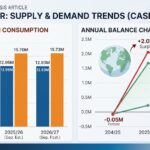
- Czarnikow International has cut its 2026/27 global sugar surplus forecast to 1.1 million tonnes, down 300,000 tonnes from March—and a sharp 2.3 million tonne reduction from February’s estimate of 3.4 million tonnes.
- Global sugar production for 2026/27 is now pegged at 180.4 million tonnes, 200,000 tonnes lower than the previous estimate.
- Global consumption has been revised upward to 179.3 million tonnes, adding pressure to an already tightening balance.
In other words, what looked like a well-cushioned market just weeks ago has been pared down to roughly one million tonnes of breathing room—a fragile buffer by any historical measure.
Price Outlook: Bias to the Upside
Sugar is one of the commodities analysts flag most often when discussing El Niño-driven price risk. Michael Ferrari, a commodity market analyst, has cautioned that the combination of an emerging El Niño and supply disruptions tied to West Asian geopolitical tensions could weigh on global cane production and lift sugar prices in the months ahead. Other analysts have similarly identified cocoa, edible oils, rice, and sugar as the commodities most exposed to El Niño’s upward pressure on prices.
The geopolitical overlay amplifies the climate signal. Arab-region economies, highly vulnerable to food-price swings, are already flagged as front-line losers should a “super El Niño” collide with ongoing disruptions to fertilizer supply and shipping routes. For sugar specifically, the combination of reduced yield in Asia, harvest delays in Brazil, and elevated freight risks could translate into a structurally higher price floor through the 2026/27 crush.
YnSugar:Key Takeaways for Industry Stakeholders
The probability of an El Niño event materializing by mid-2026 now stands in a 60%–94% range across major forecasting centers, with models pointing to moderate-to-strong intensity. Forecast confidence is expected to improve substantially after April, making the May and June updates critical waypoints for the industry.
For traders, refiners, food manufacturers, and agricultural financiers, several strategic implications stand out:
- Hedging windows may be closing. With the market already revising surplus estimates downward, delayed hedging carries rising carry costs.
- Origination diversity matters more than ever. Over-reliance on any single origin—particularly Indian or Thai raws—introduces concentrated weather risk.
- Inventory policy should reflect tail risk. A strong-to-super El Niño scenario is no longer a low-probability event; contingency stocks should be sized accordingly.
- Watch the monsoon. India’s June–September monsoon will be the single most important data point for global sugar balance in the second half of 2026.
El Niño does not guarantee shortage—but in a market already operating without meaningful slack, it tilts the balance of risks decisively to the upside. The next three months will determine whether 2026/27 turns out to be a manageable tightening cycle or the start of a more disruptive re-pricing of global sugar.
Further Reading: Czarnikow’s Global Sugar Surplus Forecast for 2026
Disclaimer: This article is for informational purposes only and does not constitute financial or investment advice. The weather probabilities and market forecasts cited (including data from WMO, NOAA, IRI, and Czarnikow) are based on the latest available information as of April 24, 2026. Agricultural markets are subject to high volatility; ynsugar.com is not responsible for any market decisions made based on this content.