China’s largest sugar-producing region has closed the books on another crushing season — and the numbers are impressive.
On May 9, 2026, the last sugar mill in Guangxi officially ceased crushing operations, marking the end of the 2025/26 season. The region, which consistently accounts for the lion’s share of China’s domestic sugar supply, delivered a standout production performance this year.
Production Highlights
Guangxi crushed a total of 60.93 million tonnes of sugarcane during the season, up 12.33 million tonnes year-on-year. That translated into 7.70 million tonnes of sugar — a gain of 1.23 million tonnes, or 19.06% higher than the previous season. It’s a result that will turn heads across the global sugar trade.
The one cautionary note in the data is the average sugar recovery rate, which came in at 12.63% — down 0.67 percentage points from the prior season’s 13.30%. While still a solid extraction rate, the dip suggests that cane quality or processing conditions were slightly less favorable despite the higher volume throughput.
Sales and Inventory Outlook
Through the end of May, Guangxi had sold 4.49 million tonnes of sugar, down 155,100 tonnes compared to the same period last year. The production-to-sales ratio stood at 58.33%, falling 13.52 percentage points year-on-year — a clear signal that supply is running well ahead of near-term demand absorption.
With roughly 3.2 million tonnes still sitting in inventory as the new marketing year gets underway, domestic price pressure in China may persist in the months ahead. Traders and importers watching China’s sugar balance sheet will want to factor this supply overhang into their forward planning.
China’s largest sugar-producing region has closed the books on another crushing season — and the numbers are impressive. On May 9, 2026, the last sugar mill in Guangxi officially ceased crushing operations, marking the end of the 2025/26 season. The region, which consistently accounts for the lion’s share of China’s domestic sugar supply, delivered a standout production performance this year.
Production Highlights: Crushing Volumes and Extraction Dip
Guangxi crushed a total of 60.93 million tonnes of sugarcane during the season, up 12.33 million tonnes year-on-year. That translated into 7.70 million tonnes of sugar — a gain of 1.23 million tonnes, or 19.06% higher than the previous season. It’s a result that will turn heads across the global sugar trade.
The one cautionary note in the data is the average sugar recovery rate, which came in at 12.63% — down 0.67 percentage points from the prior season’s 13.30%. While still a solid extraction rate, the dip suggests that cane quality or processing conditions were slightly less favorable despite the higher volume throughput.
Sales and Inventory Outlook: Managing the Domestic Surplus
Through the end of May, Guangxi had sold 4.49 million tonnes of sugar, down 155,100 tonnes compared to the same period last year. The production-to-sales ratio stood at 58.33%, falling 13.52 percentage points year-on-year — a clear signal that supply is running well ahead of near-term demand absorption.
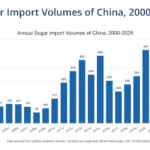
While Guangxi’s domestic output expansion cushions regional supply security, macro-hedgers and international trade desks must look at the external balance sheet. To assess how this domestic 3.2 million-tonne overhang interacts with international custom inflows, read our benchmark asset:
China Sugar Import Report 2025–2026: GACC Volumes, CIF Pricing Patterns & Structural Shifts
.
With roughly 3.2 million tonnes still sitting in inventory as the new marketing year gets underway, domestic price pressure in China may persist in the months ahead. Traders and importers watching China’s sugar balance sheet will want to factor this supply overhang into their forward planning.