El Niño Global Sugar Outlook heading into 2026/27 reveals a climate signal that is splitting fortunes across the world’s largest producing regions—but a record Brazilian crop and resilient global stocks mean a repeat of past price spikes is far from assured.
The Climate Signal: A Fast-Developing El Niño
After two seasons shaped by La Niña and recovery, the tropical Pacific is shifting decisively. As of mid-May 2026, the equatorial Pacific is transitioning rapidly into El Niño conditions. Monthly sea-surface temperature anomalies remain near the borderline threshold, but weekly values have surged well above it—a clear move from ENSO-neutral toward El Niño.
The forecasting consensus is unusually firm:
- NOAA‘s Climate Prediction Center puts the odds of El Niño emerging at 82% for May–July 2026, rising to 96% for December 2026–February 2027.
- Columbia University’s CCSR/IRI ENSO plume is even more emphatic, with probabilities peaking at 98% through mid-2026 and holding at 97–98% into early 2027, while the chance of La Niña developing is effectively zero.
What remains unsettled is intensity. No single strength category exceeds a 37% probability, leaving the question of whether 2026 produces a strong, fully coupled event genuinely open. One signal worth watching: the subsurface heat reservoir is substantial, with ocean heat content between the Date Line and 80°W now more than twice the level observed at the same point in mid-May 2023.
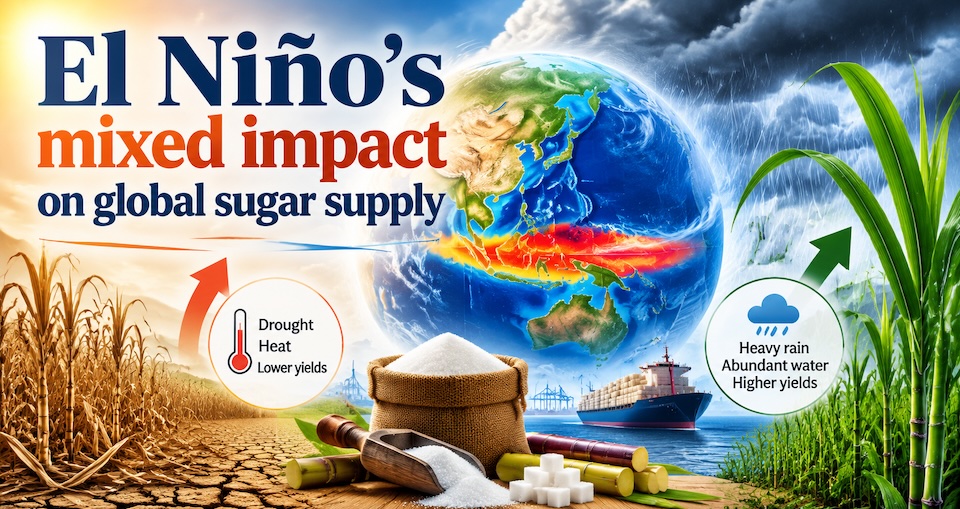
Critically, El Niño does not act uniformly. It tends to bring drought to Asia while delivering excess rain to Brazil—creating the sharp regional divergence now unfolding.
Where the Major Producers Stand Today
The current snapshot is one of contrasts rather than crisis.
- Brazil’s Center-South: The world’s single largest cane region—the 2026/27 crush opened on April 1 to a strong start. Abundant rainfall through 2025 has lifted yields and confirmed an ample cane crop. UNICA data showed April Center-South sugar output up 55.3% year-on-year to 2.475 million tonnes, with sucrose content per tonne up 5.4%.
- Northern Hemisphere (India & Thailand): Producers are in the critical pre-season cane-growth window, which makes June–September rainfall decisive for 2026/27. Thailand’s rainfall has so far shown no anomalies, but India’s monsoon forecast—now trimmed to roughly 90% of the long-period average (LPA)—has become the market’s central source of risk.
- China’s main producing region, Guangxi: It is in its spring growth phase, where planted area has expanded notably and crop conditions are reported as the best in several years.
India: Monsoon Doubts and a Recovery at Risk
India, the world’s second-largest producer, draws the closest scrutiny because its cane crop lives or dies by the southwest monsoon. The India Meteorological Department (IMD) initially projected the 2026 monsoon at around 92% of average, then lowered its cumulative June–September estimate to 90%. The shortfall is concentrated in the central, southern and northwestern producing belts—precisely where localized drought stress would bite during early growth.
The mechanism is well established. Two consecutive years of above-normal rainfall in 2024 and 2025 had rebuilt groundwater and surface reserves across Maharashtra, Uttar Pradesh and Karnataka, repairing the irrigation deficit left by the 2023 El Niño. A weak monsoon now threatens to reverse that recovery just as the buffer is being drawn upon.
Output forecasts remain split. The USDA’s New Delhi post projects 2026/27 production at 33.6 million tonnes (raw value)—a 12% rise from the current year’s revised 30 million—based on March field surveys, but explicitly contingent on continued favourable weather and uninterrupted milling from October. Industry observers warn the return of El Niño changes that calculus: a below-normal monsoon reduces cane availability, compresses recovery rates and raises per-unit costs, meaning next season could prove worse than current projections, not better.
The Import Debate: Highly Unlikely
On the import debate now circulating in some quarters, the more cautious reading is that large-scale Indian imports remain highly unlikely. Historically, India has approved only small, low-duty raw-sugar imports under exceptional circumstances—446,000 tonnes in 2016/17 and 216,000 in 2017/18, after two consecutive drought years cut output by some 20% to 22.2 million tonnes and opened a deficit of around 5 million tonnes.
Today the picture is very different: 2025/26 has seen heavy rain and flooding, the production-consumption gap sits near balance at roughly 1 million tonnes, and stocks remain near the ~5-million-tonne safety level. India’s policy lever is an export ban rather than open imports, with a 100% import duty intact. A genuine import case would require two consecutive years of sharp losses, a multi-million-tonne deficit, and depleted stocks—at which point the more probable outcome is that India reconsiders exports instead.
Thailand: Below-Normal Rain and an Acreage Retreat
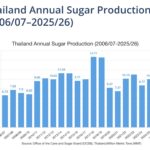
Thailand’s story mirrors India’s. Czarnikow has cut its 2026/27 production forecast to 9.8 million tonnes, citing below-normal rainfall and the prospect of a drier El Niño. The pressure is not only meteorological—White Cane Leaf Disease is stressing some crops, while low cane prices and rising input costs squeeze farmer cashflow.
The deeper risk is acreage. The USDA’s Bangkok post sees cane output falling 8% from the 2025/26 peak as planted area contracts following a February pricing decision that set the farm-gate price below the cost of production. Combined with weather, the USDA forecasts a 16% drop in sugar output, with the export reduction expected to be of comparable scale as northeastern farmers weigh switching crops. That said, with rainfall patterns in Thailand resembling China’s, the net El Niño impact here is closer to neutral and will ultimately hinge on actual June–September rain and irrigation conditions.
Brazil: Too Much Rain, Not Too Little
In the Southern Hemisphere, El Niño’s effects invert. Rather than drought, Brazil’s Center-South typically receives excess rain and reduced sunshine, which disrupts harvesting and lowers Total Recoverable Sugar (ATR) rather than total tonnage.
Underlying conditions look constructive: 2026/27 cane production is forecast to rise about 2% to 675 million tonnes after normal rainfall through 2025 helped fields recover from the 2024 drought. The key swing factor is the sugar/ethanol mix—estimated at 48% sugar and 52% ethanol—which weakens any direct read-through from weather to sugar output. This is why Brazilian sugar forecasts diverge so widely, from the USDA’s ~42.5 million tonnes to Citigroup’s 39.5 million, the latter citing greater ethanol allocation amid high gasoline prices.
The practical takeaway: Heavier rain will affect the pace of harvest, not the volume of cane. Brazil’s ample crop should be realized, and final sugar output will depend chiefly on mills’ allocation decisions. This cushion is what most directly offsets potential Northern Hemisphere losses.
The European Union: A Shrinking Beet Crop
Europe’s beet belt faces both weather variability and structural decline. The Copernicus Climate Change Service notes rising extreme-weather frequency—drought-cut yields in France and Germany, spring frost damage in Poland, and excess rain lowering sugar content in the Netherlands.
The headline driver, though, is acreage. EU and UK farmers are cutting beet area for 2026/27 by an estimated 7–8%, pushing sowings to decade-low levels. The USDA sees EU production falling 5% to 15.5 million tonnes, with area down 8%, concentrated in France and Germany. With consumption broadly stable, the European balance is expected to swing from surplus in 2025/26 to deficit in 2026/27, requiring higher imports or price rationing.
China: A Quietly Bullish Crop—and Drainage on Standby
China stands apart. Historically, there has been no direct link between El Niño and Guangxi cane output, and a stronger or weaker event is unlikely to move Chinese production much. For 2026/27, the signals are constructively bullish: planted area has confirmed an increase, soil moisture and seedling vigour are at multi-year bests, and rainfall has been frequent—locally record-breaking—favouring growth.
The Guangxi Climate Center has flagged that the analog years most similar to 2026—namely 2023, 2018 and 2014—saw the region’s “Dragon Boat rains” arrive late and turn extreme, with significant flooding. It forecasts roughly five major heavy-rain episodes this year, the strongest in mid-June, with high flood risk across the northeast, western coast and parts of the west.
🌧️ Mitigation Strategy Activated
Should waterlogging occur, cane areas are set to activate drainage immediately—ditch-clearing and mechanical pumping coordinated across local sugar authorities, mills and power suppliers—to clear standing water fast and prevent root rot.
Historical Context: El Niño Does Not Equal Higher Prices
The record cautions against assuming a price spike is automatic.
- The 2014–16 super-event: It was the most consequential: global output fell across two seasons for cumulative losses estimated above 10 million tonnes, the direct cause of the 2016 price surge.
- The 2018 weak event: Caused no global shortfall—indeed, the lagged “low prices, less planting” effect left a surplus, masked by the subsequent La Niña and the wider industry cycle.
- The 2023–24 moderate-to-strong event: Tipped the market from surplus into a slim deficit of around 100,000 tonnes, cutting Thai cane from 93 to 76 million tonnes—yet a record ~40-million-tonne Brazilian crop meant global supply held and prices fell rather than rose.
The 2026 event is likely to land between 2023–24 and 2014–16 in impact—but with two structural differences. First, the stock buffer: the global stocks-to-use ratio sits near its historical mean, thicker than the eve of the 2015/16 drawdown. Second, Brazil’s production regulator: rising cane output should offset any decline in the sugar ratio, so Brazil is likely to stay high-yielding and partly absorb Indian and Thai losses.
The Bottom Line: A Global Balance on a Knife-Edge
The 2025/26 season is ending in comfortable oversupply, but the 2026/27 cushion is thin enough that weather could erase it.
| Agency / Forecaster | 2025/26 Balance Balance | 2026/27 Balance Forecast | Key Drivers / Market Remarks |
|---|---|---|---|
| ISO (International Sugar Organization) | +2.20M tonnes (Surplus) | -262,000 tonnes (Deficit) | Production falling 1.15% to 180M tonnes due to El Niño risk in India & Thailand. |
| Czarnikow | Comfortable Oversupply | +1.40M tonnes (Surplus) | A modest global loss of 0–2M tonnes would wipe out the remaining cushion completely. |
| Forecaster Consensus Range | +2.74M to +8.30M tonnes | +156,000 to +3.40M tonnes | Upper bound drops dramatically; high vulnerability to stock drawdown. |
The analytical core is vulnerability. As Czarnikow notes, even with the 2026/27 surplus raised to 1.4 million tonnes, a modest global loss of 0–2 million tonnes would be enough to wipe it out and push the market into stock drawdown. And cane is resilient in a way that defers risk: poor monsoon rain impairs ratoon development and replanting, so the full hit often appears a season later—meaning even if 2026/27 escapes a major shortfall, the larger risk may surface in 2027/28.
But a historic, sustained rally on the scale of 2009–2011 looks unlikely. Global planted area has not contracted sharply, a severe shortage is improbable, and the more plausible outcome is a range-bound market—supported below, capped above. El Niño is a powerful catalyst, not an absolute switch; whether it drives a trend depends on its actual strength, geography, timing and duration, alongside global stocks and producer policy.
Bearish De-railers to Watch:
- Brazil’s Sugar Mix: Whether Brazil keeps its sugar mix low (above ~47% would pressure prices).
- India’s Policy Redirection: Whether India diverts ethanol back to sugar if drought materializes (≈3.5 million tonnes went to ethanol in 2025/26).
- Monsoon Outperformance: The actual June–September monsoon, which alone could end the weather trade if it improves.
- Indian Export Deadlocks: Indian export execution, where only ~900,000 of an authorized 2 million tonnes is expected to ship—leaving more sugar at home and further reducing any import need.
In summary: the near term belongs to Brazil, whose peak crush is releasing abundant supply and pressuring prices. As the year progresses, building risks across India, Thailand and the EU look set to tighten the balance. With the 2026/27 cushion already paper-thin, El Niño has moved from background factor to the single most important upside risk for sugar prices—even as a record Brazilian crop and healthy stocks argue against a runaway repeat of past spikes.
⚖️ Legal Disclaimer
The information and analysis provided in this article are for informational and educational purposes only. While we strive to ensure the accuracy and reliability of the data sourced from official organizations (such as ISO, USDA, UNICA, and IMD), ynsugar.com does not guarantee the absolute completeness or timeliness of the information. This content does not constitute financial, investment, or trading advice. Readers and market participants should conduct their own independent research before making any commercial decisions. ynsugar.com shall not be held liable for any trading losses or damages resulting from the use of this report.