Brazil sugar exports 2026 data released by the Secretariat of Foreign Trade (Secex) on July 3 show a broad-based slowdown, with June shipment volumes, revenue, and average prices all falling compared to the same period last year.
Export Volume Declines, Daily Average Drop Even Steeper
Brazil exported 3.127 million tonnes of sugar in June 2026, down 7.16% from the 3.368 million tonnes shipped in June 2025.
The comparison is complicated by calendar differences: June 2026 had 21 working days, while June 2025 had only 20. Adjusting for this, the picture looks worse than the headline figure suggests.
-
Daily average export volume (June 2026): approximately 148,900 tonnes
-
Daily average export volume (June 2025): approximately 168,400 tonnes
-
Daily average decline: approximately 12%
This working-day-adjusted comparison shows that the underlying slowdown in export pace was more pronounced than the raw monthly totals indicate.
Revenue and Prices Fall Faster Than Volume
The financial impact was even sharper than the volume decline. June export revenue fell 24.26% year-on-year, dropping from $1.443 billion to $1.093 billion.
This steep revenue decline was driven primarily by falling prices. The average export price fell from $428.54 per tonne in June 2025 to $349.59 per tonne in June 2026, a drop of roughly 18.4%. The fact that revenue fell more than three times faster than volume underscores how much weaker global sugar prices weighed on Brazil’s export earnings.
First-Half 2026 Trends Confirm the Downturn
Looking at the first six months of 2026 as a whole, the same pattern holds across all three metrics:
-
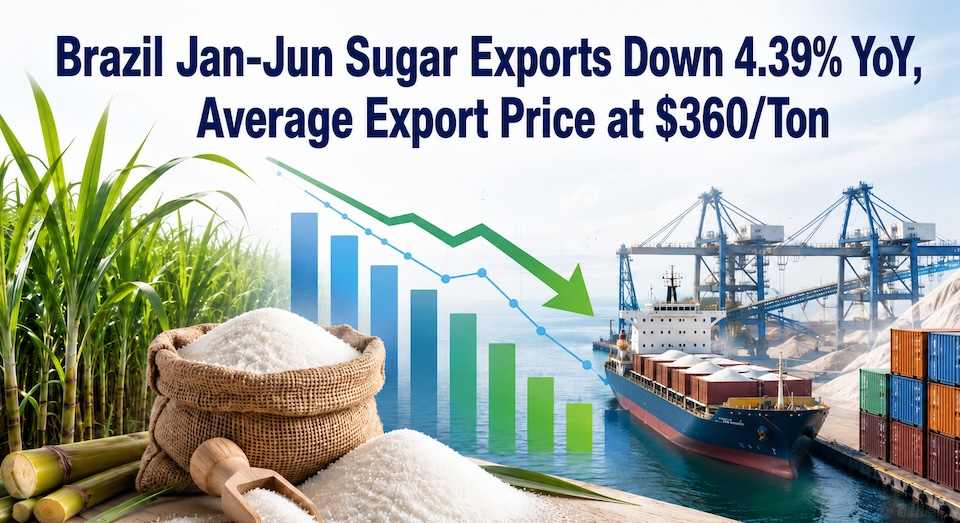
Cumulative export volume: 12.295 million tonnes, down 4.39% from 12.86 million tonnes in H1 2025
-
Cumulative export revenue: $4.426 billion, down 24.98% from $5.900 billion in H1 2025
-
Average export price: $360.01 per tonne, down 21.53% from $458.79 per tonne in H1 2025
Analysis: Global Price Pressure Is the Key Driver
According to the ynsugar research team, the simultaneous decline across volume, revenue, and average price in H1 2026 points to a clear conclusion: falling global sugar prices, rather than reduced demand or logistical constraints, are the primary force squeezing Brazil’s sugar export earnings this year. The fact that revenue and price declines consistently outpace volume declines — both in June and across the first half of the year — supports this reading.
Note on data scope: Brazil’s sugar export statistics primarily reflect raw sugar shipments, with smaller volumes of refined sugar and molasses also included in the totals.
Disclaimer:This article is based on data published by Brazil’s Secretariat of Foreign Trade (Secex) and is provided for informational purposes only. It does not constitute financial, investment, or trading advice. Market conditions and figures may be subject to revision. Readers should consult official Secex publications or a qualified commodities analyst before making business or investment decisions based on this information.