In a major leap for sugarcane breeding technology, a new high-density SNP array — built from the most comprehensive whole-genome scan of sugarcane to date — could transform how breeders develop better varieties for sugar and bioenergy production.
Sugarcane is one of the most economically critical crops on the planet. It supplies nearly 80% of the world’s sugar and 40% of its bioethanol, yet breeders have long struggled with a fundamental challenge: sugarcane has one of the most complex genomes in the plant kingdom. With roughly 100–120 chromosomes and a genome roughly ten times larger than the human genome (~10 Gb), identifying the genetic markers that matter for breeding has historically been slow, expensive, and incomplete.
A new study published in the Journal of Integrative Plant Biology (Huang et al., 2026) describes a breakthrough tool designed to change that.
📷 Research Context
What Is a SNP Array — and Why Does It Matter for Sugarcane?
A Single Nucleotide Polymorphism (SNP) is a single-letter variation in a DNA sequence that can differ between individual plants. By tracking thousands of these variation points simultaneously, breeders can link specific genetic markers to desirable traits — like higher sugar content, disease resistance, or drought tolerance — and use that knowledge to make faster, more informed breeding decisions. This approach is called marker-assisted breeding, and it’s already standard practice in crops like maize and wheat.
For sugarcane, however, the extreme complexity of its polyploid genome has made SNP array development particularly difficult. Two earlier arrays were developed independently in Australia and the United States, but both relied on a technique called reduced-representation genome sequencing, which only captures a fraction of the genome and can miss important functional regions.
Building SBA 1.0 from the Ground Up
The research team took a more comprehensive approach. Using whole-genome resequencing data from 54 diverse sugarcane accessions, they identified 39.2 million SNPs — an enormous pool from which to select the most informative markers.
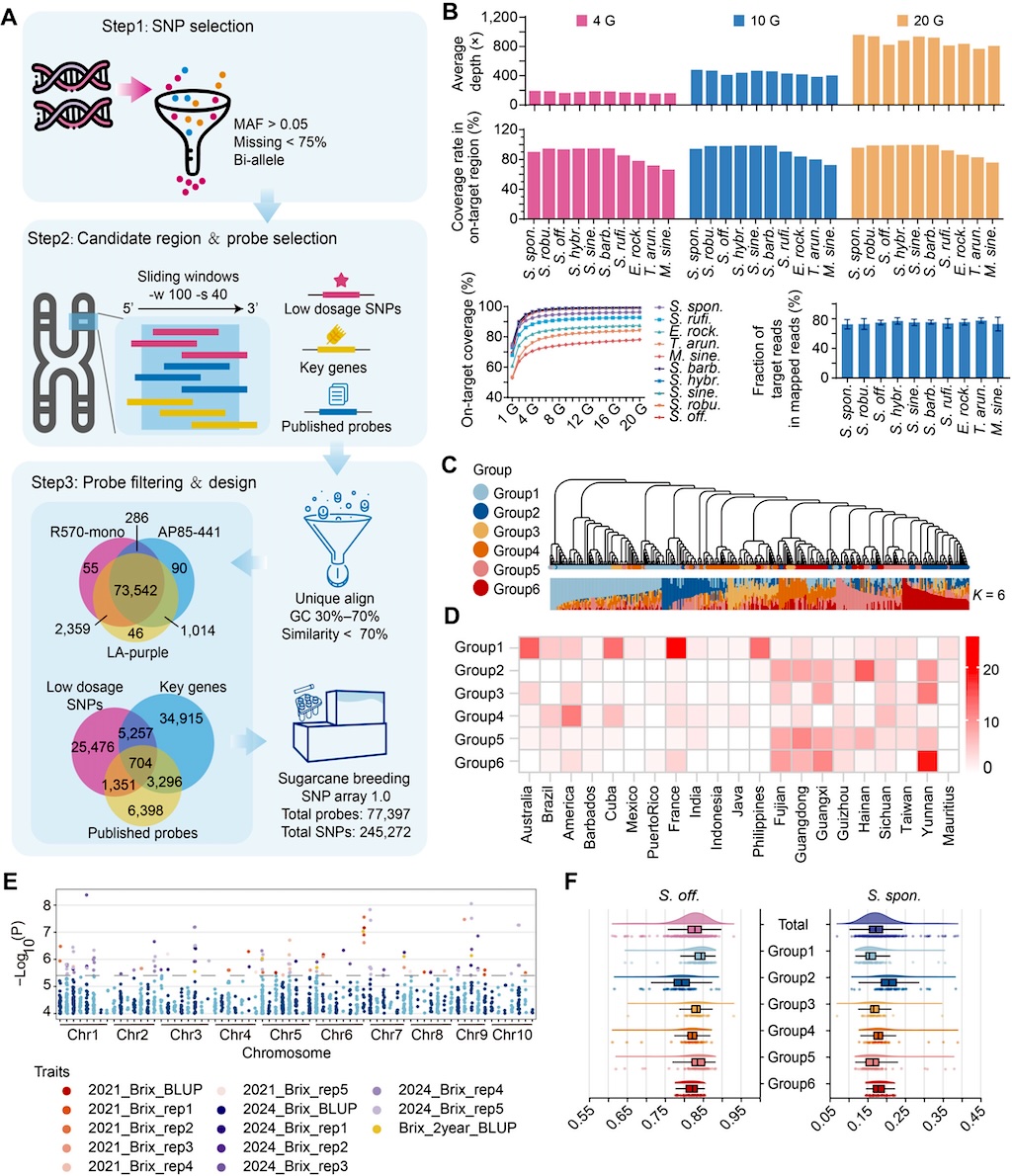
From this pool, they designed the Sugarcane Breeding Array 1.0 (SBA 1.0), a liquid-phase capture array targeting 245,272 high-quality SNPs spread across 77,392 genomic regions. Key design highlights include:
-
Coverage of 13,532 sugarcane genes — about 53.5% of all genes in the reference genome (R570)
-
8,055 genes with confirmed functional equivalents in other plant species, enabling cross-species biological insights
-
77.61% of SNPs located within gene regions, maximizing the chance that markers are biologically meaningful
-
Inclusion of low-dosage SNPs, which are especially important for polyploid species like sugarcane
Validation: Cost-Effective and Broadly Applicable
Before deploying the array at scale, the team rigorously tested its performance. With just 4 gigabases (Gb) of sequencing data per sample, 70% of tested genotypes achieved over 90% target coverage — and adding more data beyond that point didn’t substantially increase coverage, a sign of high capture efficiency. This “saturation” behavior is important: it means researchers aren’t wasting money on unnecessary sequencing.
Genotyping consistency reached 95% in Saccharum accessions and 94% in related species — accuracy levels that support confident downstream analysis. The array also performed well across 10 sugarcane and related species, suggesting broader applicability beyond just modern commercial varieties.
Population Structure and GWAS: What the Array Revealed
The team then put SBA 1.0 to work on 380 sugarcane accessions from around the world. Population structure analysis sorted the accessions into six distinct groups, revealing clear geographic patterns:
-
Groups 2, 4, and 6 were predominantly Chinese varieties
-
Groups 1 and 5 were largely from France and the United States
For genome-wide association studies (GWAS) on six yield-related traits, the array identified 36 multi-effect loci containing 1,513 genes. Among the notable findings:
-
A sucrose phosphate synthase gene associated with Brix (sugar content)
-
Genes related to plant architecture, including light signaling components (phytochrome C, cytochrome P450)
-
A cellulose synthase A2 gene linked to cell structure
Importantly, significant SNPs for the same trait often mapped to multiple homologous chromosomes — a direct reflection of sugarcane’s polyploid nature, and evidence that the array captures this complexity rather than flattening it.
Tracing Sugarcane’s Genetic Ancestry
Modern commercial sugarcane is a hybrid between two wild ancestors: Saccharum officinarum (the high-sugar species) and Saccharum spontaneum (a hardy, stress-tolerant wild relative). Using 13,351 diagnostic SNP markers, the team estimated that across the 380 accessions, the average genome is composed of ~87% S. officinarum* and ~12% S. spontaneum* — consistent with prior research.
One group (Group 2) stood out with a notably higher proportion of S. spontaneum alleles, suggesting these varieties may carry more wild-species traits, which could be valuable for stress tolerance breeding.
Why This Matters for the Future of Sugarcane
The release of SBA 1.0 addresses a long-standing bottleneck in sugarcane genomics. Unlike earlier arrays built on partial genome scans, this tool draws on whole-genome data, making it more comprehensive and future-proof. The authors note that the array’s design can be readily updated — adding or removing target SNPs as new genomic discoveries are made — ensuring it remains relevant as sugarcane science advances.
For a crop that must deliver more sugar and bioenergy on the same or shrinking land area, under increasingly unpredictable climate conditions, tools like SBA 1.0 are not just scientifically interesting — they’re practically essential.
Source: Huang et al. (2026). Sugarcane Breeding Array 1.0: A high-density SNP array for population genomics and molecular breeding in sugarcane. Journal of Integrative Plant Biology. Read the original study →