The newly launched China sugar trade risk index shows that the market remains technically stable heading into 2026, but a sweeping national policy pivot signals that the era of unchecked agricultural import growth may be coming to a measured close.
China’s sugar trade remains technically stable heading into 2026, but a newly launched risk monitoring system and a sweeping national policy pivot are together signaling that the era of unchecked agricultural import growth may be coming to a measured close — with consequences that stretch well beyond sugar, and well beyond China’s borders.
A New Tool for Early Warning
The China Sugar Trade Risk Monitoring and Analysis Report (2026, Issue 1) was published by the Guangxi Sugar Trade Relief and Industry Security Early Warning Station, an institution officially backed by the local Department of Commerce and operated by Guangxi FTKJ Co., Ltd. The report marks the operational debut of China’s first quantitative sugar trade risk index — a framework designed to move the country’s trade defense posture from reactive policy responses to data-driven early warning.
At the heart of the system is the Domestic Sugar Trade Risk Index Model, which evaluates import-driven disruption across four core dimensions:
-
Import volume and cost pressure — the scale and pricing of inbound sugar flows
-
Substitute product penetration — the erosion of domestic demand by alternative sweeteners
-
Domestic industry damage — financial and operational harm to Chinese sugar producers
-
External trade environment — geopolitical and regulatory exposure in key supplier nations
Drawing on three to five years of historical baseline data, the model calculates deviation scores across each indicator and converts them into a composite risk score, which maps onto a four-tier traffic light system: 🟢 Green (Safe), 🟡 Yellow (Watch), 🔴 Red (Alert), and 🟥 Deep Red (High Risk). Beyond operational use, the data accumulated through this system can serve as evidentiary support for China’s WTO-related trade remedy proceedings, including anti-dumping and countervailing duty investigations.
Green Light Now, But Structural Cracks Forming
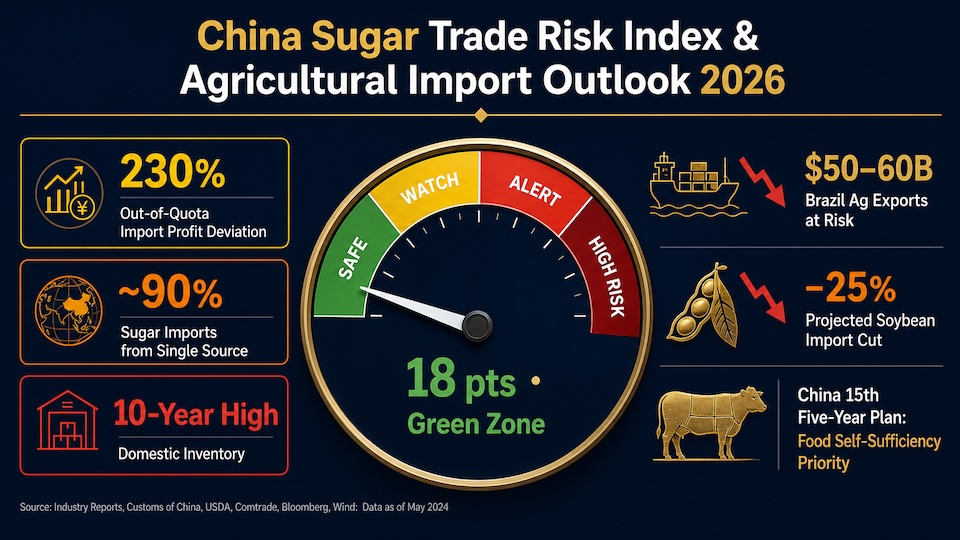
For January through April 2026, the composite index registered 18 points — firmly in the Green (Safe) zone. The headline number, however, conceals a set of quietly escalating structural pressures that the Station’s analysts were explicit in flagging:
-
Out-of-quota import profitability has surged 230% above its five-year average, creating powerful financial incentives for continued above-quota imports that could undercut domestic producers.
-
Approximately 90% of China’s sugar imports originate from a single country — Brazil — a concentration level that leaves the domestic market highly exposed to supply disruptions caused by weather events, logistics failures, or bilateral policy shifts.
-
Domestic sugar production and market supply have rebounded significantly this season, dragging down the destocking pace compared to historical norms — a trend that could trigger localized price pressure ahead.
-
The Station has committed to intensifying its monitoring of these indicators and will continue tracking supply chain developments to support the stability and long-term competitiveness of China’s sugar industry.
The Bigger Picture: China’s 15th Five-Year Plan and the Retreat from Import Dependence
The structural risks flagged in the sugar report do not exist in isolation. They reflect a broader and far-reaching policy direction embedded in China’s 14th Five-Year Plan successor — the 2026–2030 “15th Five-Year Plan” — released in March 2026. Food security and self-sufficiency are now explicit national priorities. The plan’s stated objective: secure domestic production capacity, anchor supply in the home market, moderate imports, and expand the diversity of goods available to consumers.
For Brazil — the world’s largest agricultural exporter and China’s dominant supplier across multiple commodity categories — this signals a potentially seismic shift in trade flows.
Brazil’s $50–60 Billion Exposure
“We are talking about approximately $50 to $60 billion in annual agricultural exports to China,” said Patrícia Ellen, former Secretary of Economic Development for the State of São Paulo. “The losses won’t happen overnight. They may be gradual,” she cautioned — but gradual does not mean manageable without preparation.
Brazil supplies China with dominant shares of several critical commodities. According to analysis by Systemiq, China sources an average of 71% of Brazil’s soybean exports and 54% of U.S. soybean exports. The firm estimates that full implementation of the 15th Five-Year Plan could reduce China’s soybean imports by as much as 23.5 million metric tons — a roughly 25% decline from current levels. Significant import reductions are also projected for beef, pork, and dairy products, while corn demand may see a modest uptick driven by adjustments in domestic feed formulations.
While the projected volume drops are most acute in grains and oilseeds, the strategic blueprint applies directly to sugar. As China optimizes its sweetening matrix and rigorously monitors import margins under the new risk model, Brazil’s over-reliance on the Chinese sugar market faces a parallel, structural cooling.
The U.S. Department of Agriculture currently projects China will produce 20.9 million metric tons of soybeans in the 2025/26 crop year while importing 112 million metric tons — a ratio that illustrates the continued structural reliance on imports, even as domestic production expands. For 2026/27, the USDA forecasts production of 21 million metric tons against imports of 114 million metric tons, suggesting the transition will be gradual rather than abrupt. Under conservative projections, Patrícia Ellen estimates Brazil could see its soybean exports to China fall by 10 to 20 million metric tons by 2030, translating to an annual trade value loss of $5 to $20 billion.
Not Just Volume — A Price and Margin Problem
The risk, however, extends beyond lost tonnage. “This is not just about quantities. A reduction in Chinese demand tends to put pressure on international prices, intensify competition, and compress profit margins across the entire supply chain,” Ellen noted. In other words, even producers who do not directly supply China would feel the price effects of reduced Chinese buying power rippling through global commodity markets.
Brazil’s Strategic Response: Diversify or Compress
Patrícia Ellen argues that the path forward for Brazilian agriculture is not defensive retrenchment but strategic restructuring — a dual agenda of diversification and market development. The priorities she outlines include selling a broader range of processed and value-added agricultural products, and cultivating buyers in markets that, while smaller in volume than China, offer better pricing and margin profiles.
For sugar specifically, the convergence of China’s supply chain concentration risk, slowing domestic inventory absorption, and a national policy pivot toward self-sufficiency creates a window — and an imperative — for both governments and industry participants to reassess their positions before gradual shifts become acute disruptions.
Data sources: Guangxi Sugar Trade Relief and Industry Security Early Warning Station; U.S. Department of Agriculture (USDA); Systemiq; statements by Patrícia Ellen, former São Paulo Secretary of Economic Development.
Disclaimer: The information, data, and analysis presented in this article are for informational and educational purposes only and do not constitute commercial, financial, or investment advice. While insights are drawn from official reports by the Guangxi Sugar Trade Relief Station, the USDA, and reputable industry analysts, ynsugar.com does not guarantee the absolute accuracy or completeness of the forward-looking projections. Market participants should conduct independent verification before making trade decisions.