This Brazil raw sugar exports analysis reveals that Brazil, the world’s largest sugar producer, has demonstrated remarkable resilience…
Executive Summary
Brazil, the world’s largest sugar producer and exporter, has demonstrated remarkable resilience and growth in its raw sugar export volumes over the past seven years. This analysis examines monthly export data from 2020 to early 2026, revealing key seasonal patterns, year-over-year trends, and critical market dynamics that shape global sugar trade.
Overview of Brazil’s Dominant Position
Brazil is the biggest producer and exporter of sugar in the world, accounting for 21% of total production and 45% of total exports.Sugar exports by Brazil are economically important globally because they reflect almost 50% of global sugar trade.
Brazil remains the world’s largest producer of sugarcane and sugar, with USDA forecasting total sugarcane production at approximately 671 million metric tons for MY 2025/26.
Monthly Brazil Raw Sugar Exports Analysis (2020-2026)
The Data at a Glance
| Month | 2020 | 2021 | 2022 | 2023 | 2024 | 2025 | 2026 |
|---|---|---|---|---|---|---|---|
| Jan | 160 | 210 | 136 | 212 | 320 | 206 | 202 |
| Feb | 129 | 185 | 172 | 115 | 302 | 183 | 223 |
| Mar | 142 | 183 | 144 | 183 | 272 | 185 | 181 |
| Apr | 151 | 190 | 133 | 97 | 189 | 156 | — |
| May | 258 | 270 | 158 | 247 | 281 | 226 | — |
| Jun | 297 | 275 | 236 | 308 | 320 | 336 | — |
| Jul | 284 | 247 | 288 | 298 | 378 | 359 | — |
| Aug | 308 | 260 | 304 | 382 | 393 | 374 | — |
| Sep | 312 | 258 | 308 | 321 | 395 | 325 | — |
| Oct | 395 | 232 | 375 | 288 | 373 | 420 | — |
| Nov | 290 | 266 | 407 | 368 | 339 | 330 | — |
| Dec | 298 | 194 | 222 | 385 | 284 | 291 | — |
Units: 10,000 metric tons
Key Observations
1. Strong Seasonal Pattern
Brazil’s raw sugar exports consistently follow a pronounced seasonal curve. The lowest export volumes typically occur in Q1 (January-April), coinciding with the inter-harvest period. Exports then surge from May onwards as the new harvest enters full swing, peaking between August and November.
2. Record-Breaking 2024 Performance
The 2024 marketing year stands out as exceptional, with monthly export volumes regularly exceeding 300,000 tons and reaching peaks above 390,000 tons in August-September. This reflects Brazil’s record production season.
3. 2025: Sustained High Output
Accumulated sugar production in the Center-South for the 2025/2026 harvest up to October has already reached 38.085 million tons, which represents an increase of 1.6% compared to the previous cycle.
The 2025 data shows continued strength, with October 2025 hitting 420,000 tons—the highest monthly figure in the dataset.
4. 2026 Preliminary Data
Early 2026 data (January-March) shows moderate levels between 181,000-223,000 tons, typical for the seasonal low period but below the exceptional 2024 Q1 figures.
Market Context and Drivers
Record Production Fueling Exports
Conab raised its sugar production projection for Brazil in 25/26 from 44.5 to 45 million tons in November, maintaining the prospect of a record harvest.
Sugar production is favored by greater crystallization capacity of the mills, an increase in the volume of raw material, and a favorable sugar mix. As a result, Brazil is likely to increase sugar exports in MY 2025/26, even with uncertainties in commodity markets.
The Sugar-Ethanol Dynamic
A critical factor influencing Brazilian sugar exports is the sugar-ethanol production mix. Brazilian mills have “flex” capacity to switch between sugar and ethanol production based on relative profitability.
Sugar prices have been under pressure from higher production in Brazil as sugar mills divert more cane crushing toward sugar output rather than ethanol. Cumulative 2025-26 Center-South sugar output (October through mid-March) is up 0.7% year-over-year to 40.25 MMT, with sugar mills boosting the amount of cane crushed for sugar to 50.61% from 48.08% last year.
Currency Effects
The devaluation of the Brazilian real makes Brazilian exports more attractive and puts pressure on global prices.
Global Market Impact
Surplus Conditions
Sugar trader Czarnikow expects a global sugar surplus of 3.4 MMT in the 2026/27 crop year, following an 8.3 MMT surplus in 2025/26.
Sugar prices entered 2026 at their lowest level since October 2020. The ICE No.11 front-month contract has traded below 14.0 USc/lb — a decline of approximately 29% year-on-year from March 2025 levels.
Looking Ahead: 2026/27 Shift Expected
On 28 March 2026, Brazilian mills initiated a strategic diversion of sugarcane toward ethanol production, driving a projected 14.2% reduction in sugar exports.
Consulting firm Safras & Mercado forecasted that Brazil’s sugar production in the 2026/27 season will fall by 3.91% to 41.8 million metric tons from 43.5 MMT expected in 2025/26. The firm also expects Brazil’s sugar exports in 2026/27 to fall by 11% year-over-year to 30 MMT.
Based on the historical data and current market signals, here is the conclusion rewritten as a professional YnSugar Market Outlook tailored for your international audience.
YnSugar Market Outlook: The Strategic Pivot of 2026/27
While the seven-year data paints a picture of undisputed Brazilian dominance, the “World’s Sugar Bowl” is currently navigating a sophisticated structural shift. As we transition into the 2026/27 cycle, the era of unbridled export growth is facing a calculated pause.
1. The “Flex” Factor: Fuel Over Food
The defining narrative for the coming year isn’t a lack of cane, but a strategic diversion. With geopolitical energy pressures pushing ethanol parity toward the 18-cent/lb mark, Brazilian mills are no longer incentivized to maximize sugar output at all costs. We expect the sugar-to-ethanol mix to retreat from the record 50.6% seen last year back toward a more balanced 48%.
2. Supply Tightening in a Surplus Market
Despite a projected global surplus of 3.4 MMT for the 2026/27 crop year, the “Brazil Factor” will act as a critical stabilizer.
-
Production Contraction: Expect a 3.9% drop in total sugar production (falling to approximately 41.8 MMT).
-
Export Floor: Total sugar exports are forecasted to decline by 11% to 14.2%, removing roughly 4 million tonnes of supply from the global market.
3. Price Dynamics & The Real (BRL) Influence
While the devaluation of the Brazilian Real continues to make exports attractive, the persistent trade below 14.0 USc/lb on the ICE No.11 has reached a floor. If Brazil successfully executes its pivot to ethanol, we anticipate a recovery in global benchmarks as the market realizes that Brazil is willing to “wait out” low sugar prices by prioritizing domestic fuel margins.
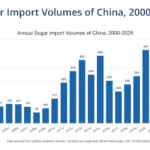
💡 Related Intelligence: Brazil’s dominant export position makes it the cornerstone of China’s sugar import structure — see our full import report for detailed demand-side analysis and multi-year data tracking.







Good news for businesses