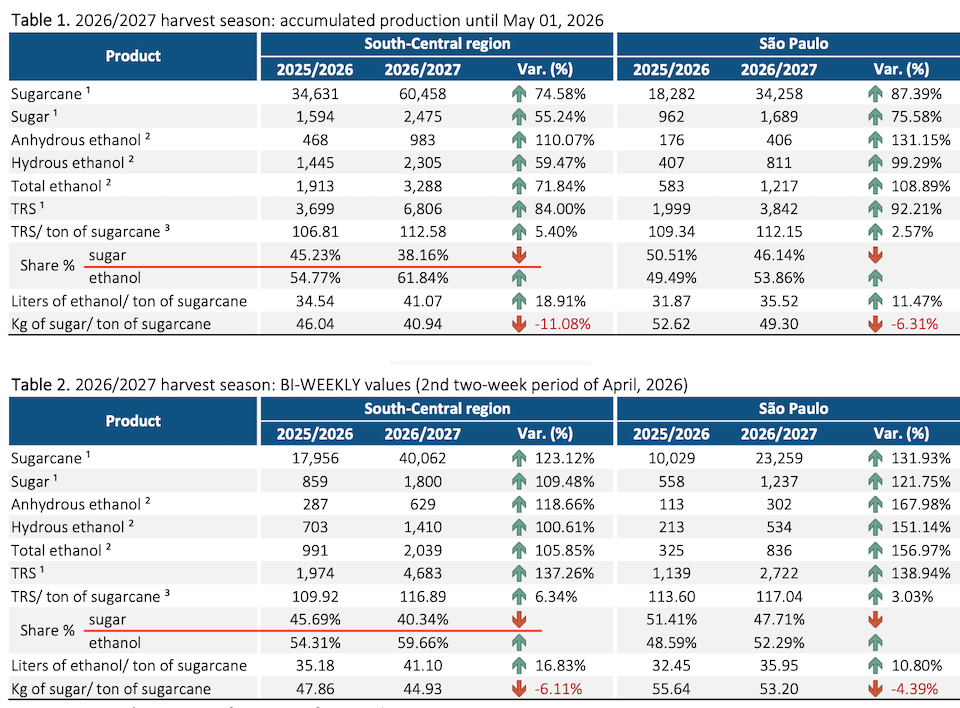
April 1, 2026 marked the official start of the new season, and the latest data highlights significant shifts in Brazil sugar production 2026/27.
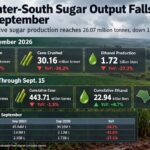
According to the latest data from the Brazilian Sugarcane Industry Association (UNICA), as of May 1, 2026, mills in Brazil’s Center-South region — the country’s main producing area — had crushed a cumulative 60.458 million tonnes of sugarcane since the start of the 2026/27 season. This represents a sharp 74.58% year-on-year increase compared with 34.631 million tonnes processed during the same period last season.
The cumulative production data show that this season has gotten off to a noticeably faster start than the previous one, with significant gains across cane crushing, sugar output, and ethanol output. However, it is worth noting that while sugar production rose in absolute terms, the share of cane allocated to sugar production fell markedly compared with the same period last year. Instead, mills are channeling a larger portion of their cane into ethanol.
1. Cumulative Production Overview: Crushing Pace Notably Accelerated
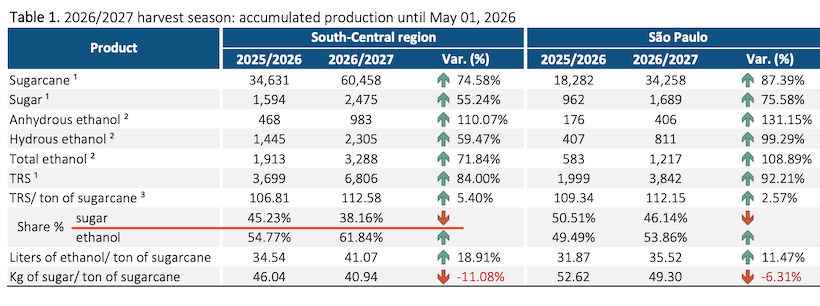
As of May 1, total cane crushed in the Center-South stood at 60.458 million tonnes, up 74.58% year-on-year. In São Paulo state alone, mills crushed 34.258 million tonnes, an 87.39% increase — outpacing the regional average.
On the sugar side, cumulative output reached 2.475 million tonnes, up 55.24% from 1.594 million tonnes a year earlier. São Paulo state produced 1.689 million tonnes of sugar, a 75.58% year-on-year gain.
The data clearly indicate that mills in Brazil’s main producing region began the 2026/27 season significantly earlier, with sugar output rising alongside crushing volumes. However, the growth in sugar production lagged behind the increase in cane crushing, suggesting that the sugar segment has not fully captured the upside from higher overall throughput.
This is reflected in the sugar yield per tonne of cane: in the Center-South, mills produced 40.94 kg of sugar per tonne of cane, down from 46.04 kg in the same period last season — an 11.08% decline. In São Paulo, sugar yield was 49.30 kg per tonne, down 6.31% year-on-year.
2. Sugar-Ethanol Mix: Sugar Allocation Declines
Looking at the product mix, Brazilian mills have shown a clear preference for ethanol in the early stages of the 2026/27 season.
As of May 1, 38.16% of cane in the Center-South was allocated to sugar production, down from 45.23% in the same period last year. The share directed to ethanol rose from 54.77% to 61.84%.
This indicates that despite a sharp rise in crushing volumes, mills have not expanded their sugar share — quite the opposite, they have redirected more cane to ethanol. Combined with the decline in sugar yield, the early phase of Brazil’s new season can be characterized as “faster crushing, higher sugar output, but a lower sugar mix.”
3. Cumulative Ethanol Output Surges
On the ethanol side, growth has clearly outpaced that of sugar.
As of May 1, total cumulative ethanol output in the Center-South reached 3.288 billion liters, up 71.84% year-on-year. The breakdown:
- Anhydrous ethanol: 983 million liters, up a striking 110.07%
- Hydrous ethanol: 2.305 billion liters, up 59.47%
São Paulo state’s ethanol performance was even more impressive, with cumulative ethanol output of 1.217 billion liters — up 108.89% year-on-year.
In terms of ethanol yield per tonne of cane, the Center-South averaged 41.07 liters per tonne, up 18.91% year-on-year; São Paulo averaged 35.52 liters per tonne, up 11.47%.
The strong rise in ethanol production reflects both the sharp jump in crushing volumes and a deliberate shift by mills toward a higher ethanol mix. The particularly steep gain in anhydrous ethanol suggests that fuel ethanol demand — or improved ethanol margins — is increasingly shaping mill production decisions.
4. Bi-Weekly Data: Crushing Doubles in Late April, Ethanol Bias Strengthens
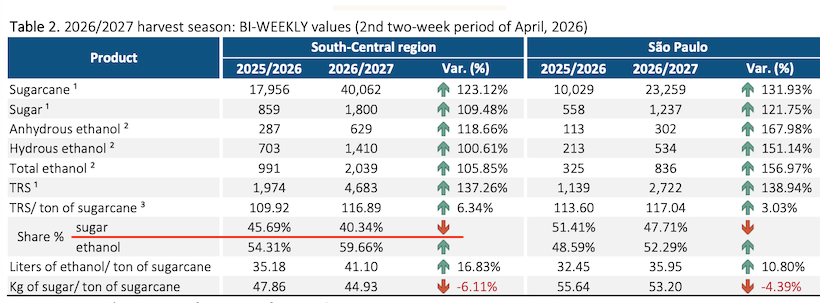
Turning to the second fortnight of April 2026, mills in the Center-South crushed 40.062 million tonnes of cane, a 123.12% increase from 17.956 million tonnes in the same period last year.
Sugar output during that fortnight reached 1.800 million tonnes (+109.48% YoY), while ethanol production totaled 2.039 billion liters (+105.85% YoY).
In terms of allocation, the Center-South’s sugar mix in the second half of April stood at 40.34%, down from 45.69% a year earlier. The ethanol share rose from 54.31% to 59.66%.
São Paulo crushed 23.259 million tonnes during the same fortnight (+131.93% YoY), producing 1.237 million tonnes of sugar (+121.75% YoY) and 836 million liters of ethanol (+156.97% YoY). The state’s bi-weekly sugar mix was 47.71%, down from 51.41% last year, while ethanol rose from 48.59% to 52.29%.
In short, even amid a clearly accelerated start to the season, mills’ focus in late April leaned firmly toward ethanol. While sugar production rose substantially, the increase was driven primarily by stronger crushing throughput rather than a higher sugar allocation ratio.
5. TRS Improves, but Sugar Extraction Efficiency Declines
Notably, cane quality — measured by Total Recoverable Sugar (TRS) — improved in this reporting period.
As of May 1, the cumulative TRS per tonne of cane in the Center-South was 112.58 kg/tonne, up from 106.81 kg/tonne last season — a 5.40% increase. São Paulo’s figure stood at 112.15 kg/tonne, up 2.57% year-on-year.
For the second fortnight of April, TRS in the Center-South reached 116.89 kg/tonne (+6.34% YoY), and São Paulo’s reached 117.04 kg/tonne (+3.03% YoY).
This indicates that the sugar content of cane is higher than at the same point last year. However, despite improved cane quality, sugar yield per tonne of cane has fallen: cumulative sugar yield in the Center-South was 40.94 kg/tonne (-11.08% YoY), while the late-April fortnight showed 44.93 kg/tonne (-6.11% YoY).
The takeaway is clear: even though cane quality has improved, the higher allocation to ethanol production has dragged down the effective sugar yield per tonne of cane.
6. Summary
Overall, Brazil’s Center-South region has opened the 2026/27 season at a significantly faster pace than the previous one. As of May 1, 2026, cumulative cane crushing was up 74.58%, sugar production up 55.24%, and total ethanol production up 71.84% year-on-year.
However, the defining theme of this season’s opening is not “sugar-heavy” but “fast crushing, ethanol-first.”
Despite better cane quality and higher TRS levels, mills have lowered their sugar mix — the Center-South’s sugar allocation has dropped from 45.23% to 38.16%.
The bi-weekly data for the second half of April confirm that Brazil’s main producing region is still in a rapid ramp-up phase, with crushing more than doubling year-on-year and both sugar and ethanol output expanding sharply. Yet the production mix continues to tilt toward ethanol, suggesting mills are responding more aggressively to fuel ethanol market demand in the early stages of the season.
The ynsugar research team‘s view: The latest UNICA data send a clear signal — Brazil’s 2026/27 supply has come online quickly, but mills are noticeably less inclined to produce sugar than they were a year ago. Going forward, any shift in the sugar-ethanol spread that prompts mills to swing their mix back toward sugar will be a key variable shaping the pace of sugar supply for the new season.
Disclaimer: The production data and statistical percentages cited in this report are sourced entirely from the official publication of the Brazilian Sugarcane Industry Association (UNICA). While ynsugar strives to ensure accuracy in translation and market interpretation, all official trading decisions should be cross-referenced with the primary data released by UNICA.